
 ← PreviousGongju, Sejong and Mokcheon
We leave rural South Korea behind for good and enter the urban sprawl that revolves around Seoul. The end of our journey in this country is drawing near, and it's as if we're plugging back into ultra-modern civilisation as we get closer to Incheon airport. Between bus and bike, here's a summary of these last three days.
Wednesday 3 September
We're living our last week in the Land of the Morning Calm. Our feelings are mixed: excitement about discovering new countries and a desire for change on one hand, and nostalgia at leaving such an endearing country on the other. In seven days to the day, we'll leave South Korea for Europe. In the meantime, we have to make our way to Incheon, home of Seoul's international airport. Only 130 kilometres separate us from our final destination, but after much research and thought, it's clear the route won't be very interesting.
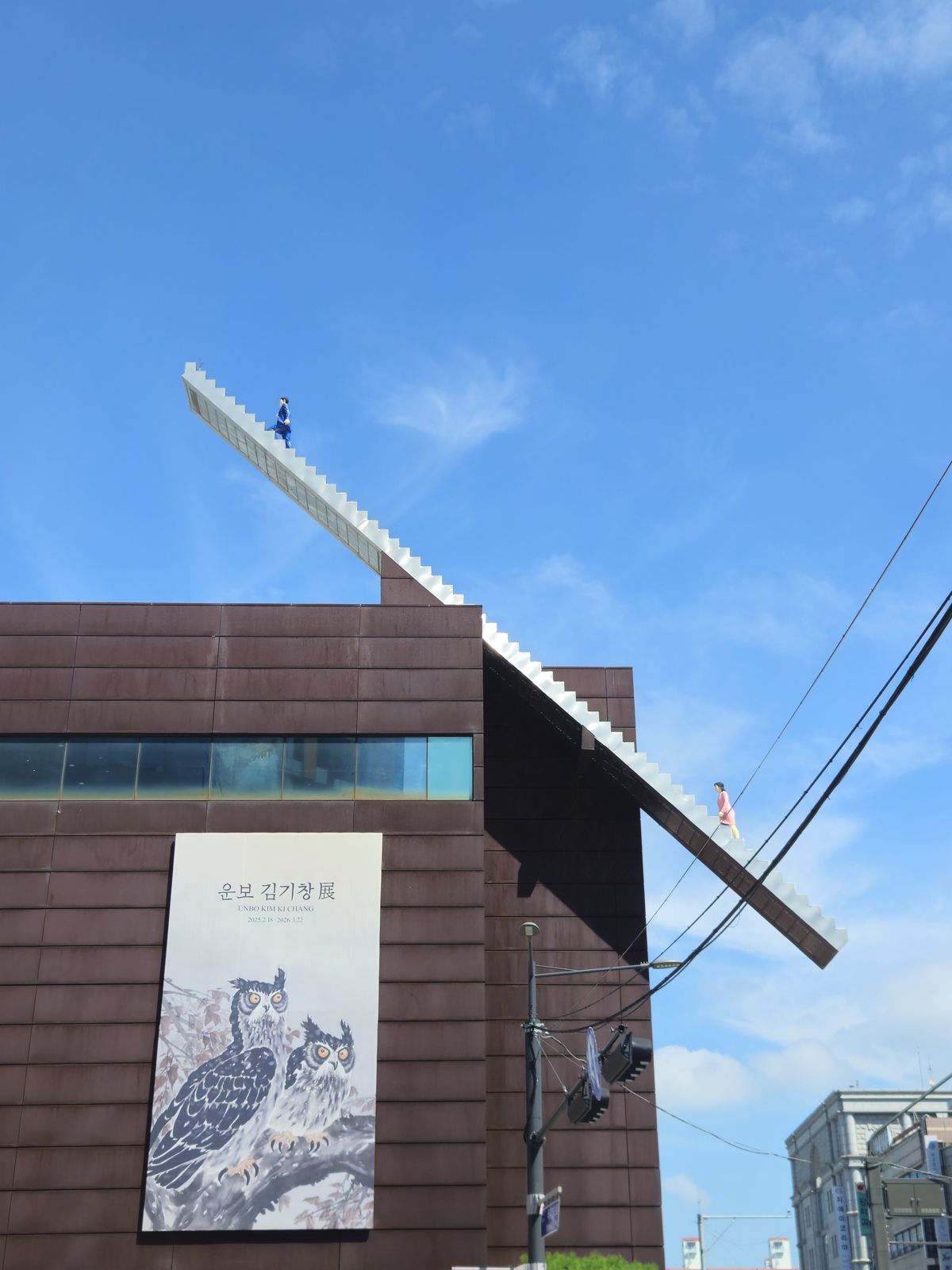
We're now less than 100 km from Seoul, and the road to Incheon would just be one city after another, each bigger than the last. The idea of riding almost entirely in town on big roads surrounded by cars doesn't thrill us, so we decide to ride only 10 kilometres this morning to the nearest bus terminal. There are quite a few cars on our route but, as always, we're not worried at all, because drivers all move over into the left lane to overtake us and we never feel in danger.
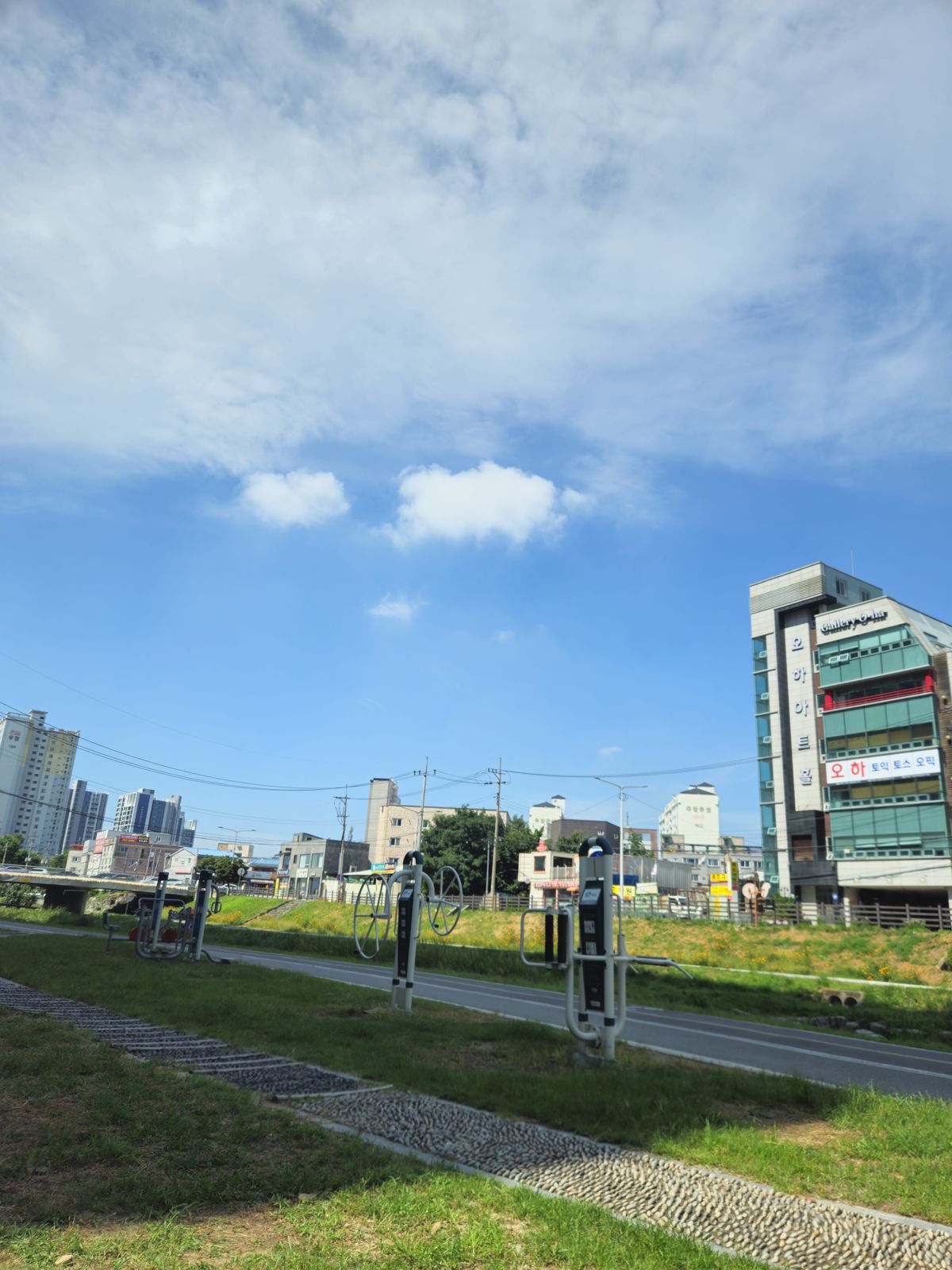
We're aiming for the city of Suwon, 70 kilometres to the north. A historically important city in South Korea, with several must-see UNESCO World Heritage sites. Every bus terminal has plenty of very intuitive machines for buying long-distance tickets, so ours are bought in under two minutes. The next bus leaves in an hour and a half, which gives us time to eat and enjoy a small outdoor gym beside a charming little stream. It's a habit in every Korean city: the smallest watercourse has footpaths and cycle paths laid out along it. Many countries have a lot to learn from Korean urban planning.
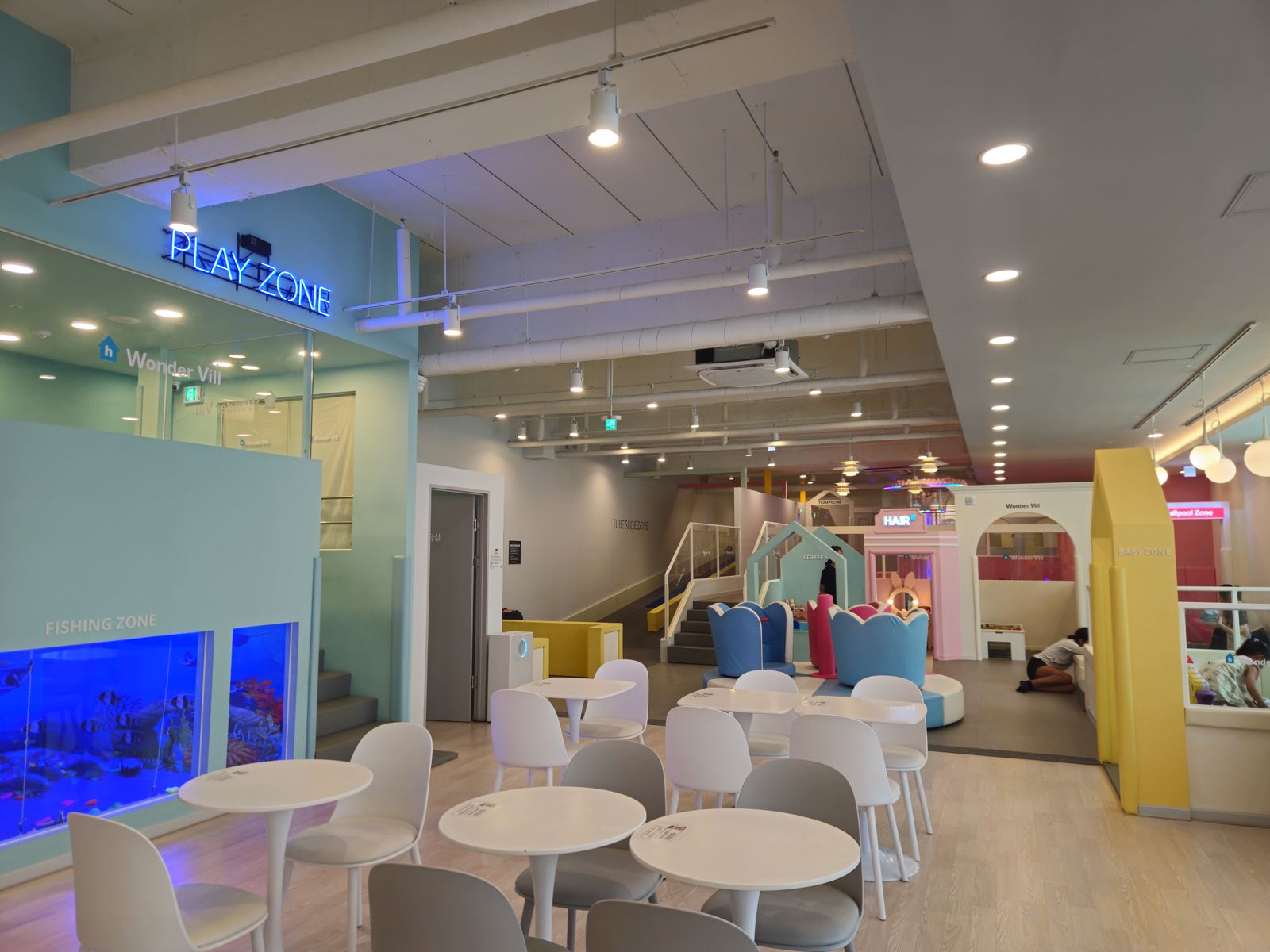
The journey to Suwon only takes an hour. Clémence passes the time colouring and trying to write a few letters. It's nearly 2 pm when we arrive. We can't check into the hotel until 4, so we decide to head to a kids' café in the meantime. It costs us €10 for two hours. There are lots of areas: play kitchen, trampolines, a big slide with rubber rings, a ball pit, building blocks… Needless to say, Clémence doesn't notice the time passing. She makes a little friend who has just turned three today. They have fun jumping like crazy and doing somersaults on the trampolines; it's very sweet.
We finally head to the hotel for quiet time and a shower. Cassandre then goes for a run while Stéphane takes Clémence to one of the many playgrounds in the neighbourhood. She often tries to play with the little Korean children, but there seems to be a barrier for them, as they're always shy. That wasn't the case at all in Japan, where children had no problem playing with her. We make up for it by playing together a lot, but we can tell she can't wait to get back to countries where people will understand her better.
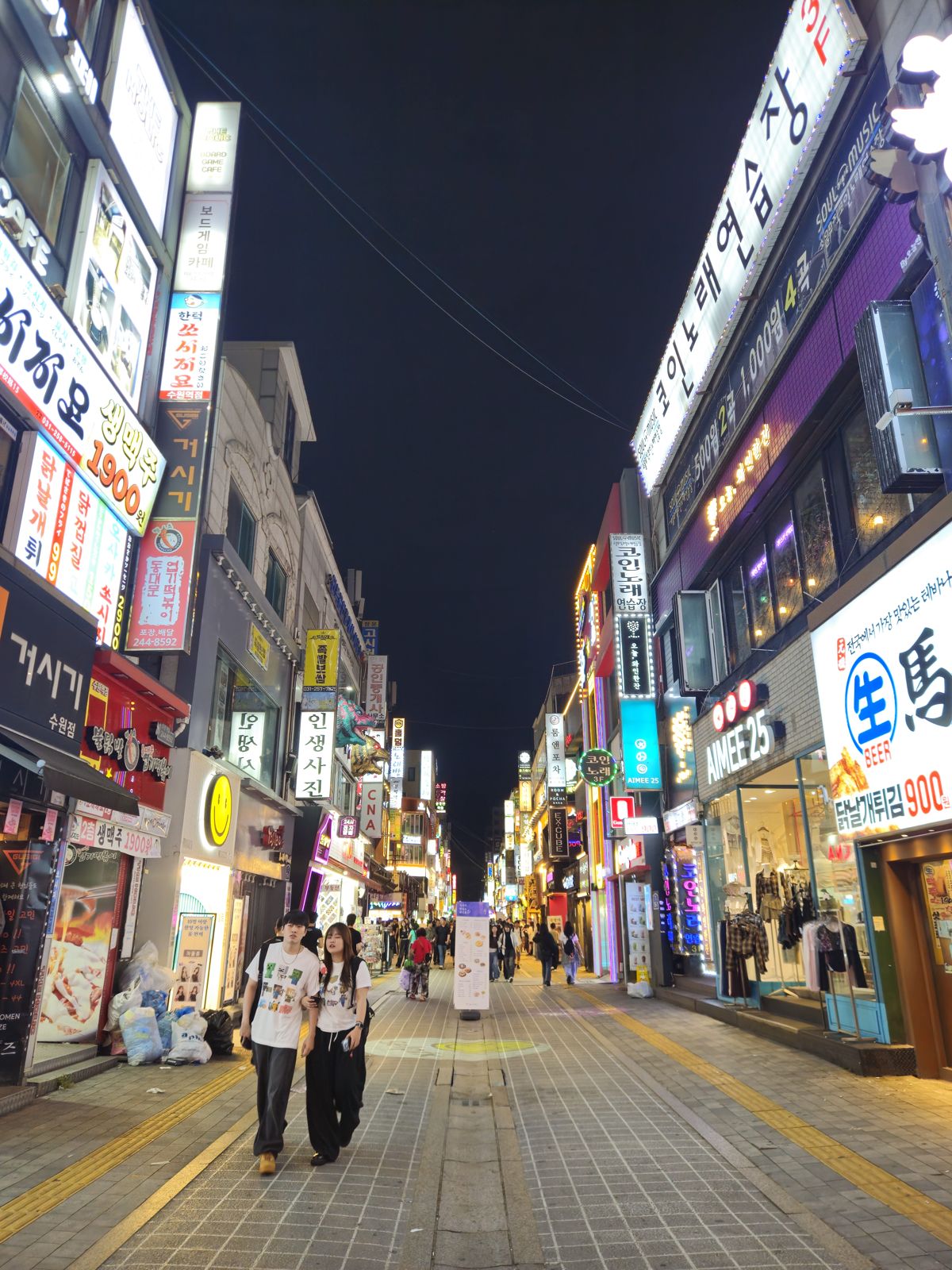
To please her, we go out for pizza at one of the local restaurants. Miraculously it isn't spicy, and if there's one aspect of life in Korea we won't miss, it's that one. They even spice dishes that have no business being spicy, and it's tricky to manage with a child who isn't used to it. Luckily, tonight we strike gold, and Clémence goes to bed with a full tummy.
Thursday 4 September
After living in a country for a few months, there are habits you have to lose. And we've picked up a bad one that we'll need to correct fast when we're back in Europe: not locking our bikes. South Korea is one of the safest countries in the world, and it's no legend: you see people leave their phones and wallets on restaurant tables when they go to the toilet. So we got into the habit and almost never lock our bikes. For a while now we've been forcing ourselves to think about it so we don't make that terrible mistake in Europe.
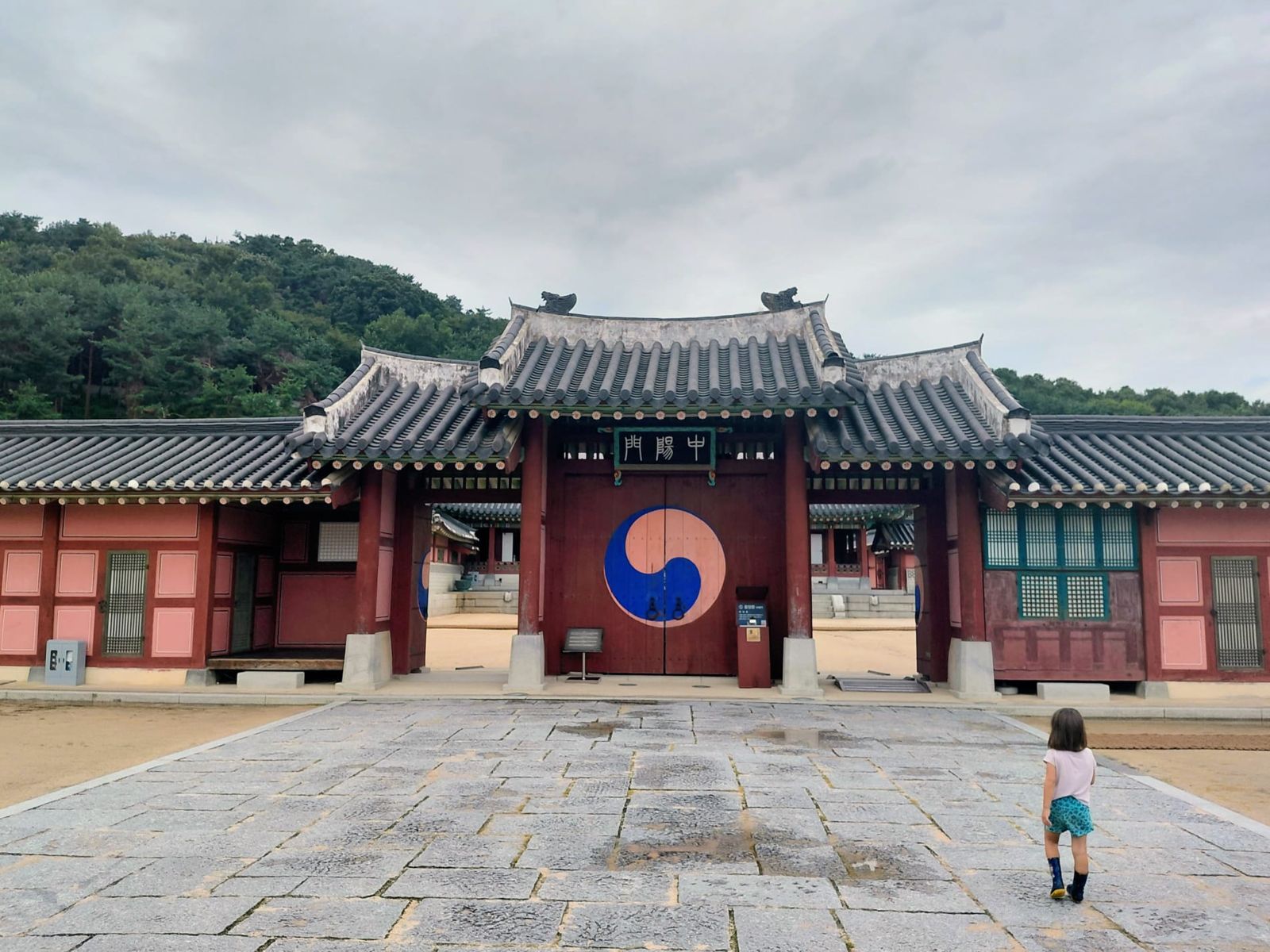
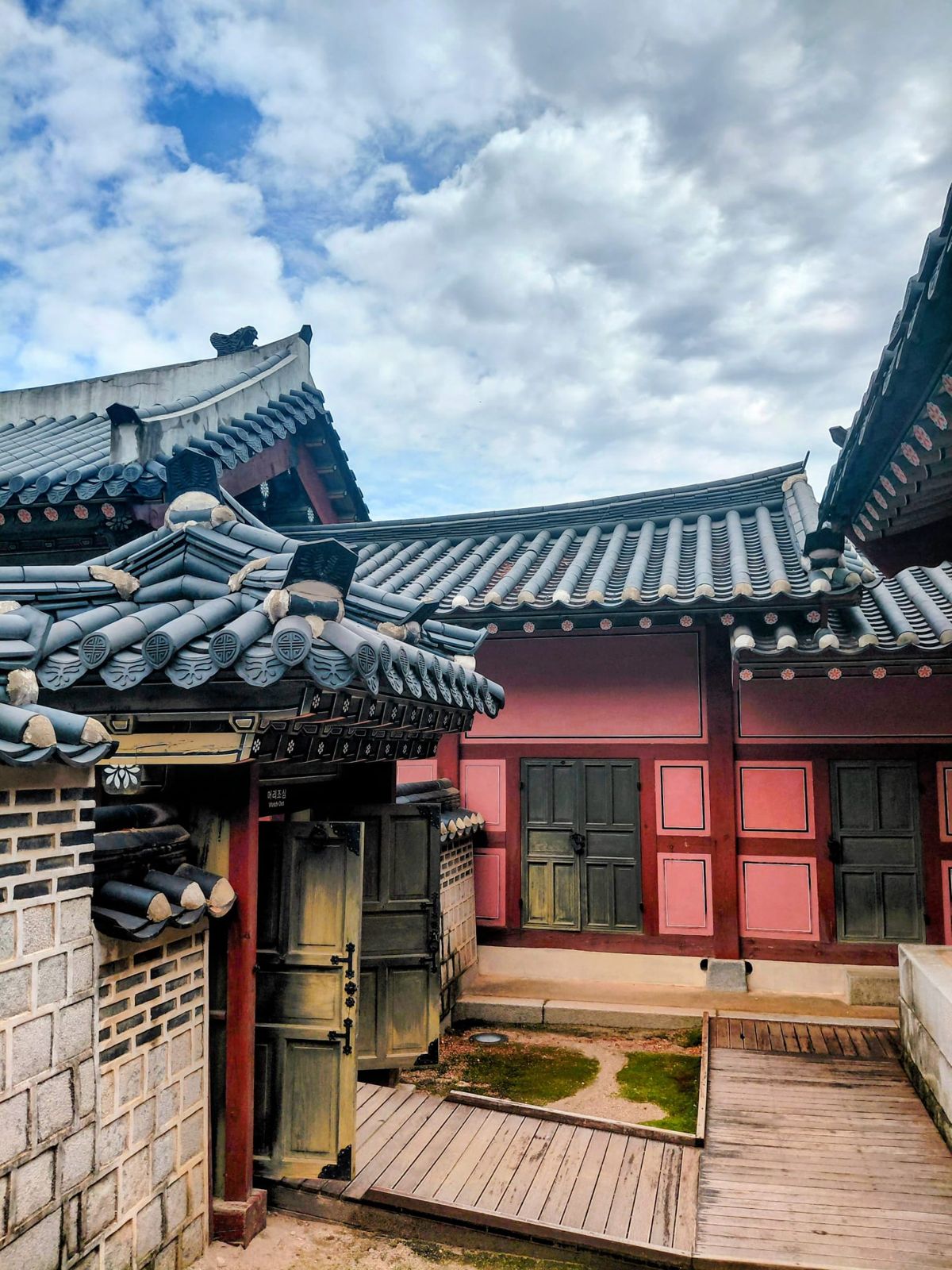
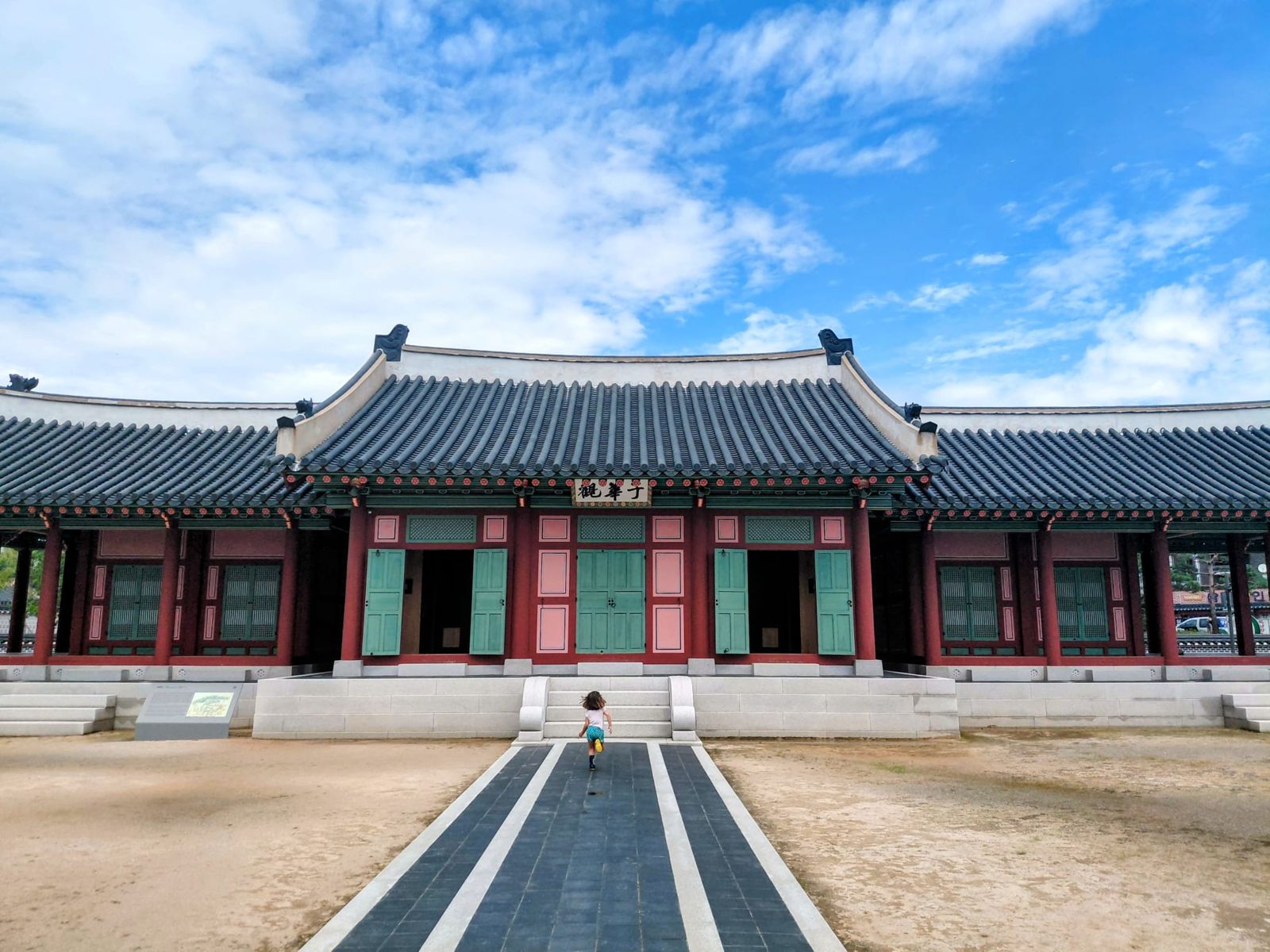
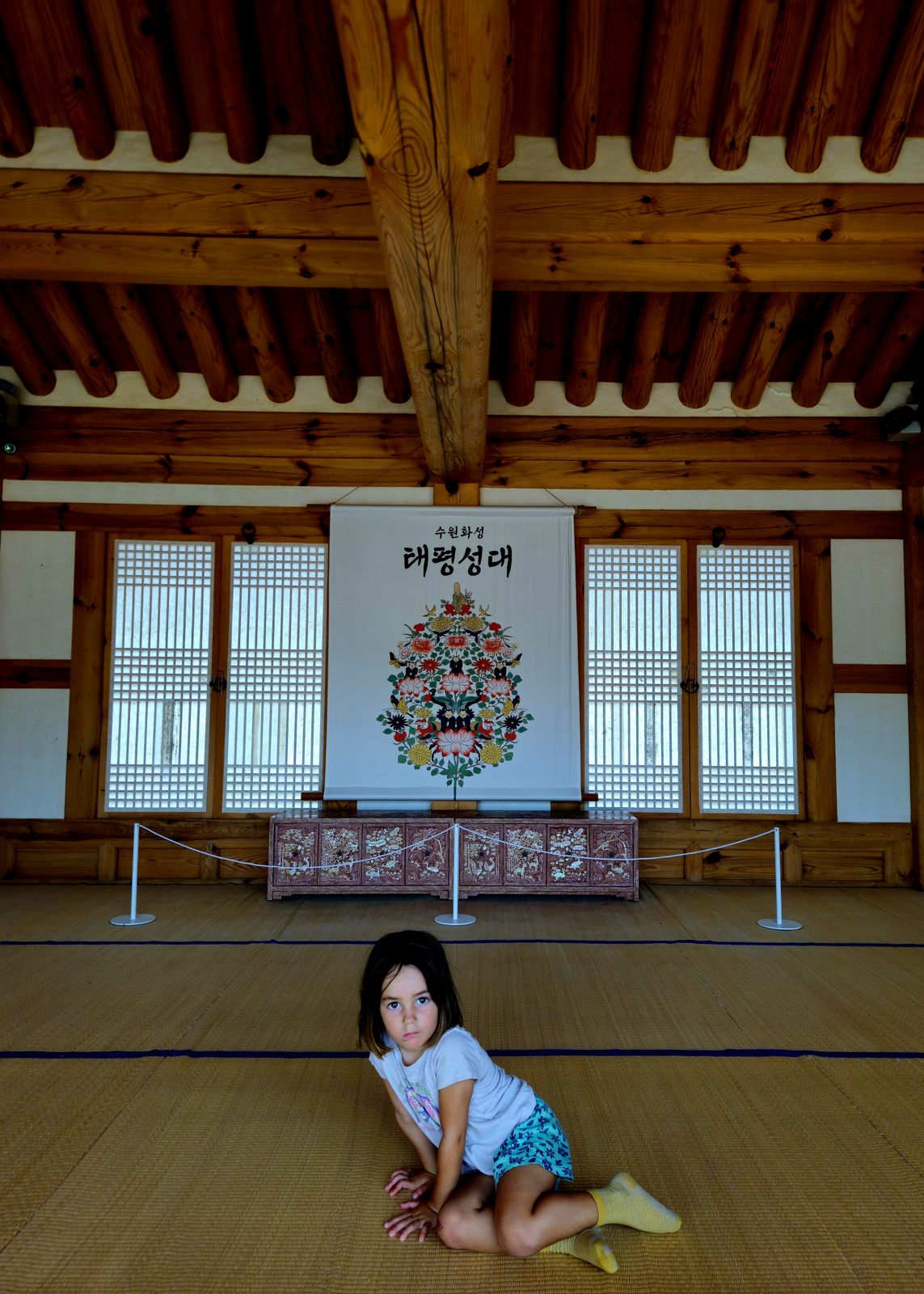
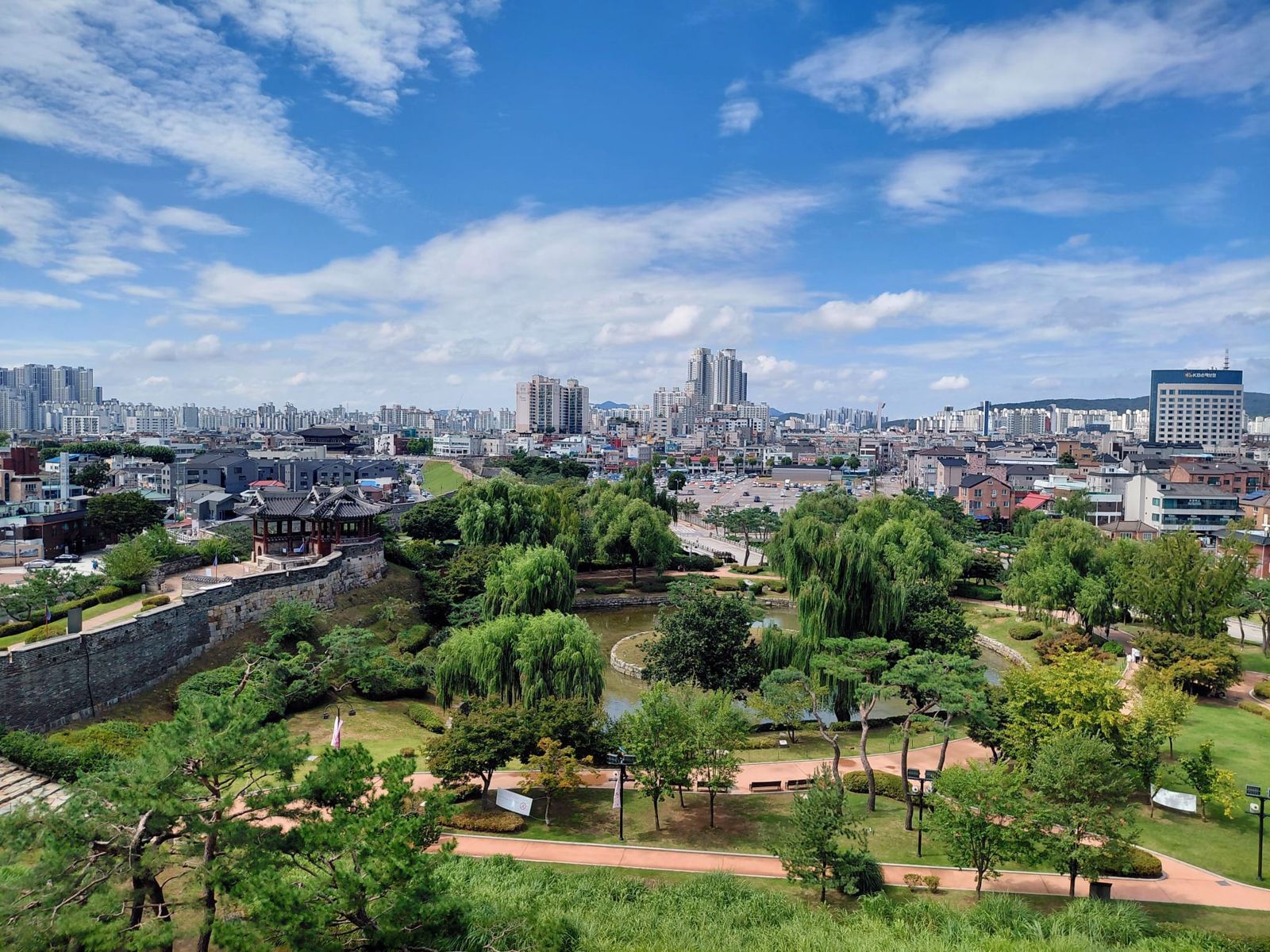
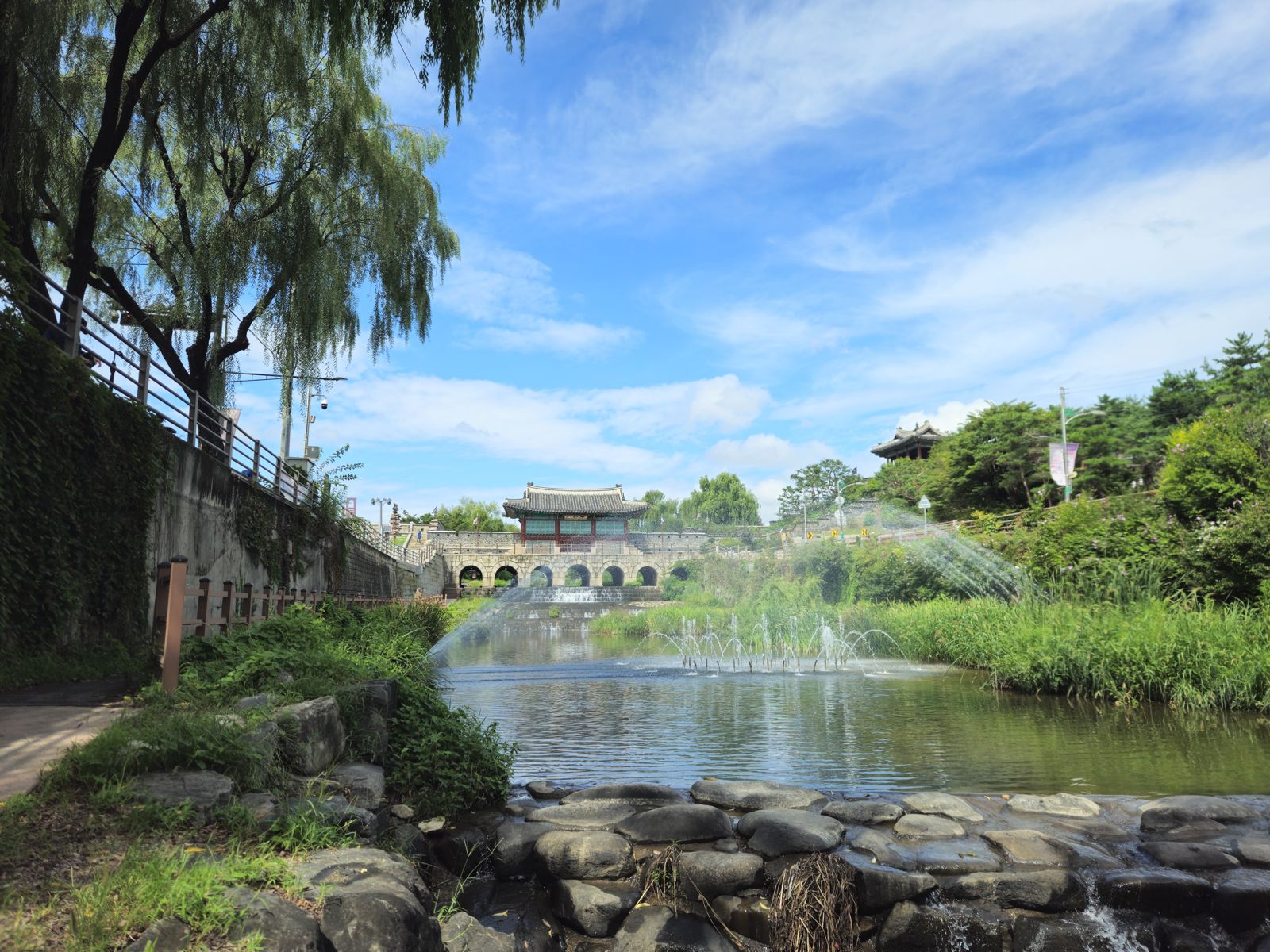
So our bikes are firmly locked when we come down from our hotel room and head for Hwaseong Fortress and its temporary palace. Temporary, because this is where King Jeongjo (and many after him) came to rest or take refuge in times of war. Unsurprisingly, the site is a reconstruction. Originally built in 1789 on King Jeongjo's orders, it was the biggest palace in the country outside the capital during the Joseon dynasty. But it was largely destroyed during the Japanese occupation, when the Japanese built a school and a hospital there. In 1989, more than 40 years after the occupation, restoration of the palace began. The work was completed in 2023 after some thirty years. Information boards identify each room of the palace and its uses, and some scenes of daily life are even recreated with mannequins in traditional dress.
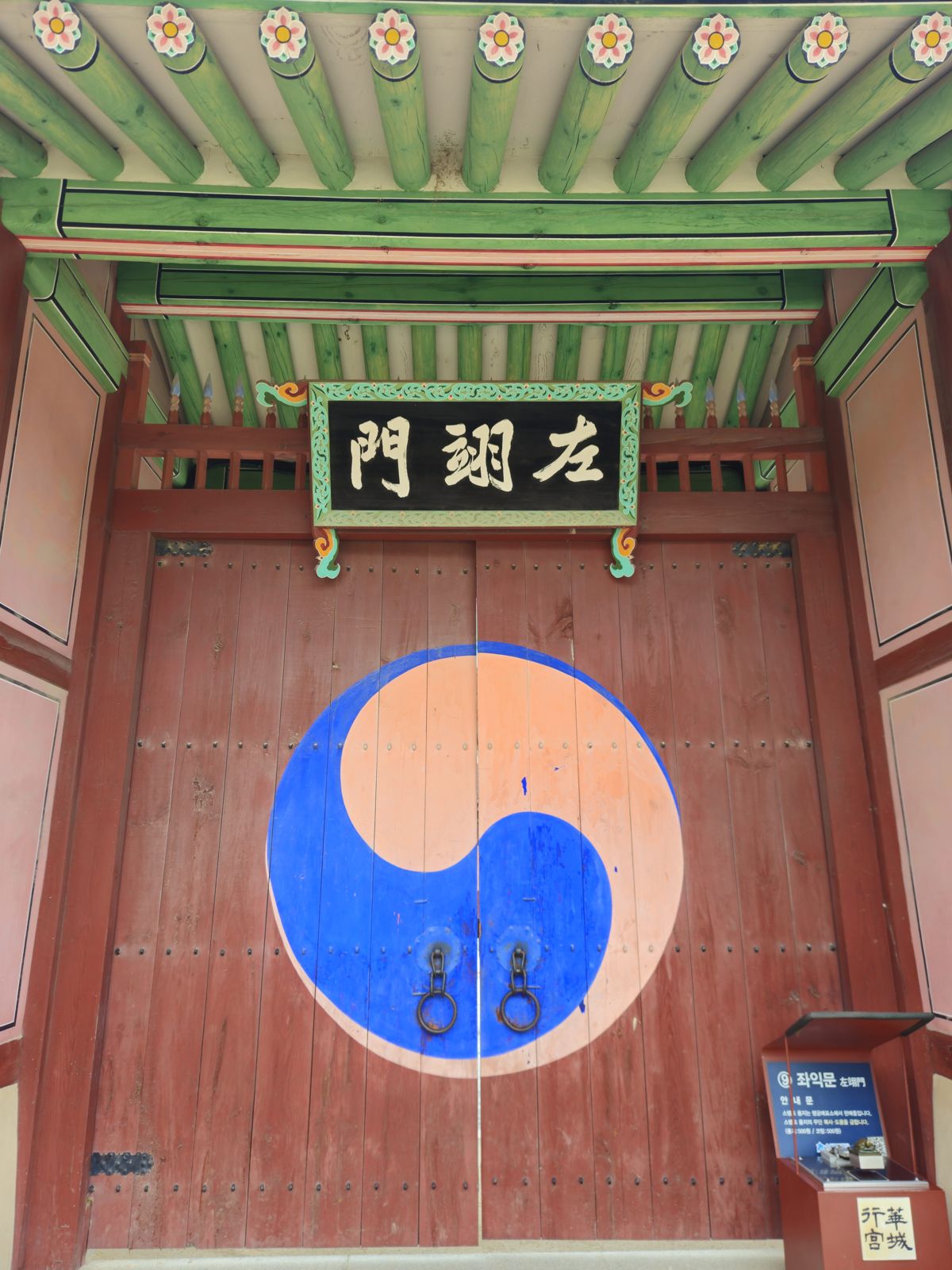
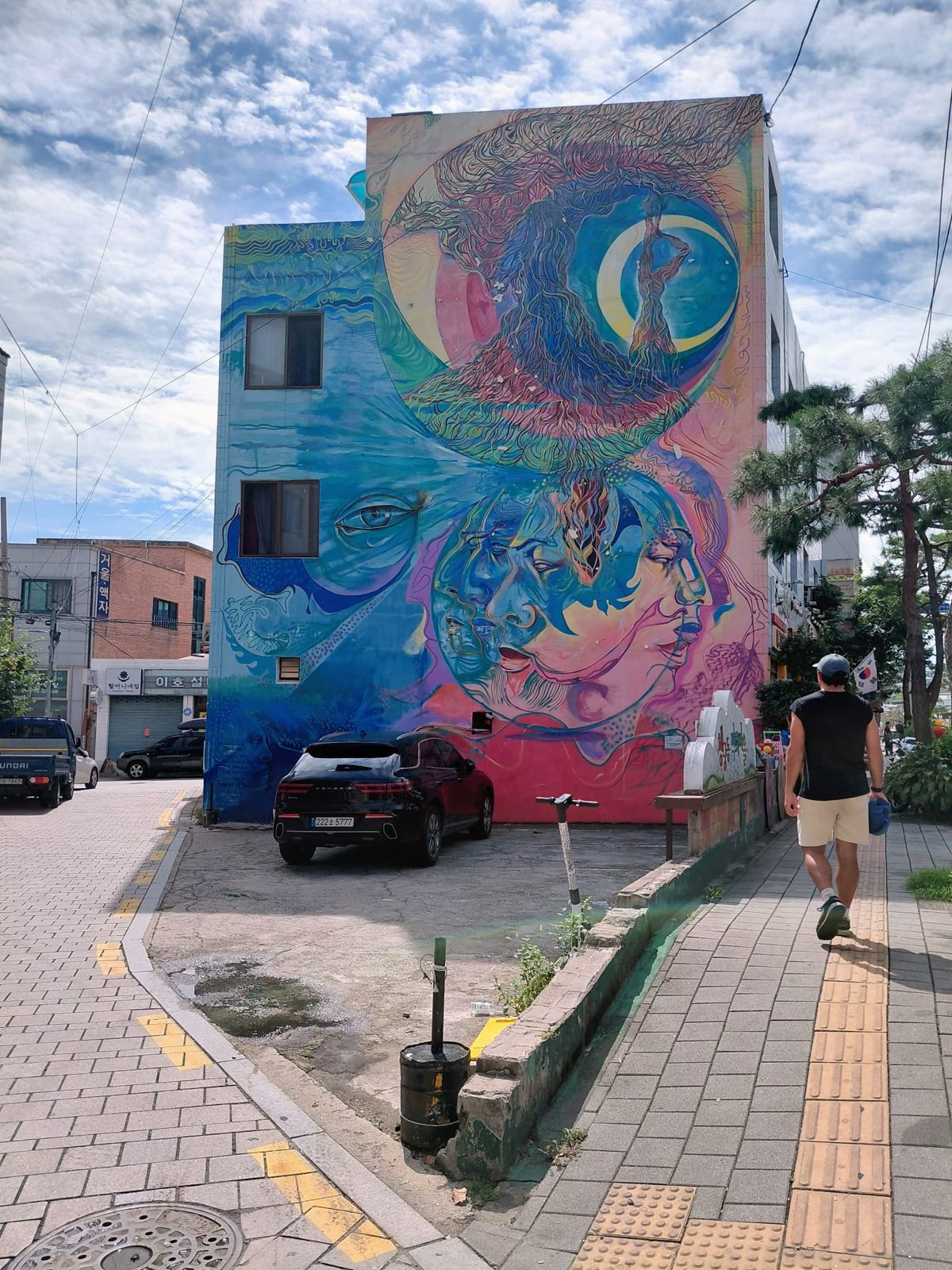
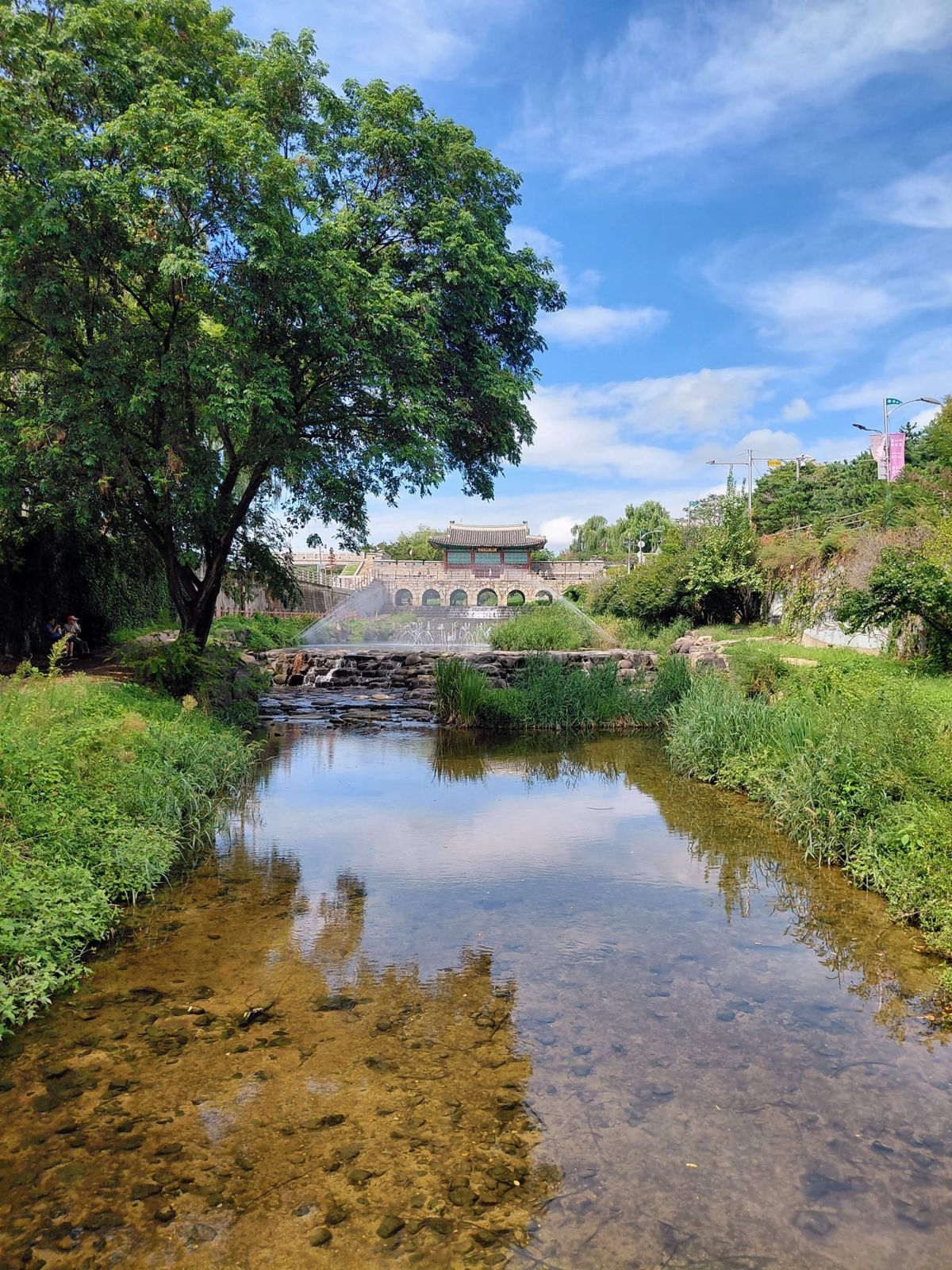
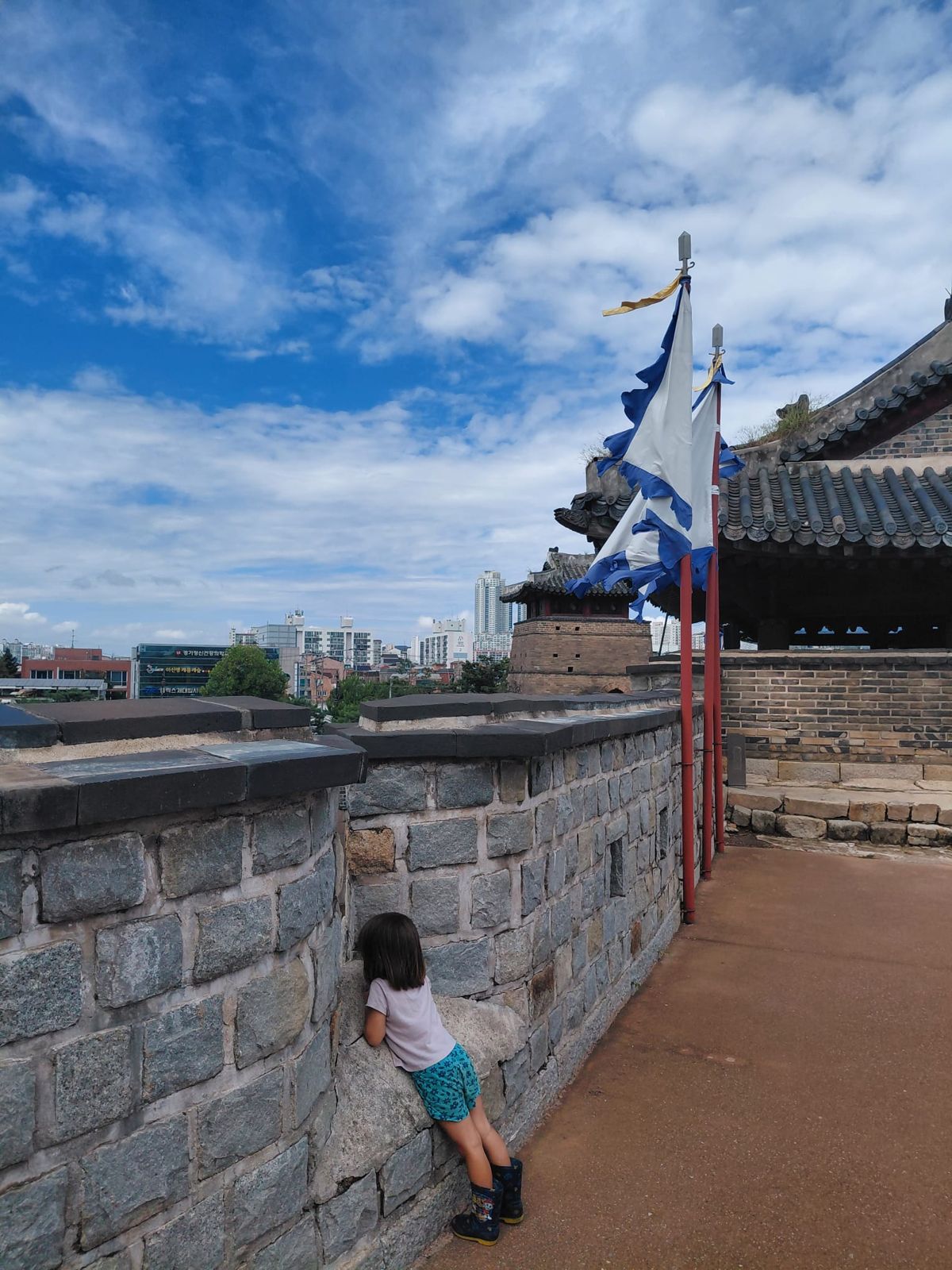
We then eat pork fried rice in a lovely little restaurant along a street full of cafés, restaurants and small designer shops. We carry on on foot towards the fortress walls that surround the city centre, to admire Suwon from higher up. For almost 6 kilometres, the walls follow the contours of the hilly landscape. The walk is open to all, though some sections take a bit of effort. Along the way you come across pentagonal bastions and artillery towers built to hold cannons, reflecting the region's military history.
This is already the outskirts of Seoul, even though we're 30 kilometres away, and the city is very dense. It has a KTX station, several metro stations and more than a million inhabitants. Yet it's very airy, with several big parks, including Gwanggyo Lake Park, which we cross. The main lake is split into two "reservoirs", Wonchon Lake and Sindae Lake, and the park has a 5 km circular walking path. Well equipped, the park is ideal for picnics, strolls, running or cycling in the middle of the forest. This urban oasis has won an award from the International Federation of Landscape Architects. We wanted to visit the agriculture museum, which has a hall for children, but it's closed when we arrive, much to Clémence's disappointment. So we fall back on a playground by the lake.
Still on our bikes, we head back to the hotel for a snack, and then Stéphane goes for a run while Cassandre and Clémence discover a new playground. Yes, we could write a travel guide just to the country's playgrounds, we've seen so many. We end the evening in a Japanese restaurant where the waiter assures us our adult dishes are only a tiny bit spicy and Clémence's not at all. His palate must be numb, because all three meals burn our mouths, and we even have to buy Clémence food at a convenience store because she couldn't eat a thing. Once the spiciness has left her mouth, we take her up to bed.
Friday 5 September
We've made a mistake in our route. We're too close to Seoul to take long-distance buses to the airport. On intercity buses, we can put our bikes and trailer in the hold without any problem; nobody ever objects. But since we're in the capital's metropolitan area, there's now the metro and trains, and buses no longer have a monopoly on transport. We don't really have any option but to cover the distance by bike.
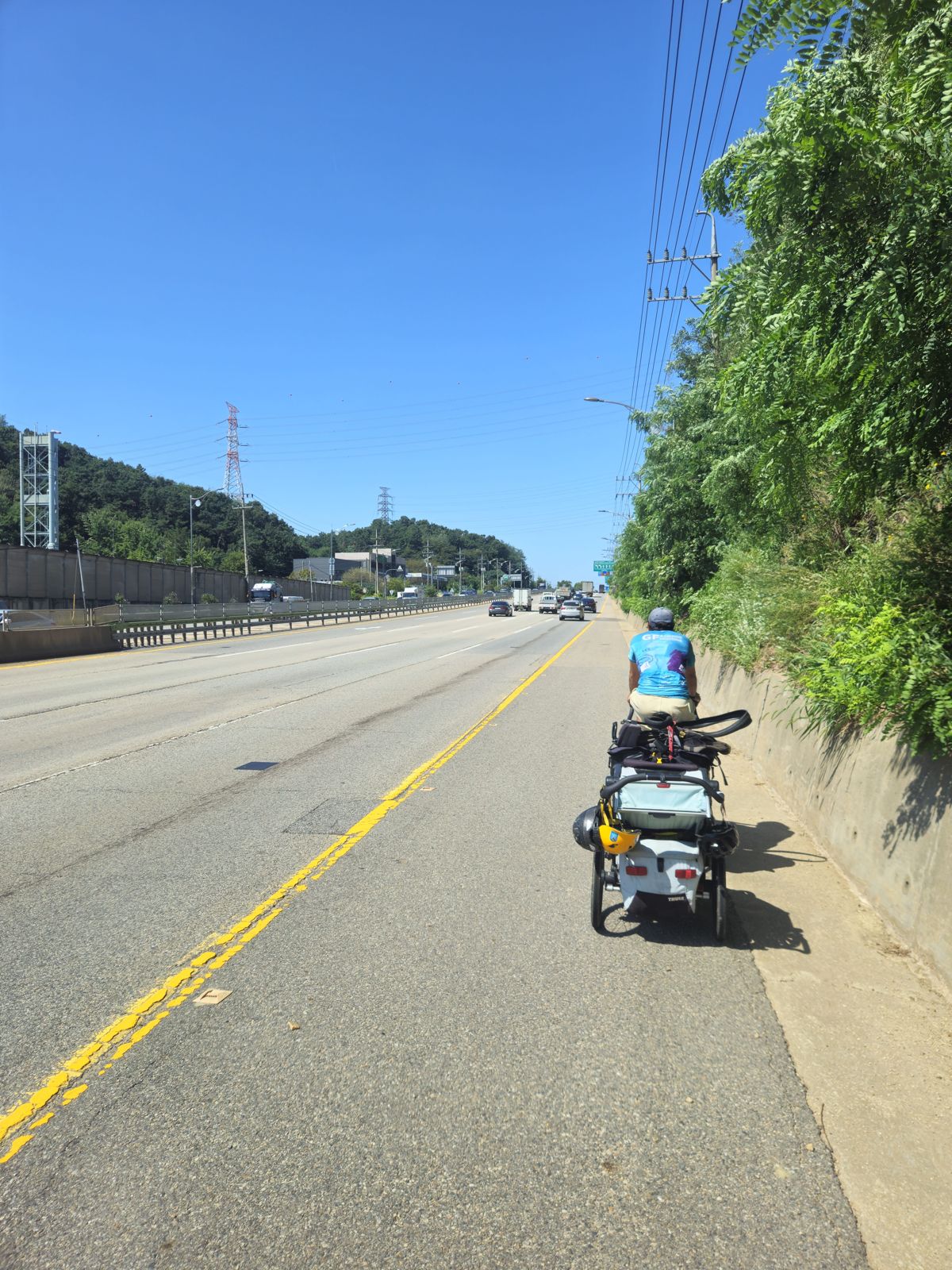
We weren't thrilled by the idea, and we were right. The route suggested by the cycling navigation apps is awful. Getting out of Suwon goes smoothly; we ride mostly on the road. Further out, we find ourselves on tiny hilly roads that sometimes turn into dirt tracks, which is the lesser evil, since we end up having to use the hard shoulder of a huge 70 km/h road and some very dangerous stretches where we should never have been on bikes. Good thing we're experienced. Twenty kilometres on, we take a break at Ansan bus terminal to try to find a bus. Bad luck: some run from Incheon to here, but not the other way.
We take advantage of the air-conditioned terminal for a cool-down break when a man comes up to us with a little heart-shaped balloon for Clémence. He's very friendly and comes back a few minutes later to ask whether he can take our photo. We happily agree, and he returns once more with the printed photo, which he gives us as a gift. After a horrible first half of the day on the road, this little gesture warms our hearts.
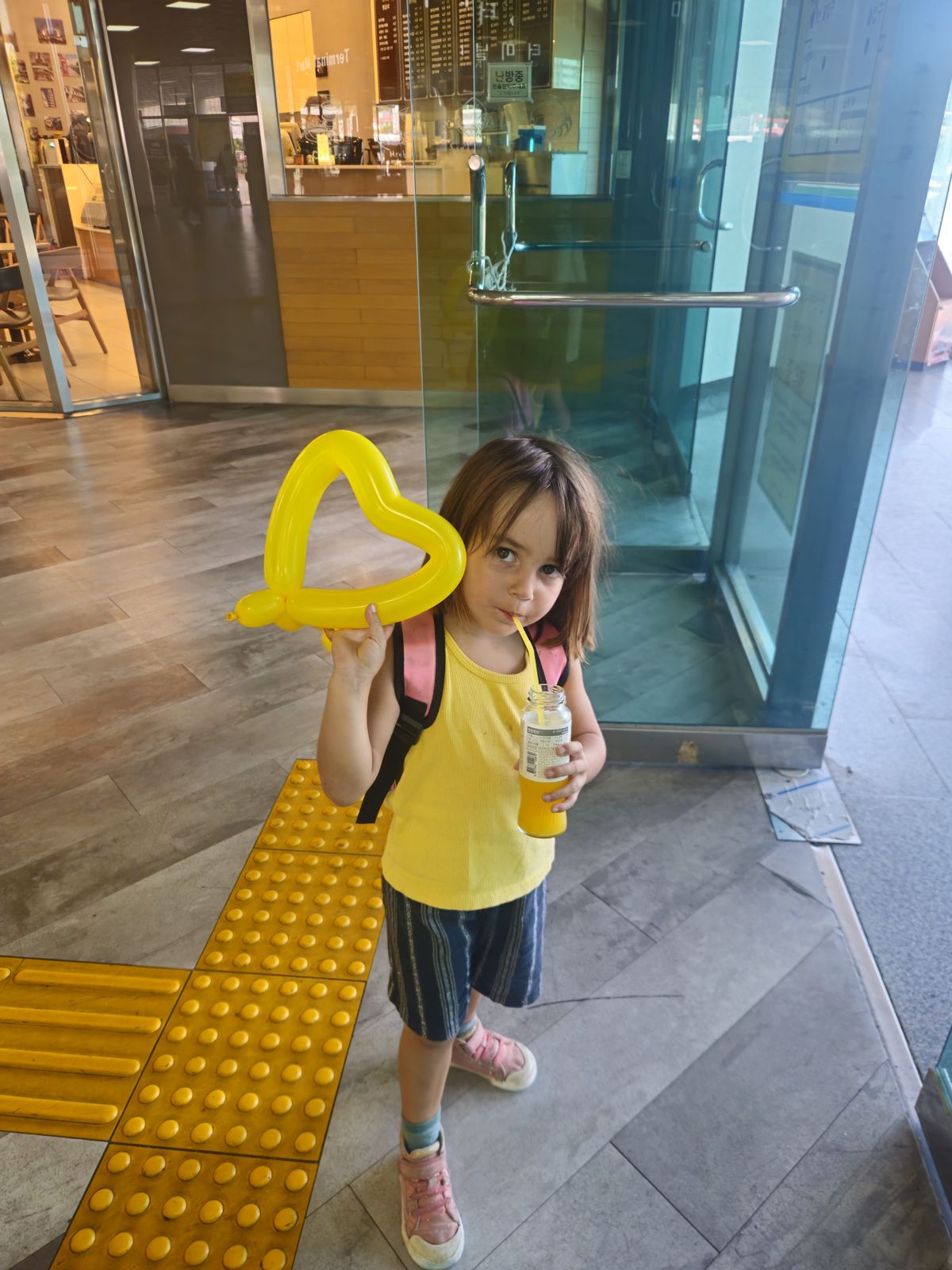
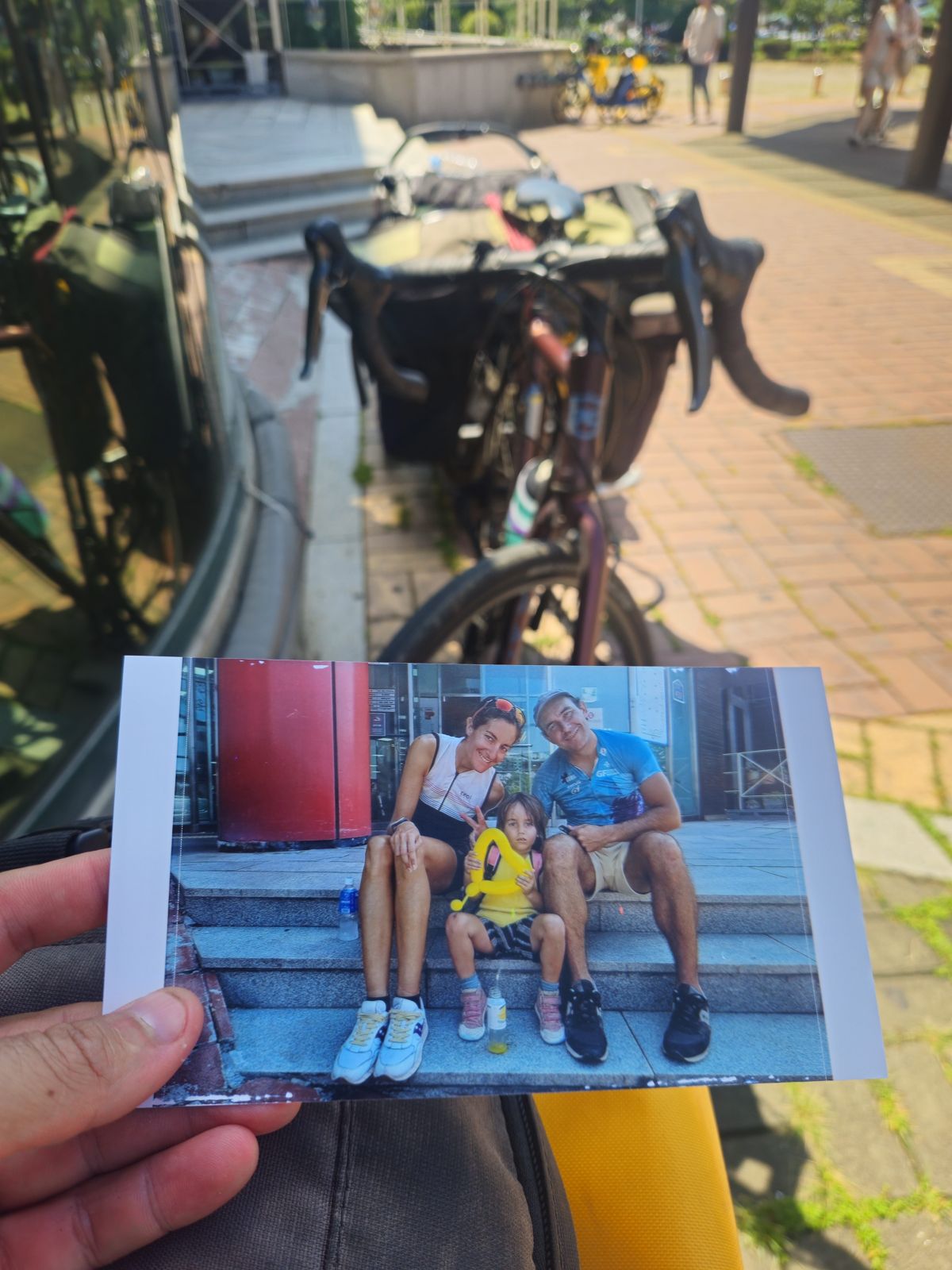
For the rest of the day, we decide to follow the metro line, which leaves us the option of leaving the bikes at a station if we've had enough. In Ansan the pavements/cycle paths are very wide, so we make slow but steady progress. Slow, because we spend an unbelievable amount of time stopped at pedestrian lights. In Korea, cycle paths are always on the pavement, so we have to obey pedestrian lights. Since they last twice as long as the lights for cars, we lose a monstrous amount of time at every crossing. Whenever the coast is clear, we cross without waiting for green, because you can sometimes wait several minutes at a single light! If there's a crossing every 200 metres, we'll let you work out the time lost…
Cycling in big cities, the sense of injustice is strong, because cars get a staggering amount of space while we have to share bumpy pavements with pedestrians. We go on the road whenever we can, but sometimes the roads are too big with too many cars and there's no point chancing it. We stop for lunch at the foot of a metro station, in a cheap little restaurant where we eat cheese pork cutlets and mandu.
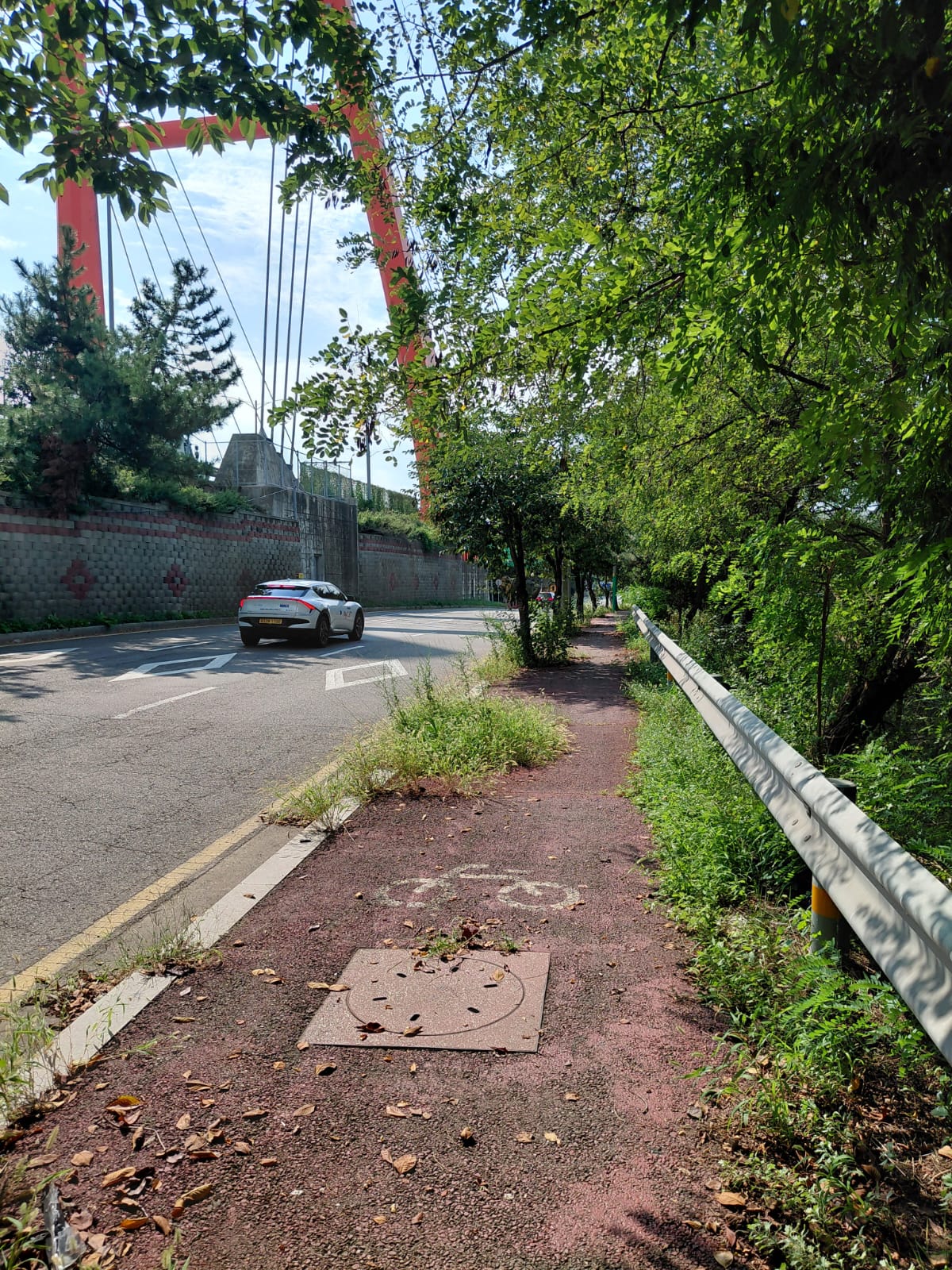
We psych ourselves up for the last fifteen kilometres of the day, but they turn out to be the hardest. Apart from a few fast stretches on cycle paths worthy of the name, we sometimes find ourselves on pavements in such bad condition they look more like motocross tracks. Not content with taking up all the space, drivers also park on the pavement, which makes our progress exasperatingly slow in places. We have to juggle broken paving stones, giant tree roots and pedestrians. The approach to Songdo, where our hotel is, is along big avenues with wide, well-kept pavements, but once again the wait at red lights is endless and we feel we'll never reach the hotel. We arrive exhausted, mentally and physically. It took us four hours of pedalling to cover 45 km, almost twice our usual time.
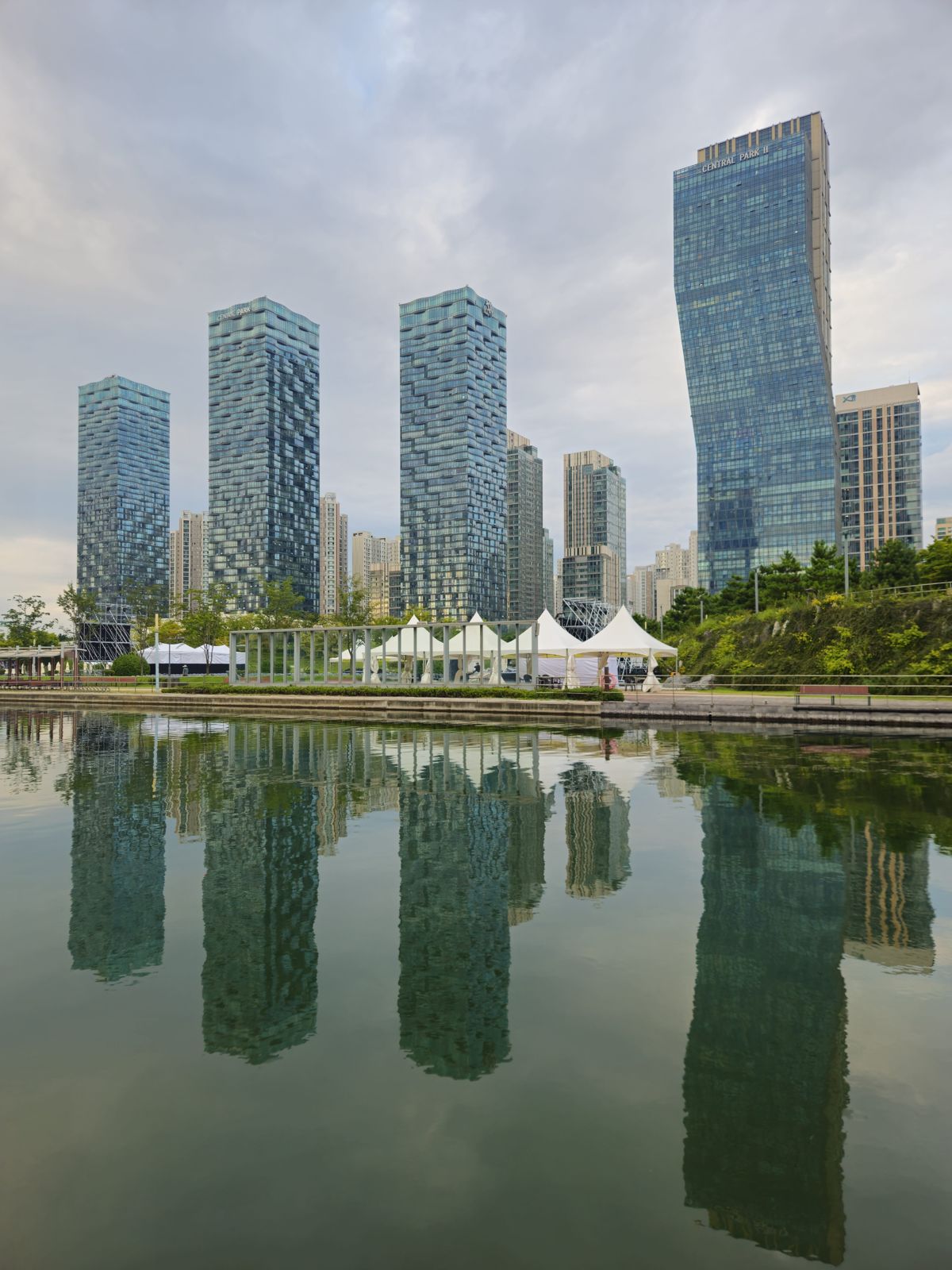
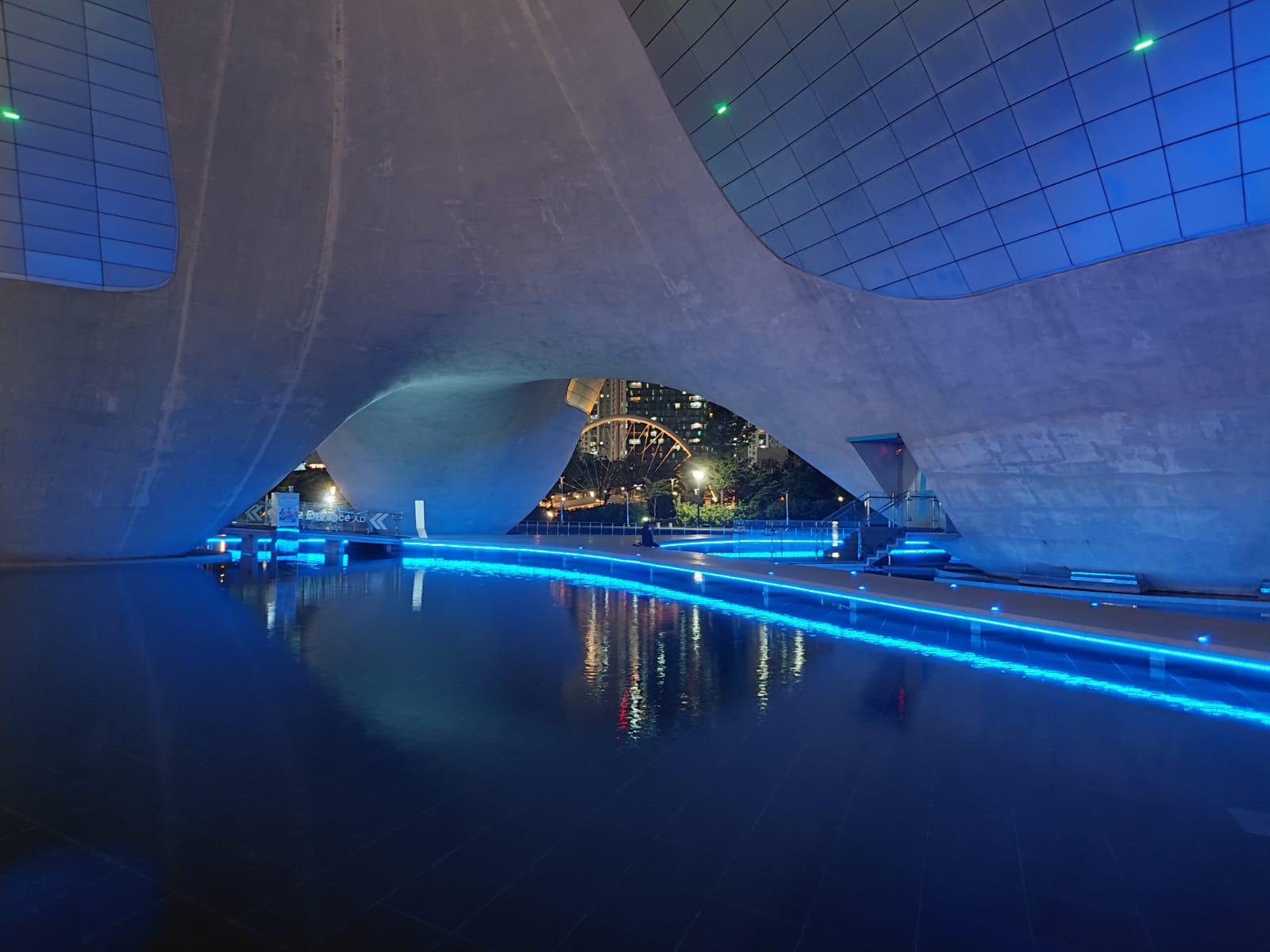
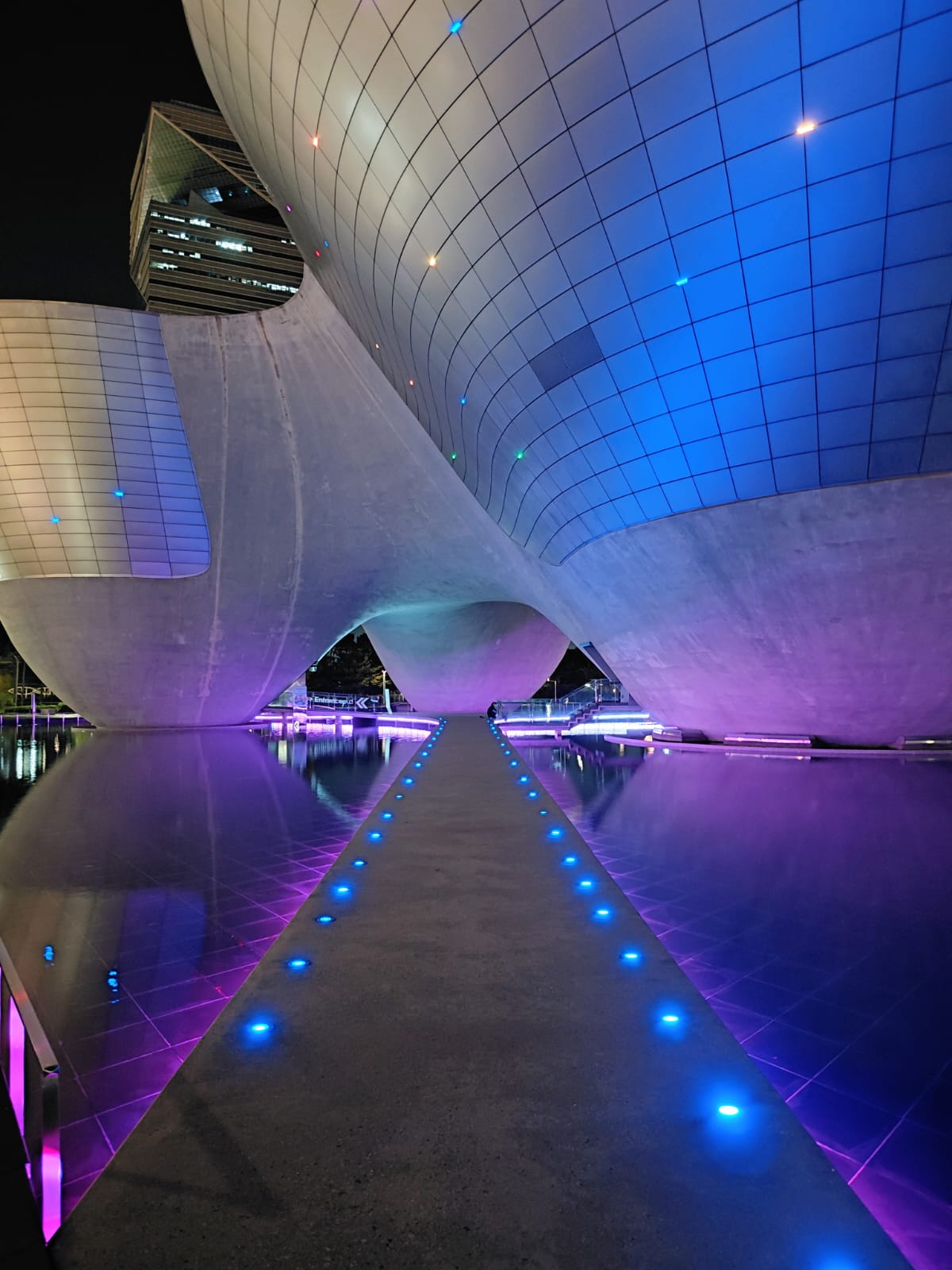
We're right in the heart of Songdo, Incheon's business district, and it's an understatement to say its Central Park blows us away. Around a waterway, ultra-modern skyscrapers fill the skyline, with bridges, fountains, green spaces and more. Cassandre doesn't miss the chance to go for a run, and Stéphane takes Clémence for a walk and then to the playground. That's where the day's little drama happens. Trying out a rope structure, Clémence fails to catch herself and her teeth hit a metal bar. The sound chills Stéphane's blood; he picks her up straight away to find blood everywhere.
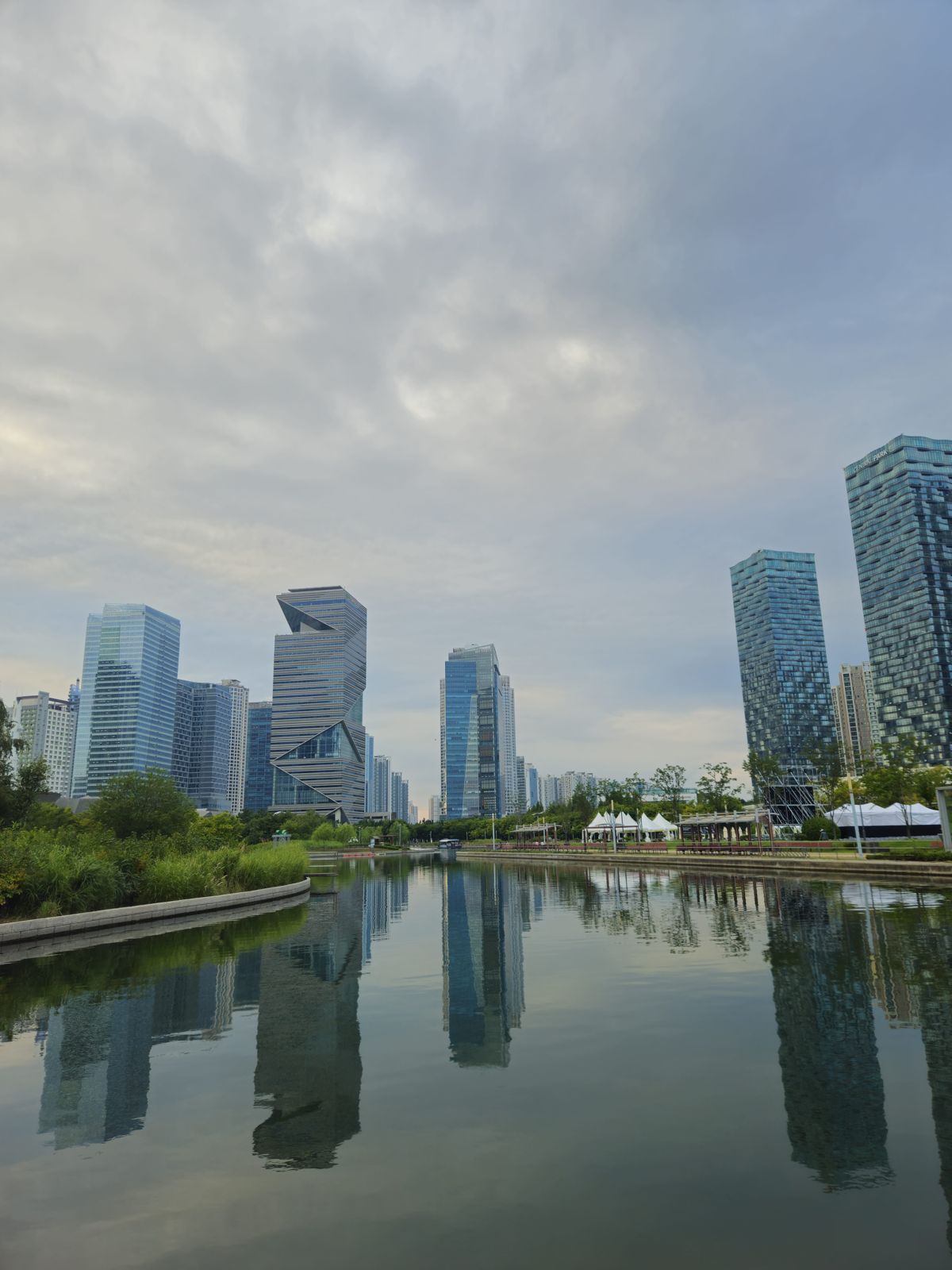
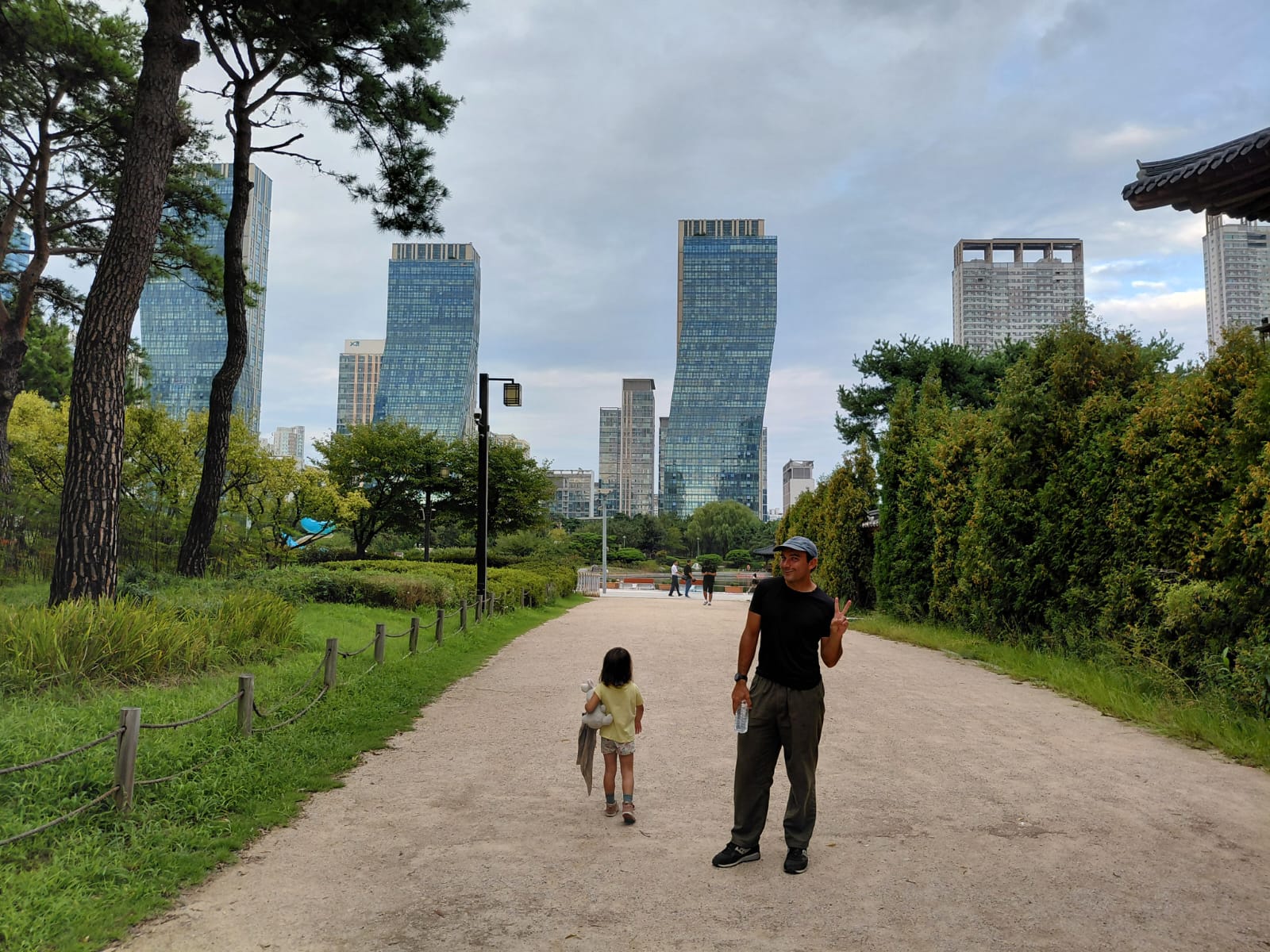
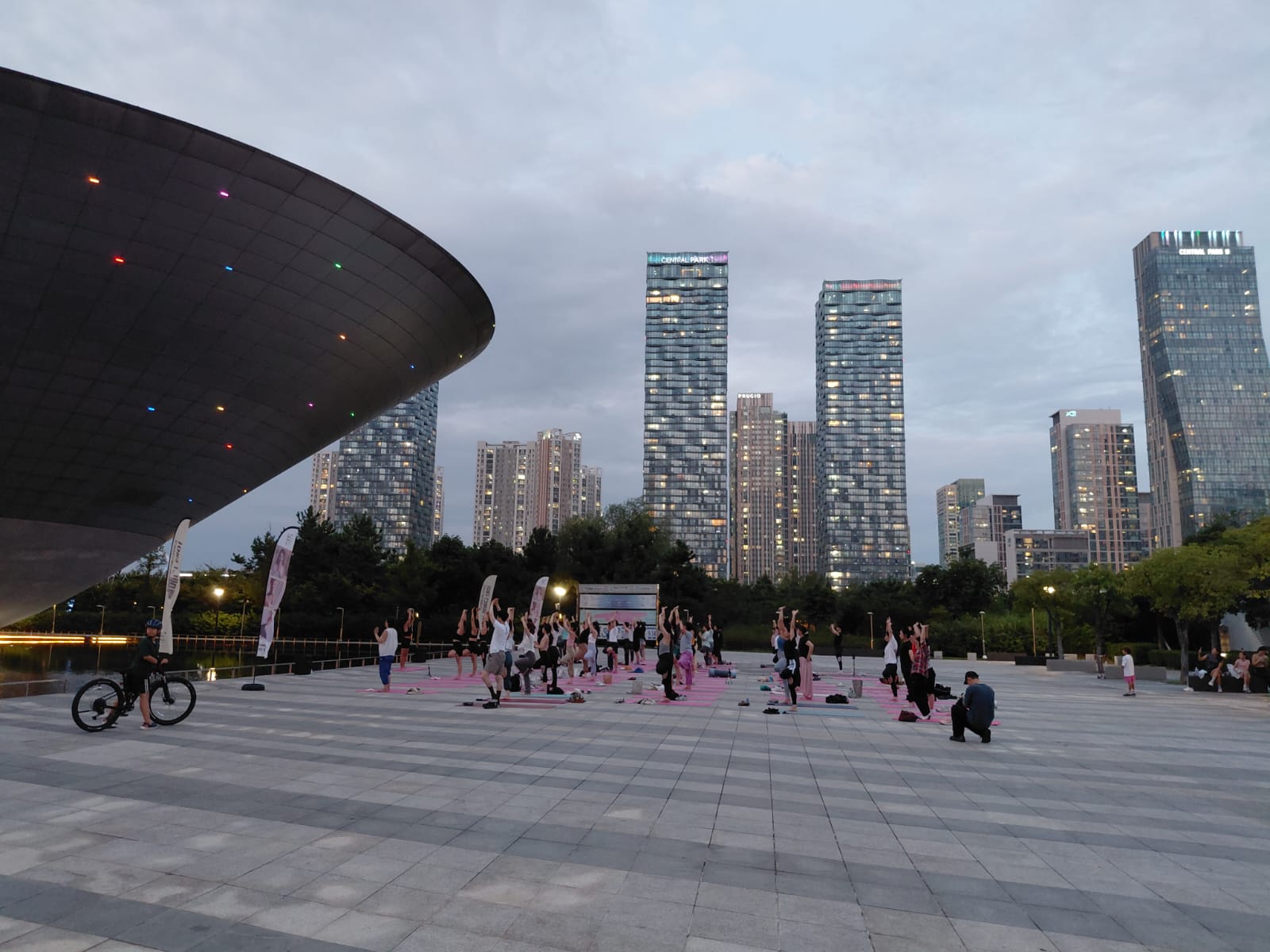
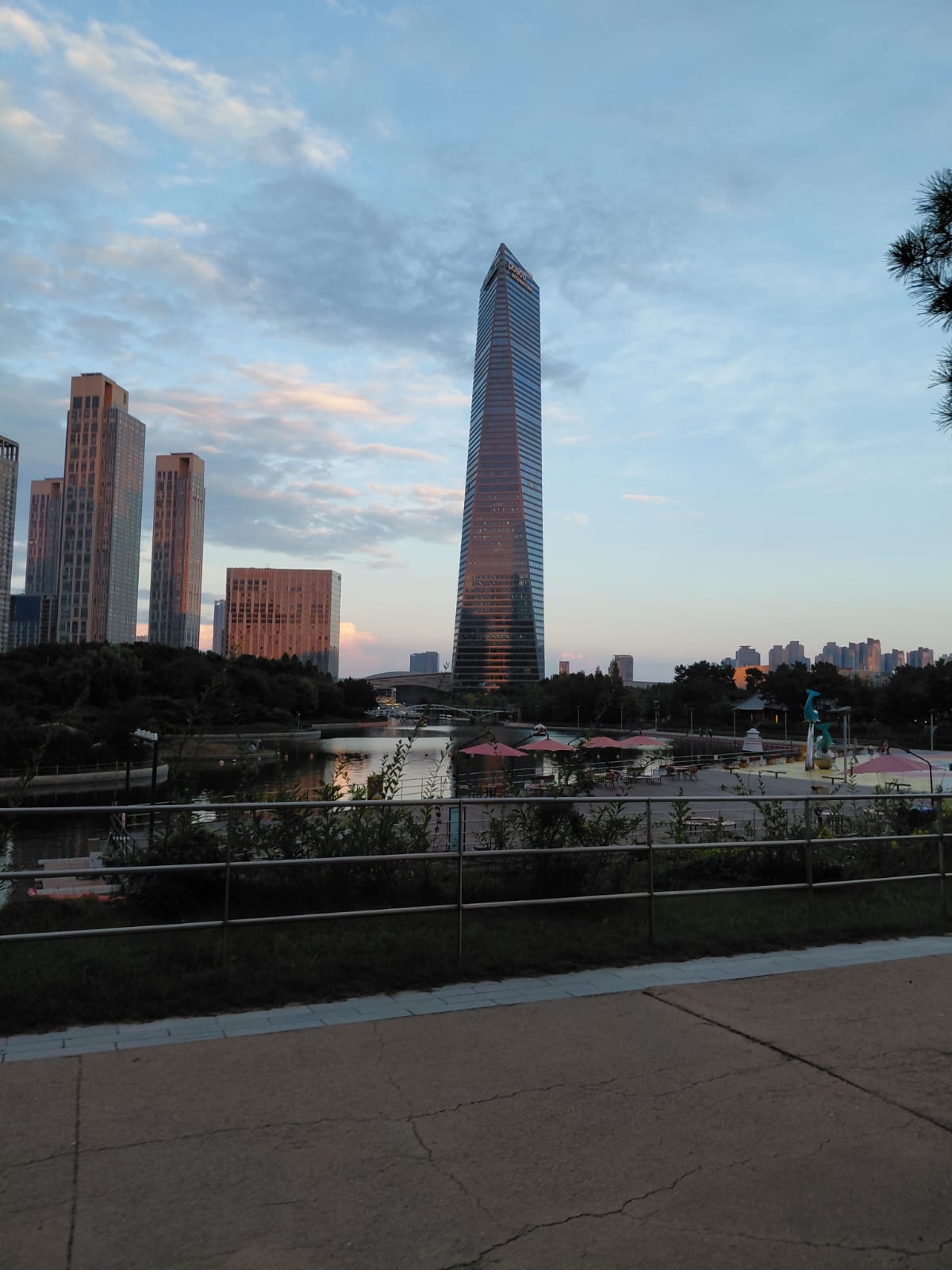
He grabs napkins from a nearby café and cleans her mouth. In the end her teeth only knocked her lips, and it's her lips that are bleeding heavily. More fright than harm, but a big scare that sends us back to the hotel early to disinfect the wound. We still go out to eat, and once the shock has passed, Clémence even goes back to play at the same playground. It's late, but it's full of children having fun. Koreans live to a different rhythm from ours, probably dictated by the heat, and little ones play quite late into the evening. It's so pleasant out that it would be a shame not to. We do eventually head back to the hotel to recover from all the emotions of the day.
On the road