
 ← PreviousDeeper into rural Korea
Koreans have a strong sense of public service. It's obvious as you ride through towns, villages and countryside. The smallest village has its station or bus terminal, and they're attractive buildings. There's an impressive number of public toilets and they're always clean. We frequently pass landscaped parks with facilities in perfect condition.
Today's stage is 60 kilometres, but a good part of it is on a gentle downhill. We ride at a good pace, and just as well, as we cross isolated landscapes full of farmland and rice paddies. Clémence has discovered that rice grows in these expanses full of water and tells us every time she sees one. That's the whole point of a trip like this: making discoveries far from home.
Travelling in such a faraway country is also an experience as a family. We step slightly out of the role of all-knowing parents that we are in our children's eyes. Here we can tell her we don't understand any more than she does when someone speaks to us, that we don't know what that bright yellow bird is or what the lady in the street is doing. In short, we're on the same level of knowledge, and it strengthens family bonds.
Just before noon we've already done half the distance, as we've hardly stopped on the way. So we stop for brunch in a cute, cosy café, just how we like them. The cost of living is surprisingly affordable in Korea. You can find hotel nights for €30–40 and easily eat for three for twenty euros at most per meal. Supermarkets and corner shops are also very competitive for a quick bite. As in Japan, you can buy meals in Korean convenience stores and heat them up and eat them there.
After the traditional playground break, we take advantage of Clémence looking tired to set off again and let her nap in the trailer. Although generally flat, the cycle route sometimes throws walls at us. For example, round a bend, a 30% climb for 300–400 metres (an eternity, in other words) that we have to tackle by pushing our heavy rigs, as the gradient is impossible with our load. At times it takes both of us to push the bike pulling the trailer with Clémence inside. We're exhausted at the top and struggle to get going again.
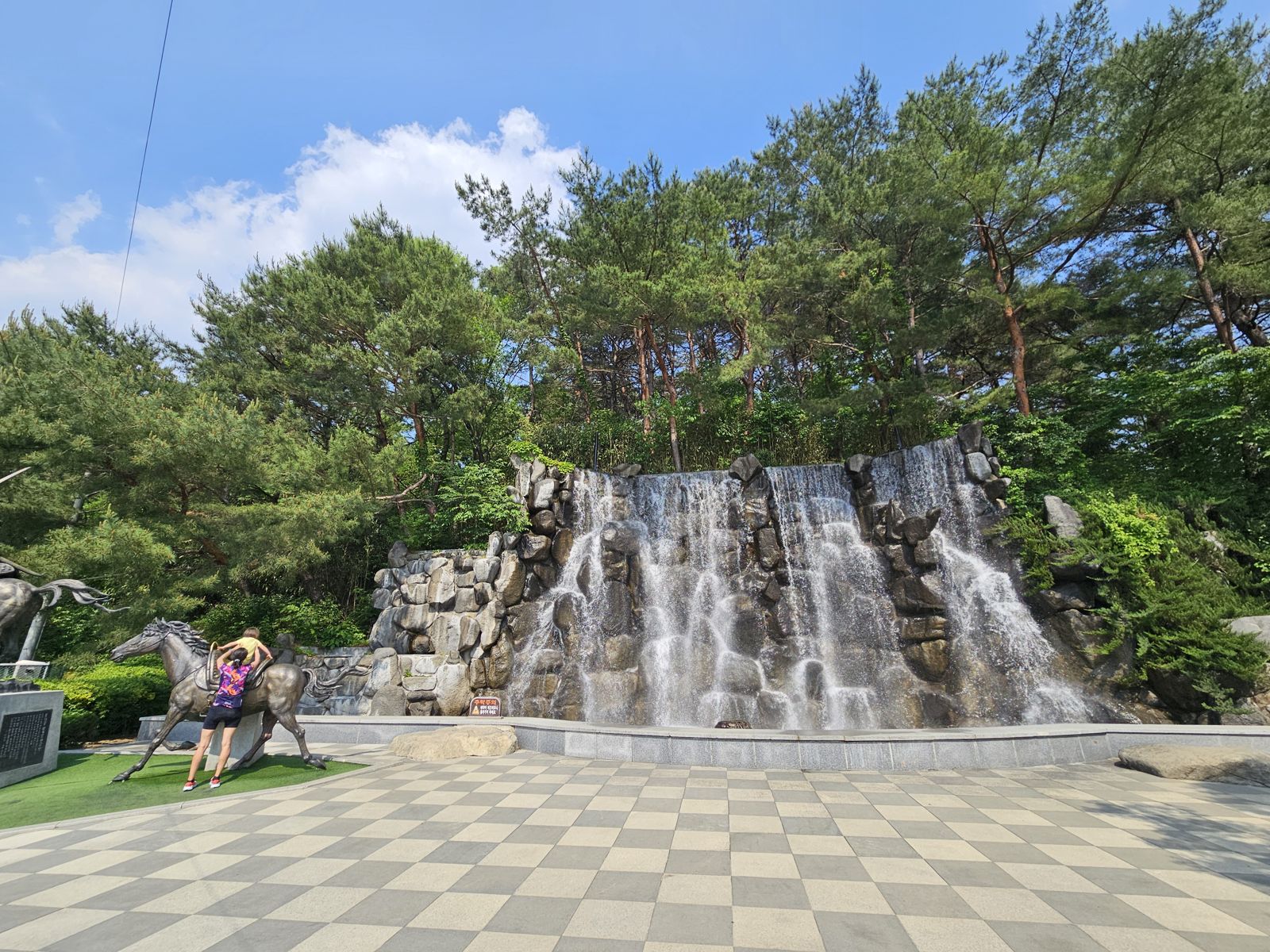
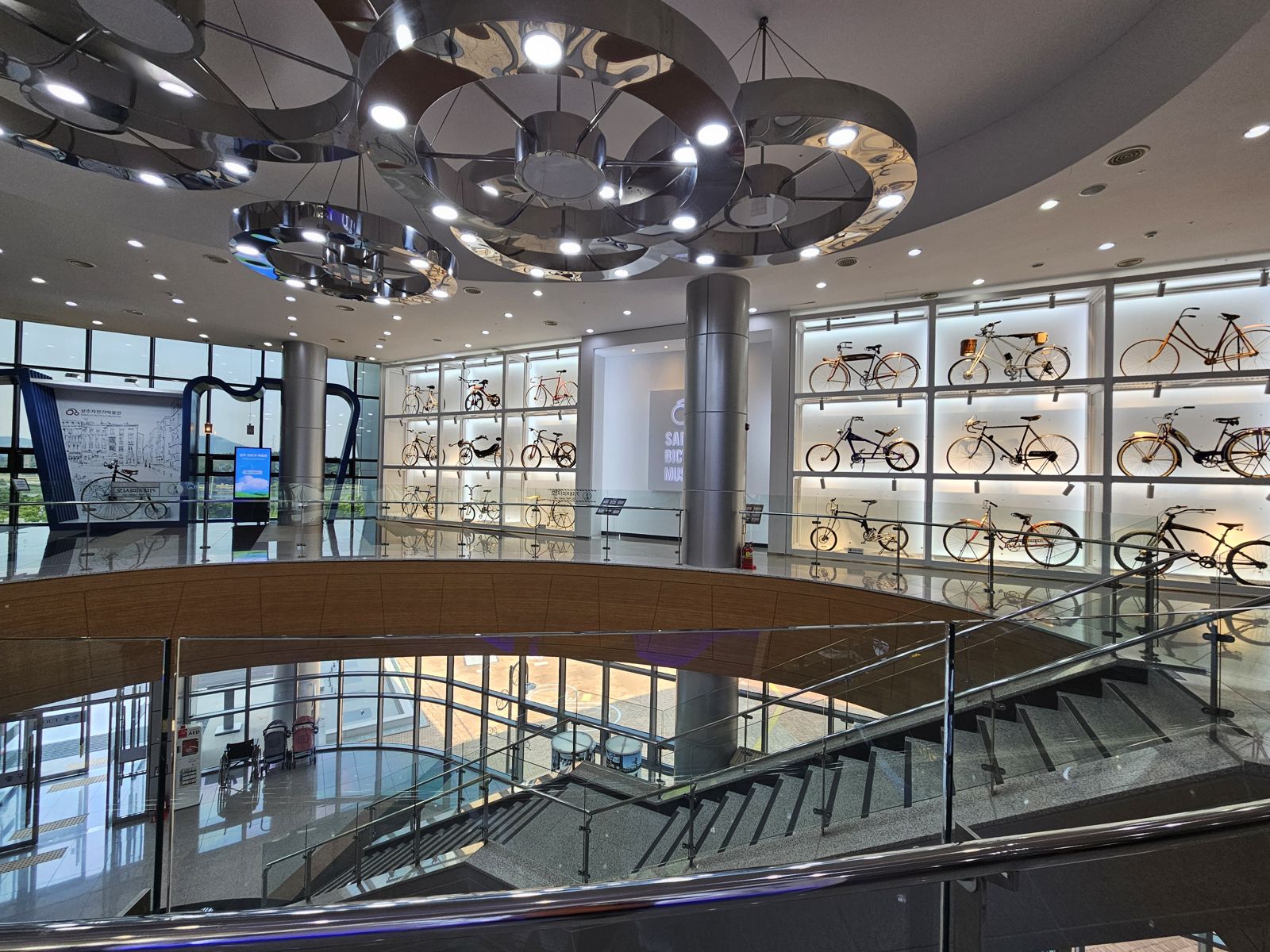
Once we've recovered, we stop briefly at the top of a hill with a pretty artificial waterfall whose spray cools us down. Shortly afterwards we reach the bicycle museum in the city of Sangju. Oddly, in the middle of nowhere, a gigantic cultural building glorifying the bicycle has been built. It's not thrilling, just an exhibition of bike models through the ages, but one of the guides is very funny. He's absolutely determined to show us the exceptional collection of hats and helmets displayed in the basement, but he speaks so fast, in very limited English and with such enthusiasm, that we don't understand a thing.
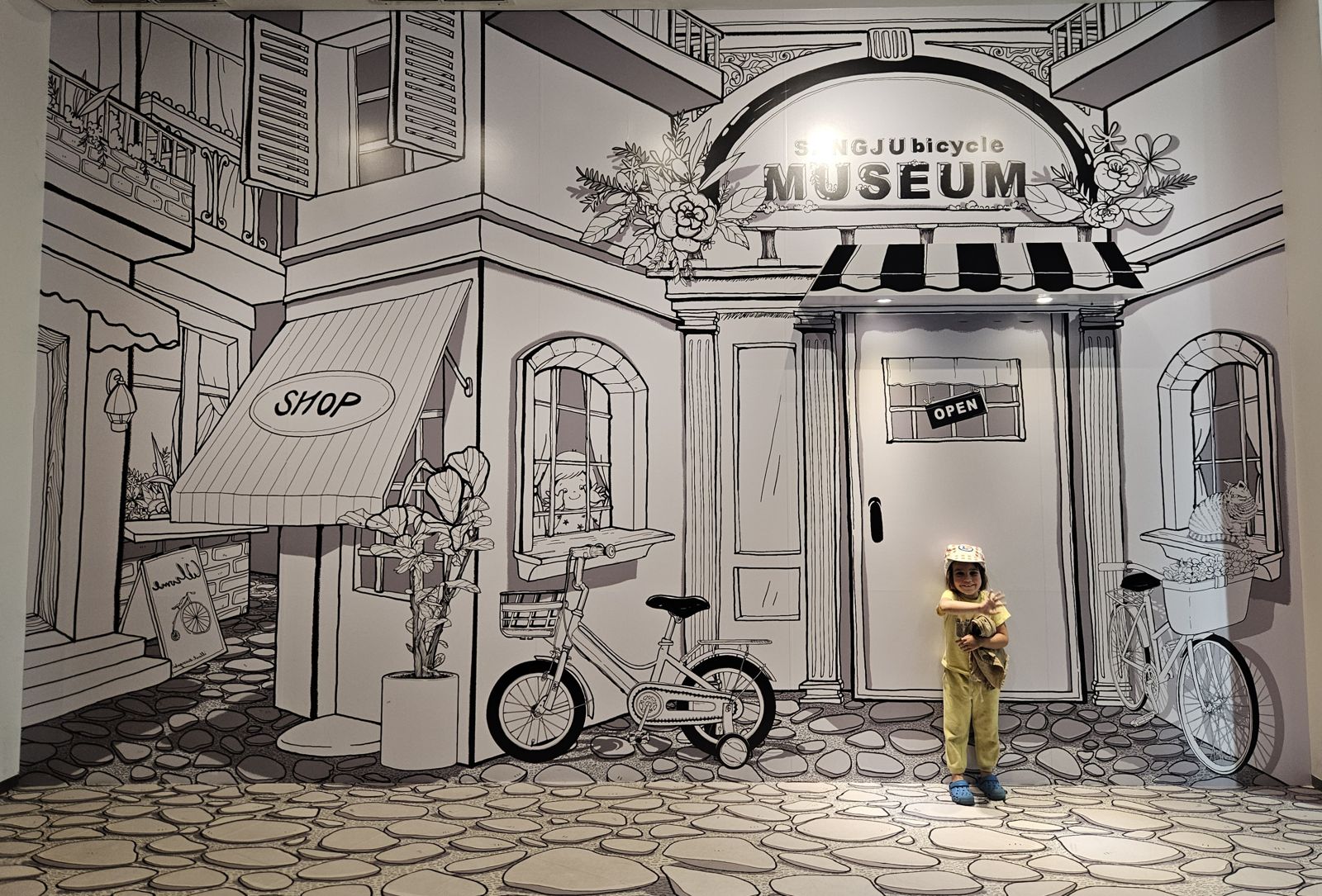
We finally reach the city of Sangju a little further on, Korea's cycling capital. Unfortunately labels are sometimes pure marketing slogans, as the little city is anything but bike-friendly. It's actually extremely unpleasant. Almost no cycle paths, big roads, no pavements… It has the same misleading effect on us as Clermont-Ferrand, which bills itself as a "bike city" because the Tour de France has often passed through (or nearby), when it's one of the least bike-friendly cities we've crossed on our various trips. Luckily the hotel is up to scratch.
Wednesday 28 May
Stéphane made a mistake. He thought it would be nice and sensible to stay in town to be closer to where life happens. Misled by the idea that Korea was a bike-friendly country, he didn't think it might not be the case everywhere, at least a little. This morning, leaving Sangju already proves him wrong. Even though we follow the cycle route suggested by Naver, we ride on stressful dual carriageways. Fortunately Koreans are careful drivers and almost always overtake using the opposite lane. We even find ourselves on an 80 km/h expressway for a few kilometres before reaching the cycle route.
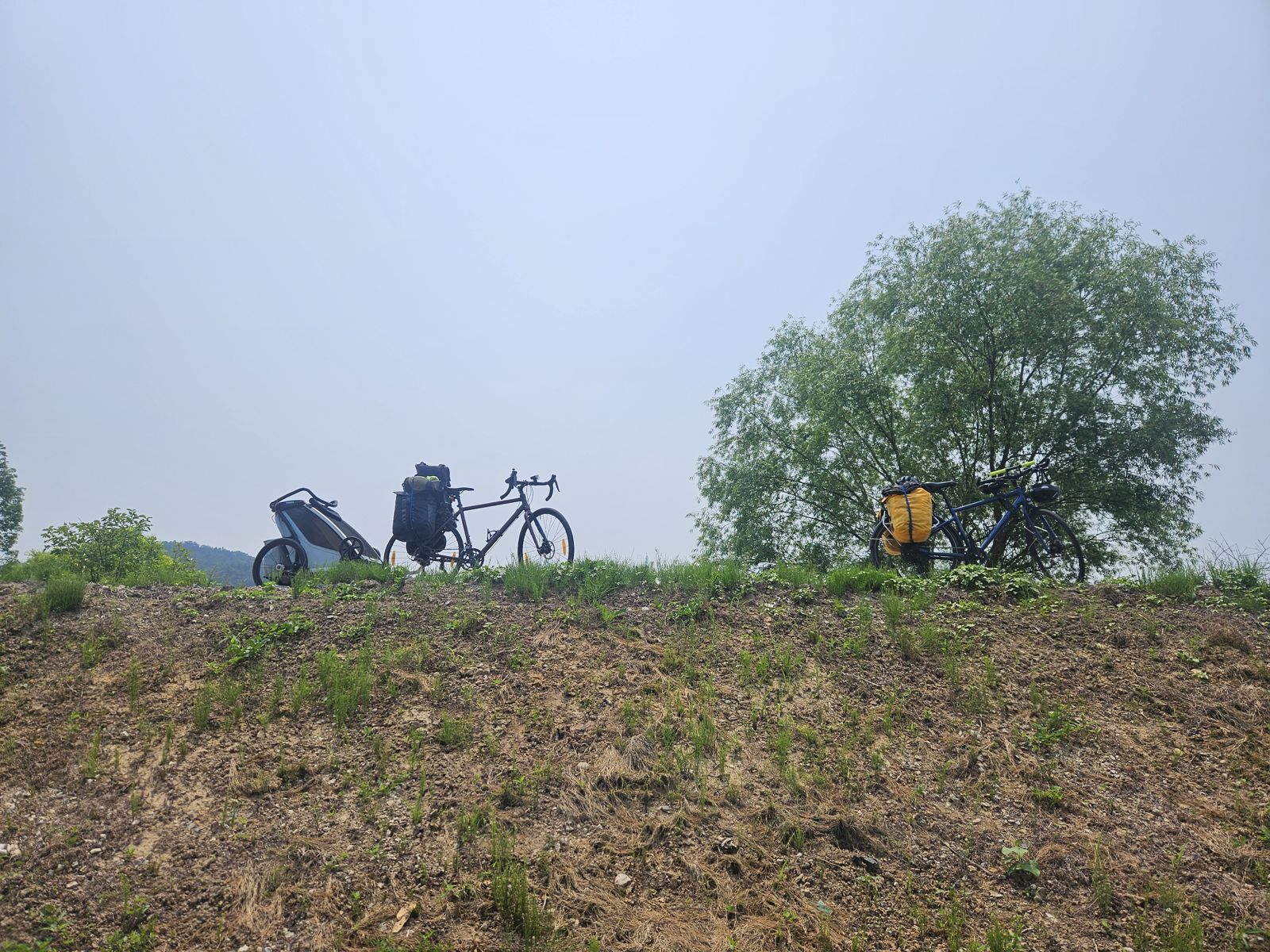
This first part has already annoyed us, but the greenway isn't in good condition at all on this stretch. We have to deal with roadworks, dirt or gravel sections and above all walls to climb. We have nothing against climbing, but the succession of 20% slopes wears us out. It feels as if we do nothing but climb and immediately go back down. There's nowhere to eat or take a break, and we have to wait 25 kilometres before finally finding a village. It's 11 on the dot, and luckily the first café we come to has just opened. It's nice to be able to sit down in the cool.
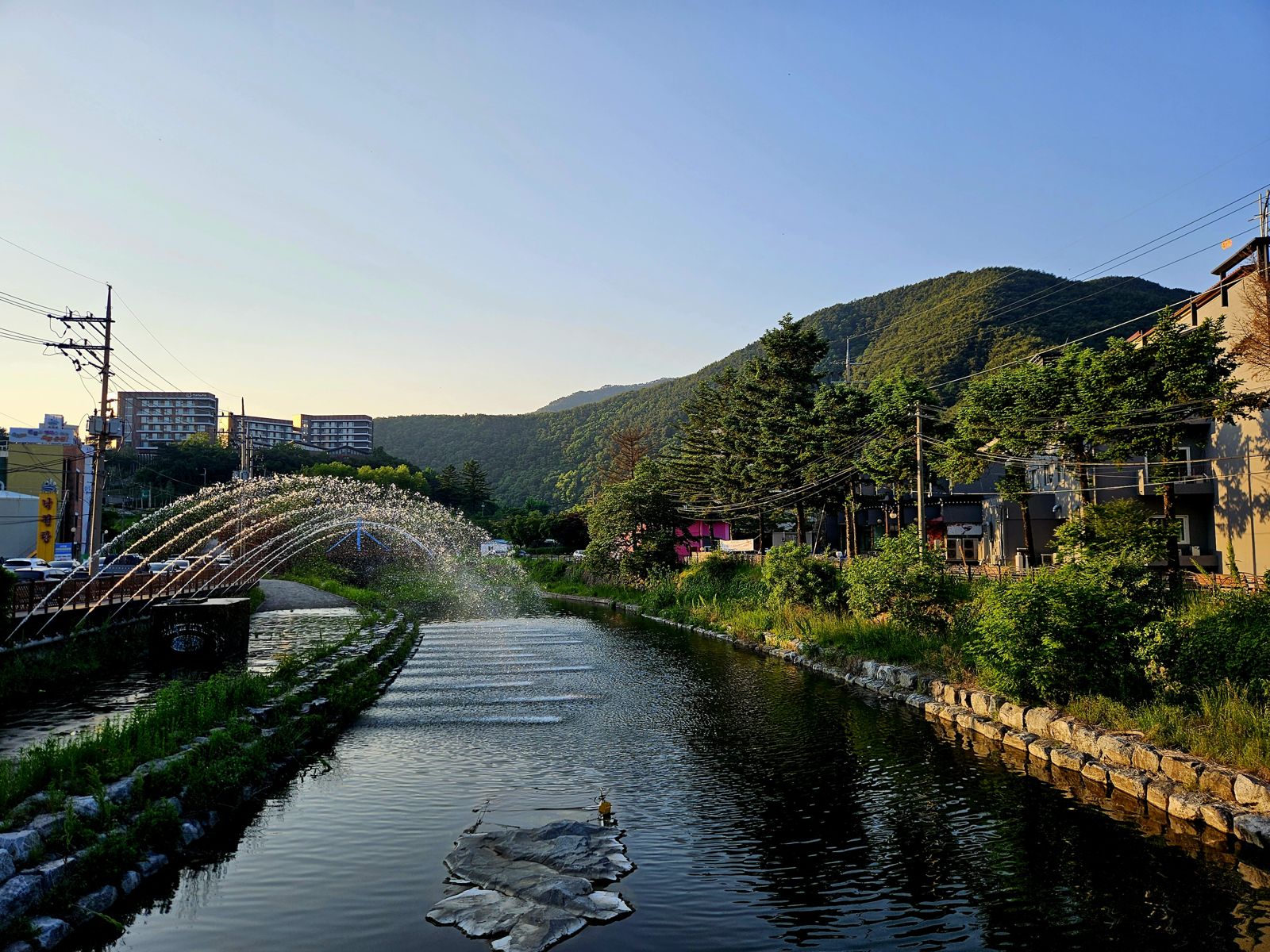
Because that's it: it's now really hot and humid in central South Korea. We set off again, as we can't hang around. There's nowhere interesting to stop or grab a bite before the 50-kilometre mark of the day. We cross fields as far as the eye can see and rice paddies, and follow a new river. A man on a scooter catches up with us, signals us to stop, then gives us bottles of water and takes a selfie with us. Others wave as they pass. It brings a bit of cheer to a landscape that's becoming repetitive, with its long straight lines in the blazing sun.
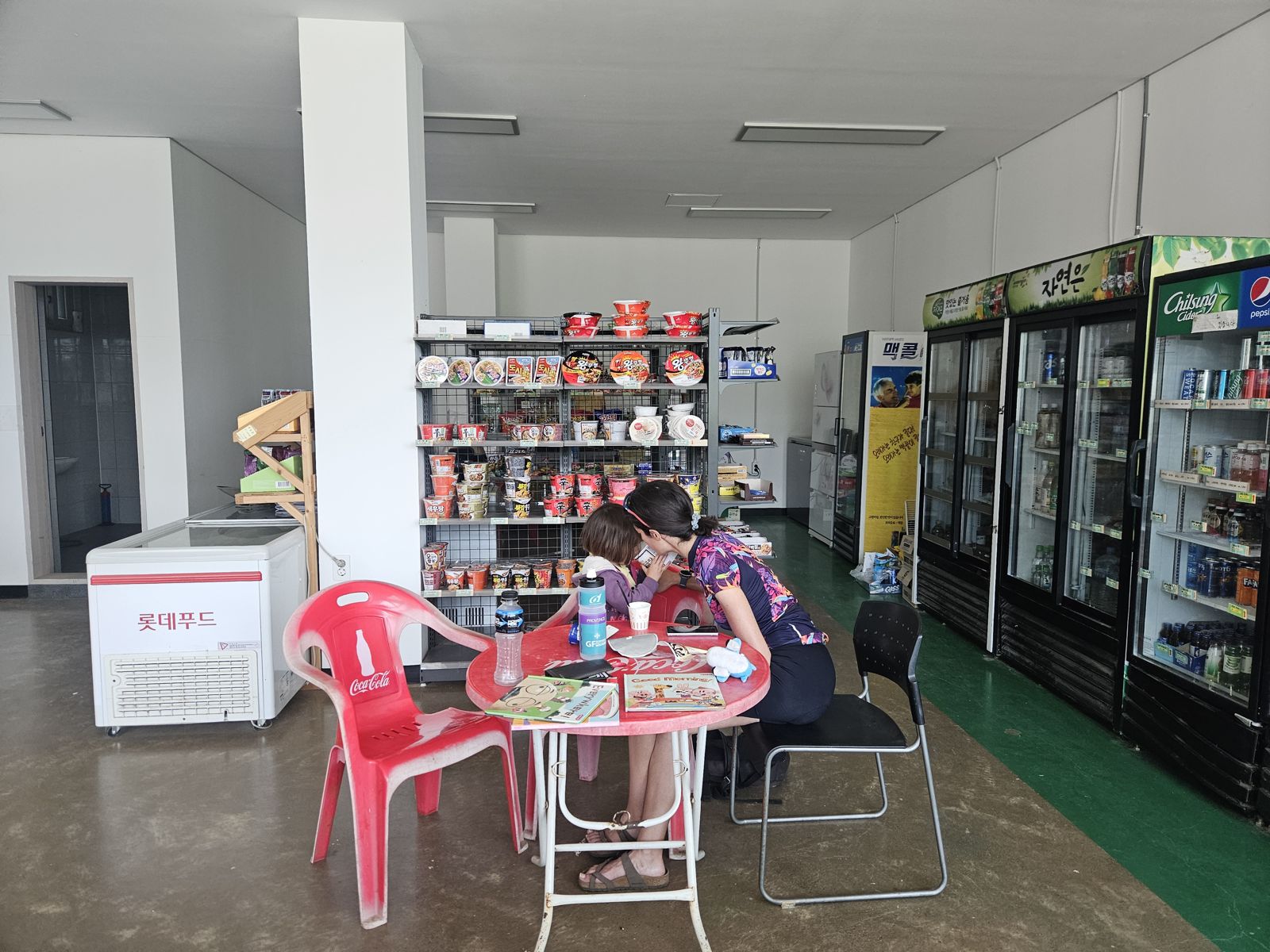
We finally stop after almost two hours of non-stop pedalling to eat in a little convenience store lost in the middle of nowhere. Clémence devours a bowl of instant noodles and we set off for Gumi. Unfortunately, it's the same story as the city we left this morning. No cycling infrastructure, dozens of lanes for cars and pedestrian lights you wait at for whole minutes. Crossing a street can take five minutes if you need two crossings. We mostly ride on the road, but as soon as the roads get too big (more than three lanes each way), we no longer feel safe at all and prefer to use the pavements — and it's a good thing they're there, or it would be an obstacle course!
The day already feels far too long when we finally reach the hotel on the other side of the city, at the top of yet another hill. This very out-of-the-way little neighbourhood is lovely, surrounded by greenery and mountains and by a lake, but we wonder whether the whole crossing (almost 40 minutes from one side of the city to the other!) was worth such a detour. We learn from our mistakes; you won't catch us trying to ride into cities again.
Thursday 29 May
Total change of plan. After the disappointment of the last two days, we decide to cancel all our upcoming nights. We need to slow down. We decide to hang around the little neighbourhood where we are. It's very cute, with lots of cafés and restaurants, and the surroundings are beautiful. One of the difficulties in South Korea is finding tourist information in English. For example, we find very little about Geumosan Provincial Park, at whose gates we're staying, and it's by chance that we discover a cable car goes up from 500 metres from our hotel.
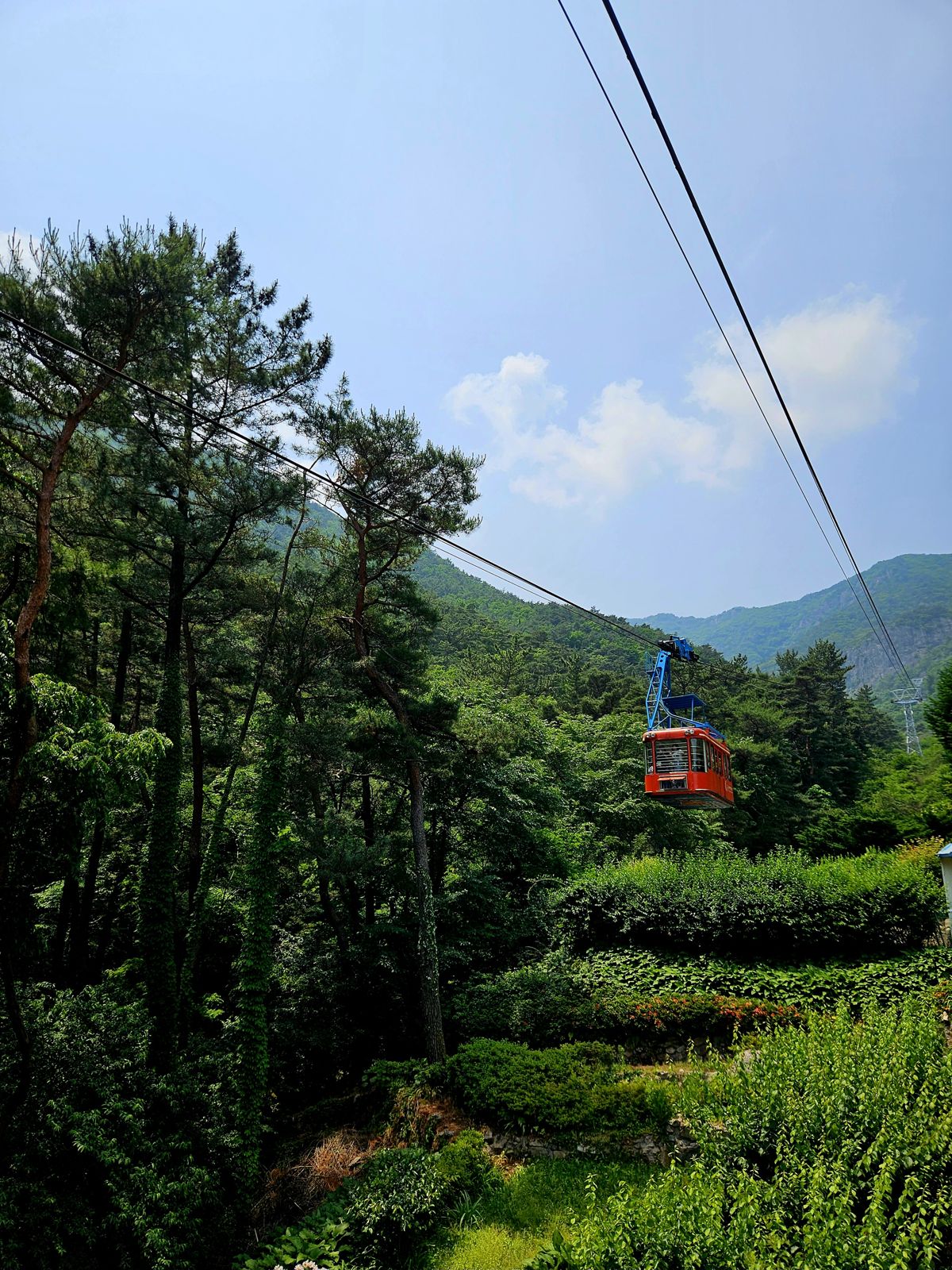
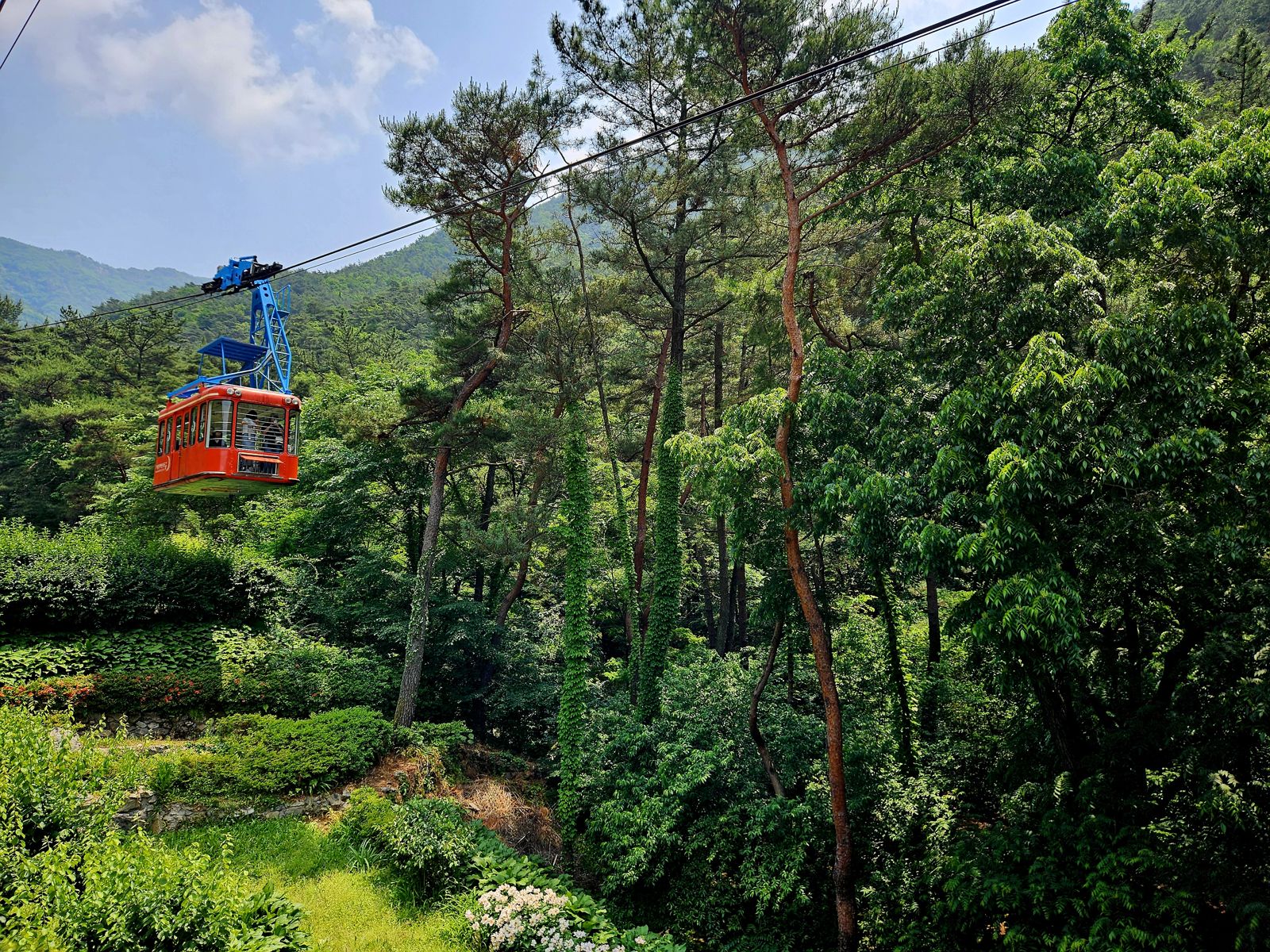
After breakfast in a very chic café, we head for the cable-car station. We go into a pretty building and soon we're climbing the mountainside. At the top, several trails lead off. One goes to a superb temple with colourful vaults, and we marvel at the beauty and serenity of the place. Clémence is surprised to see people praying, and we discover how hard it is to explain the concept to a child. We take another trail to a rather ordinary waterfall. We're more fascinated by an animal that looks like a caterpillar but moves by folding itself in two. Clémence is fascinated and can't take her eyes off it.
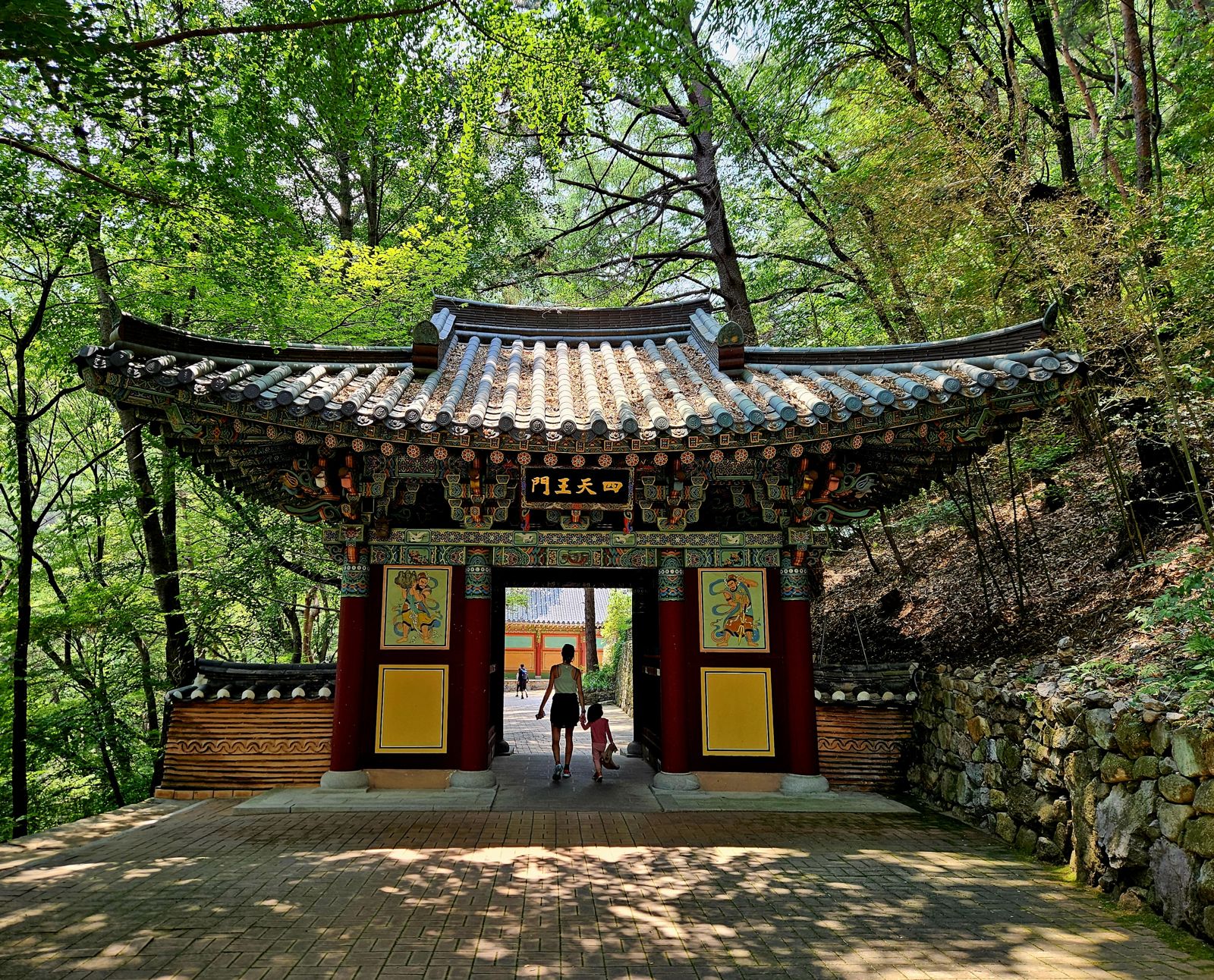
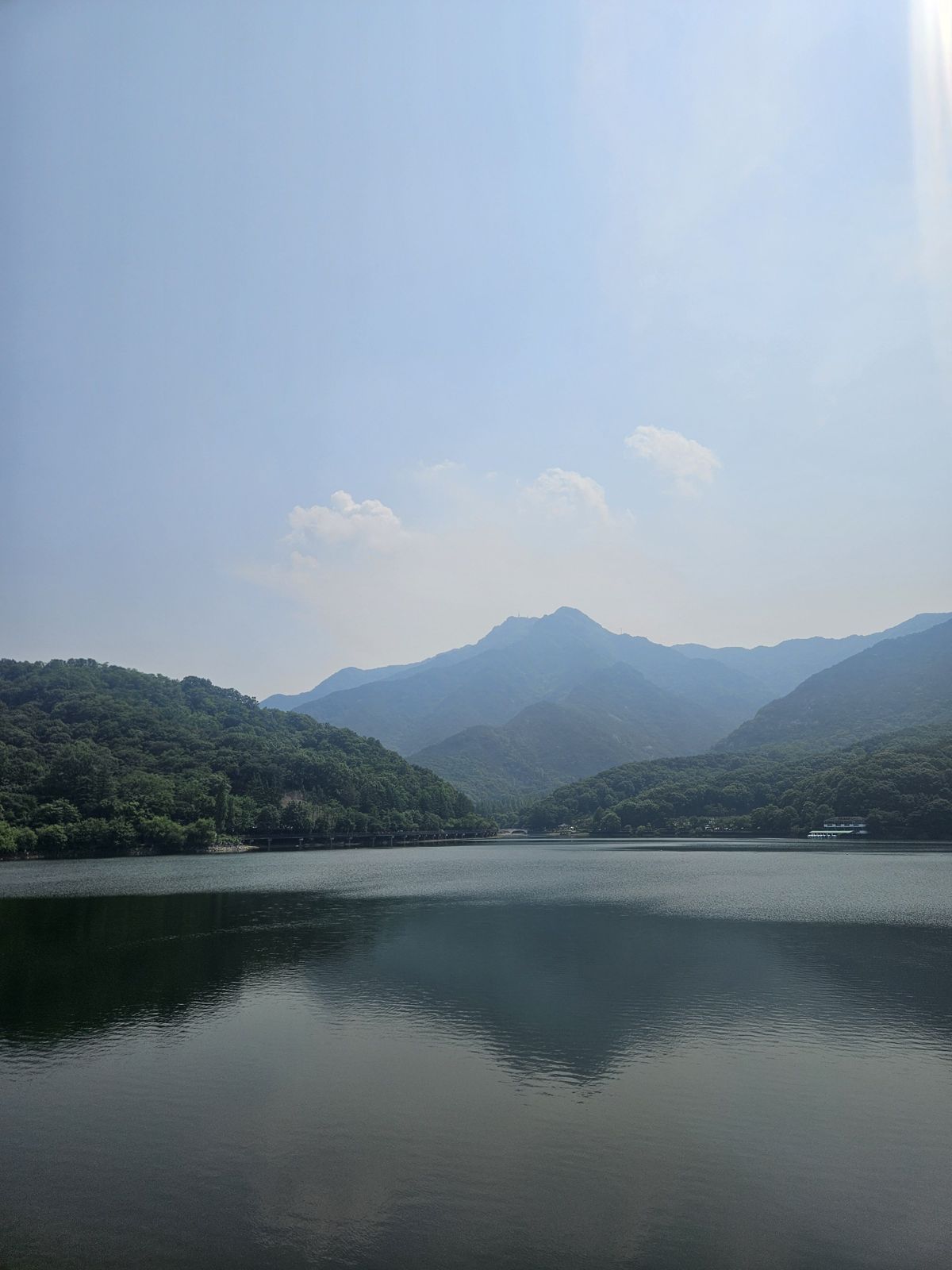
We'd happily stay up there hiking all day, but unfortunately, if we want to leave the city outside rush hour, we can't hang around for hours. Fortunately there's a cable car every fifteen minutes, and soon we're back down. We buy a picnic at a convenience store and eat it while walking around the very pretty lake at the foot of the park. It's sunny and hot and the view is splendid, but only on one side.
On the other side is the city, with its huge buildings and above all its horrible traffic waiting for us. Yet we have to cross it again to reach the greenway, and the prospect doesn't thrill us at all. We choose the strategic time of 3 pm to set off, and even though there isn't that much traffic, it takes us almost an hour to do just ten kilometres.
The whole city is dedicated to cars; we often have to ride on the thin strips you could call pavements, as the roads are extremely wide and hostile to cyclists, even if Koreans drive carefully. To be safe, we cross junctions at the pedestrian crossings, but we wait ages for green every time. Of the 55 minutes it took us to cross the city, our watches tell us we were moving for 40. Yes, over those 10 km we spent a quarter of an hour standing still just waiting to cross junctions at pedestrian crossings! We're quite glad to finally reach the playground on the other bank to play with Clémence and leave this hell behind.
We've decided to adapt to local ways and do as Koreans do for hotels. The population here is so dense that it's always easy to find somewhere to stay, and above all, lots of places aren't on booking sites. So tonight we haven't booked anything; we'll turn up at several places we've spotted on the way and simply ask if they have a room. And we strike lucky first time, about fifteen kilometres on. In a run-down motel, an elderly Korean couple offers us a room for the modest sum of €30. Stéphane goes up to see it; it's spacious and everyone will have their own bed. It's not the height of luxury, but it'll more than do.
On the road