 ← PreviousAlong the Geum River
With our last pedal strokes in South Korea, we keep discovering a fascinating country: Gongju and its red crosses that light up at night, Sejong, the brand-new but deserted administrative capital, and countryside still set to the rhythm of rice paddies and bridges under construction. For clarity, the map of the route we rode in this story is below.
Sunday 31 August
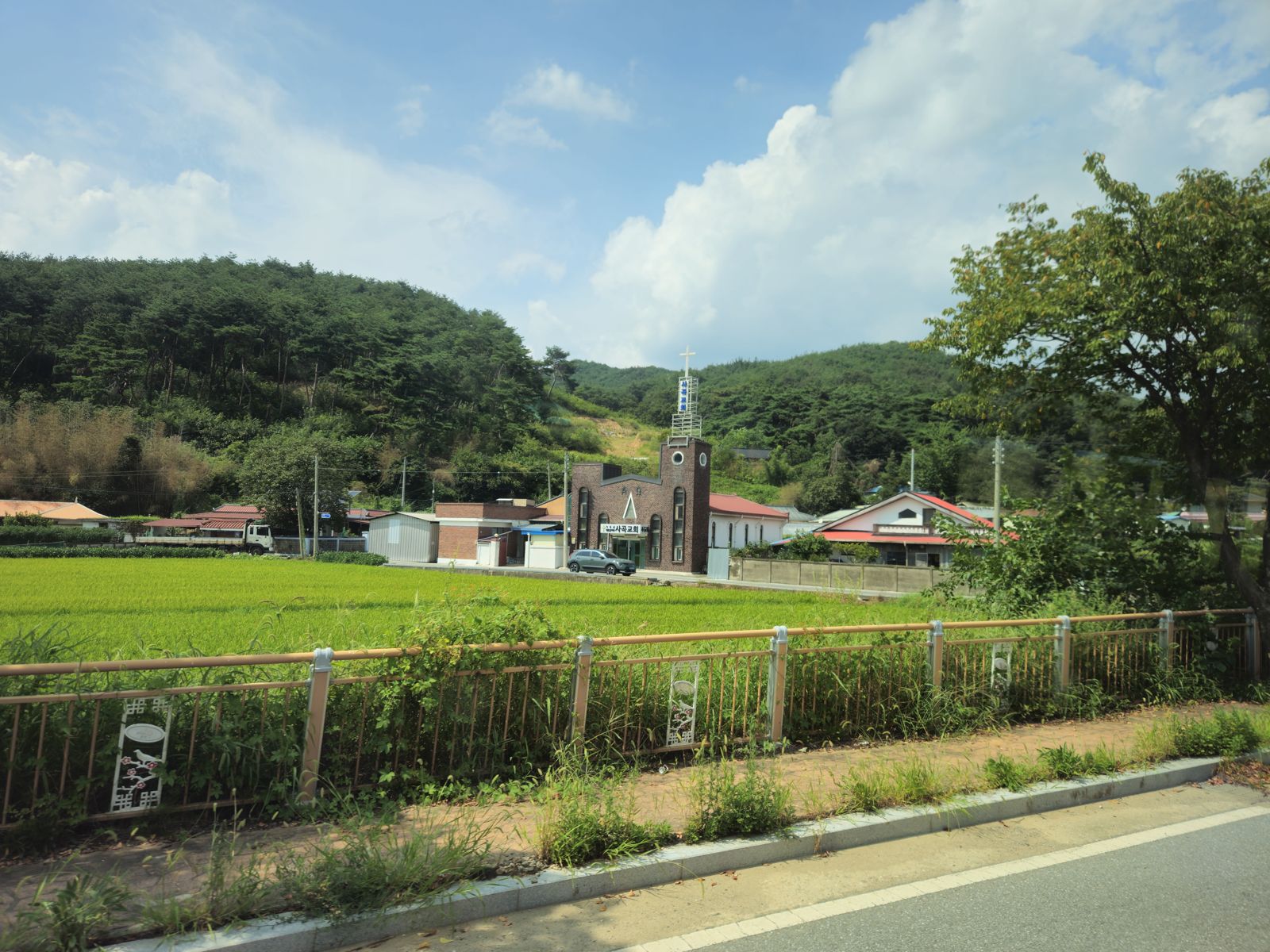
From Europe, our view of East Asian countries is very stereotyped. The popular imagination readily associates Korea with Buddhism, and while that's partly true, most Koreans are Christian. 33% of the population worships in churches (25% Protestant and 8% Catholic), and they're everywhere. You hardly notice them by day, but the crosses topping their roofs glow red at night all over the country. So some towns turn out to be very devout after dark. That's the case in Gongju, where a forest of red crosses switches off at dawn.
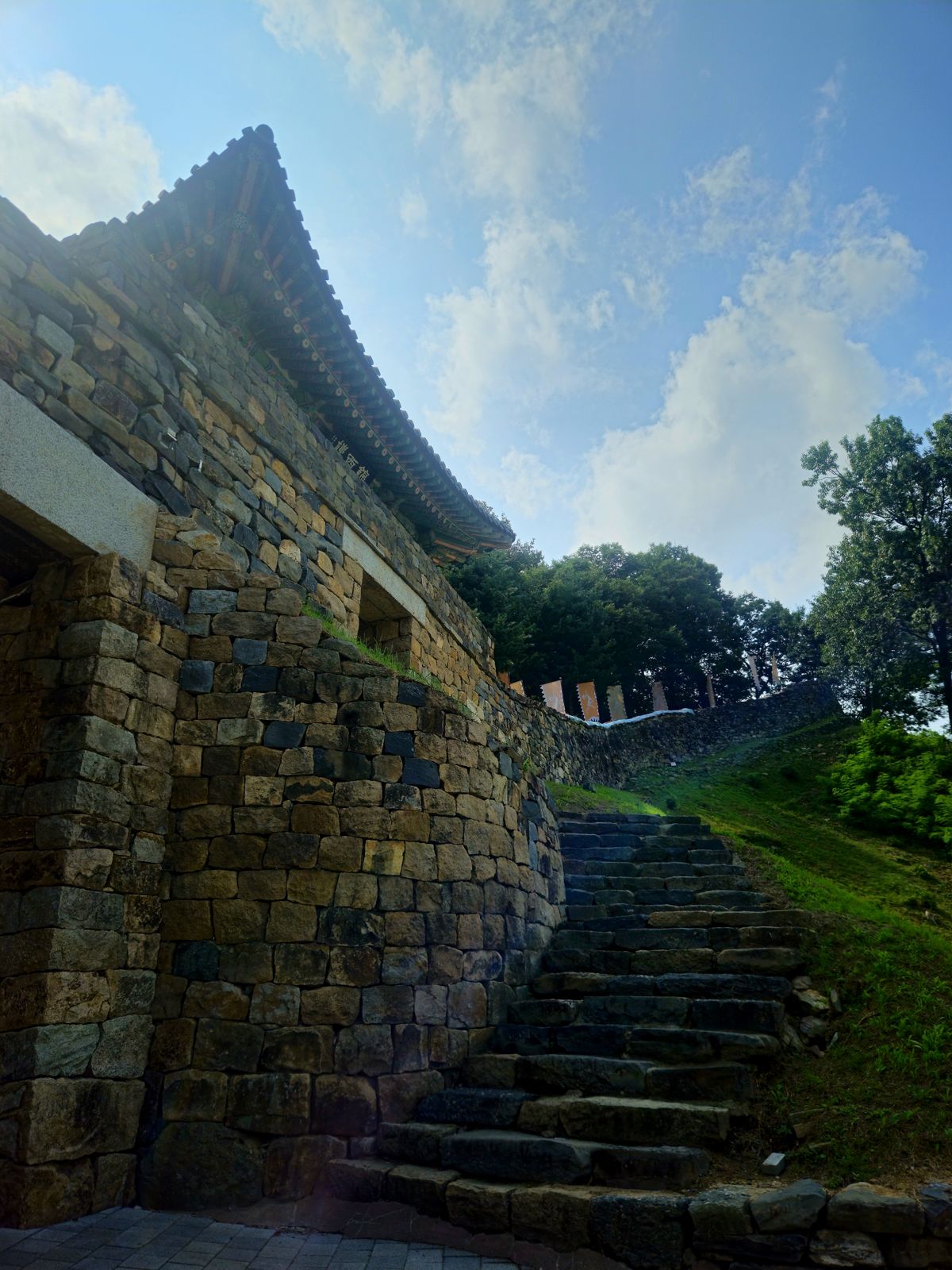
We see none of it, as we wake up well after sunrise this morning. Gongju is a town with a very rich historic heritage, yet few foreign tourists visit. After a very simple breakfast in our room, we head across the river, barely a kilometre by bike, to another major fortress from the Baekje era. So once again we're the only non-Koreans walking around. It's still very hot and humid today, and the dreadful clouds of gnats wear us out even more than the walk itself. It follows ramparts that skirt the void; sometimes we're walking a tightrope, and Clémence understands she mustn't let go of our hands.
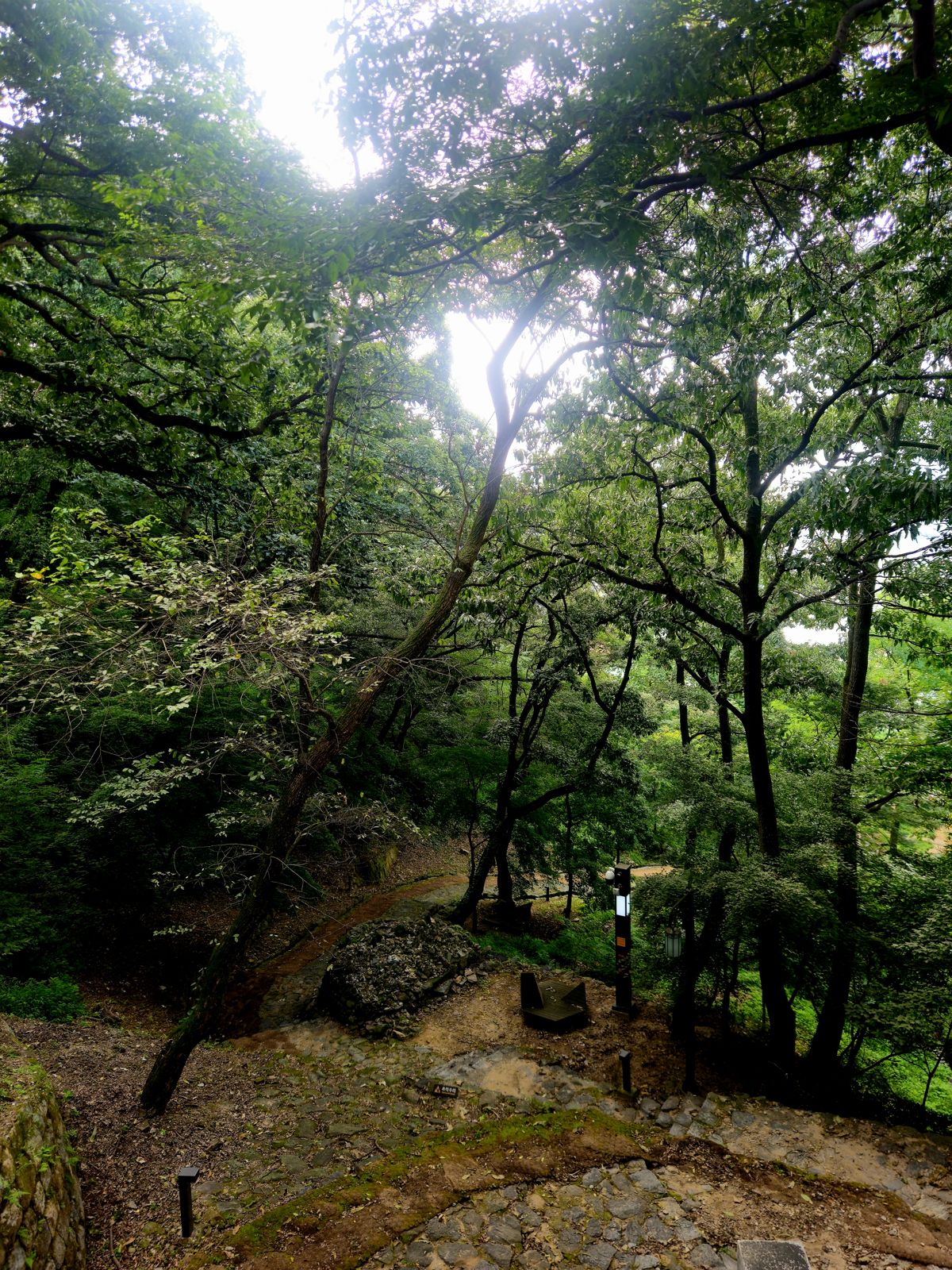
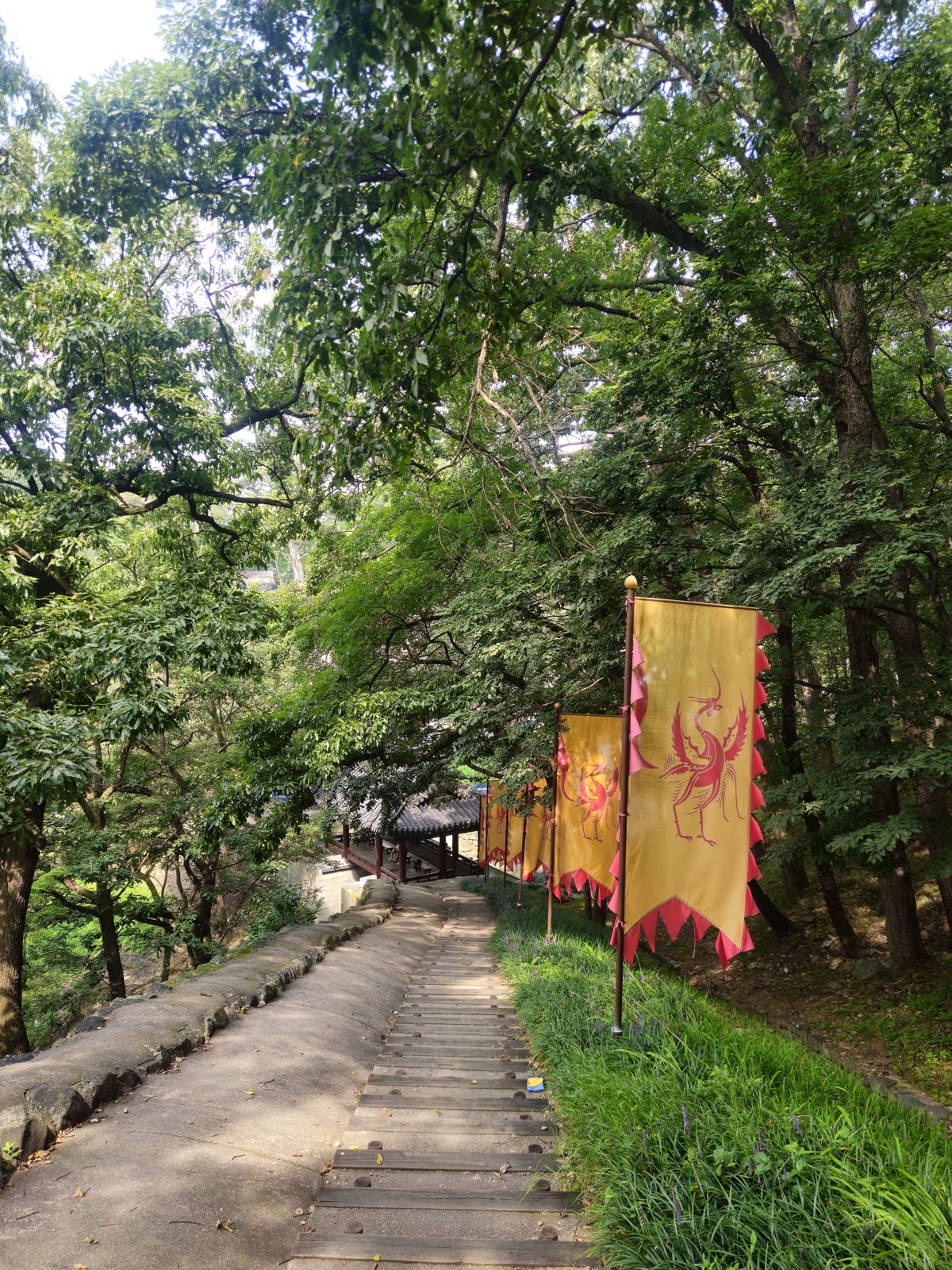
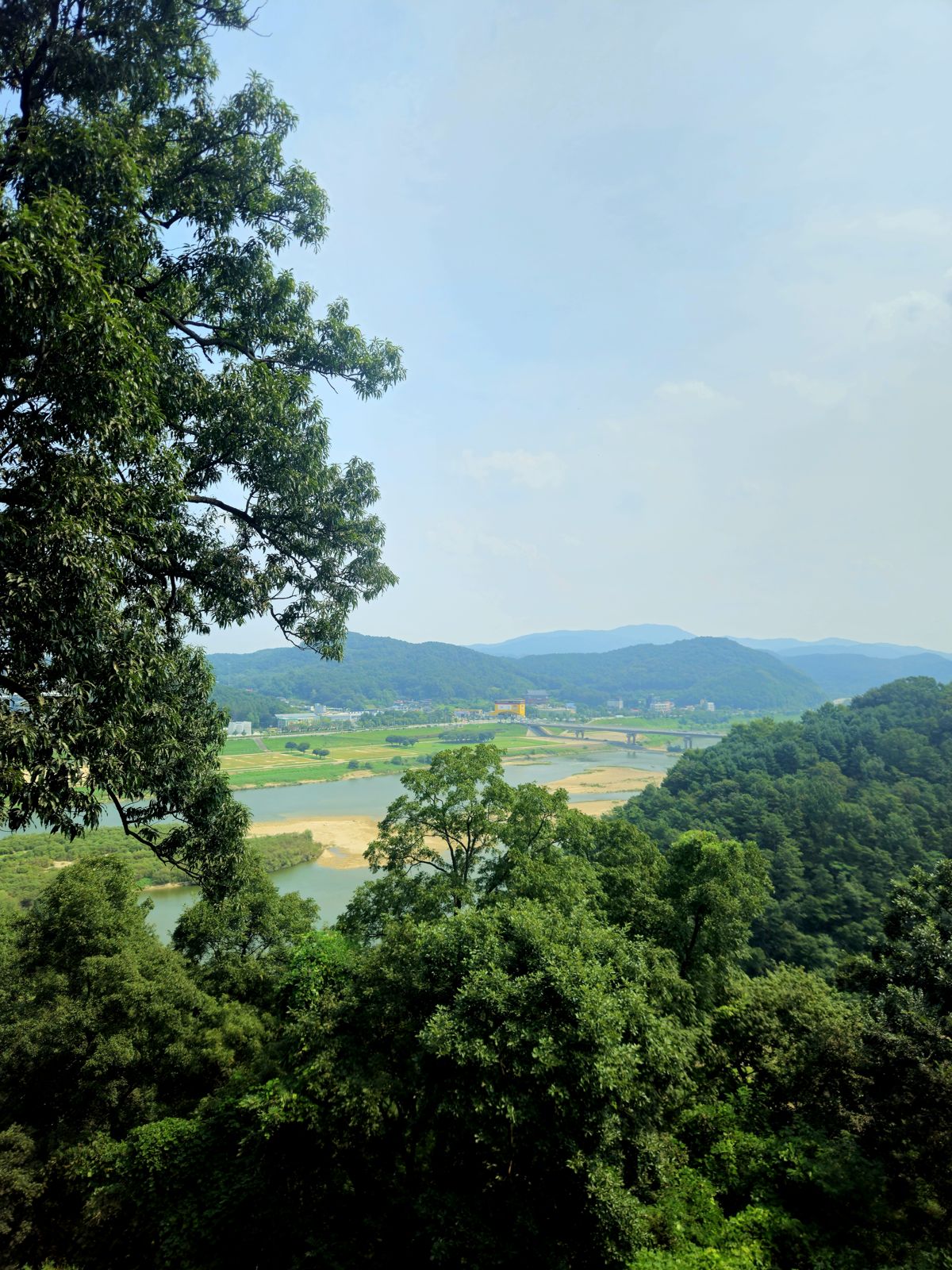
After a long series of ups and downs, we reach the end of the loop drenched in sweat and take refuge in a traditional restaurant. We find ourselves in a canteen popular with locals, and eyes widen once more as we walk in. The pace is fast, the atmosphere fun, and we're served quickly. Our bibimbap is good, and the owner tries to put us at ease in passable English. We eat our fill, get back on the bikes and leave them at the hotel. Then we hop on a bus that winds for thirty minutes through the Korean countryside between streams, rice paddies and green hills.
Our destination, Magoksa temple, is one of Korea's gems. Set beside a slow-flowing river, it's stunning in its colours and beauty. Unfortunately, like all the historic sites of southern Korea, we're walking through a reconstruction. The original temple was destroyed by the Japanese, like almost every monument in the country. In their determination to impose their religion, Shinto, they set about erasing every sign of other faiths. A lost cause, since we're still visiting these buildings centuries later. The place is very pleasant because it's breezy and the southern wind cools us down. Admittedly not as much as the bus back, where the temperature is nearly twenty degrees lower than outside.
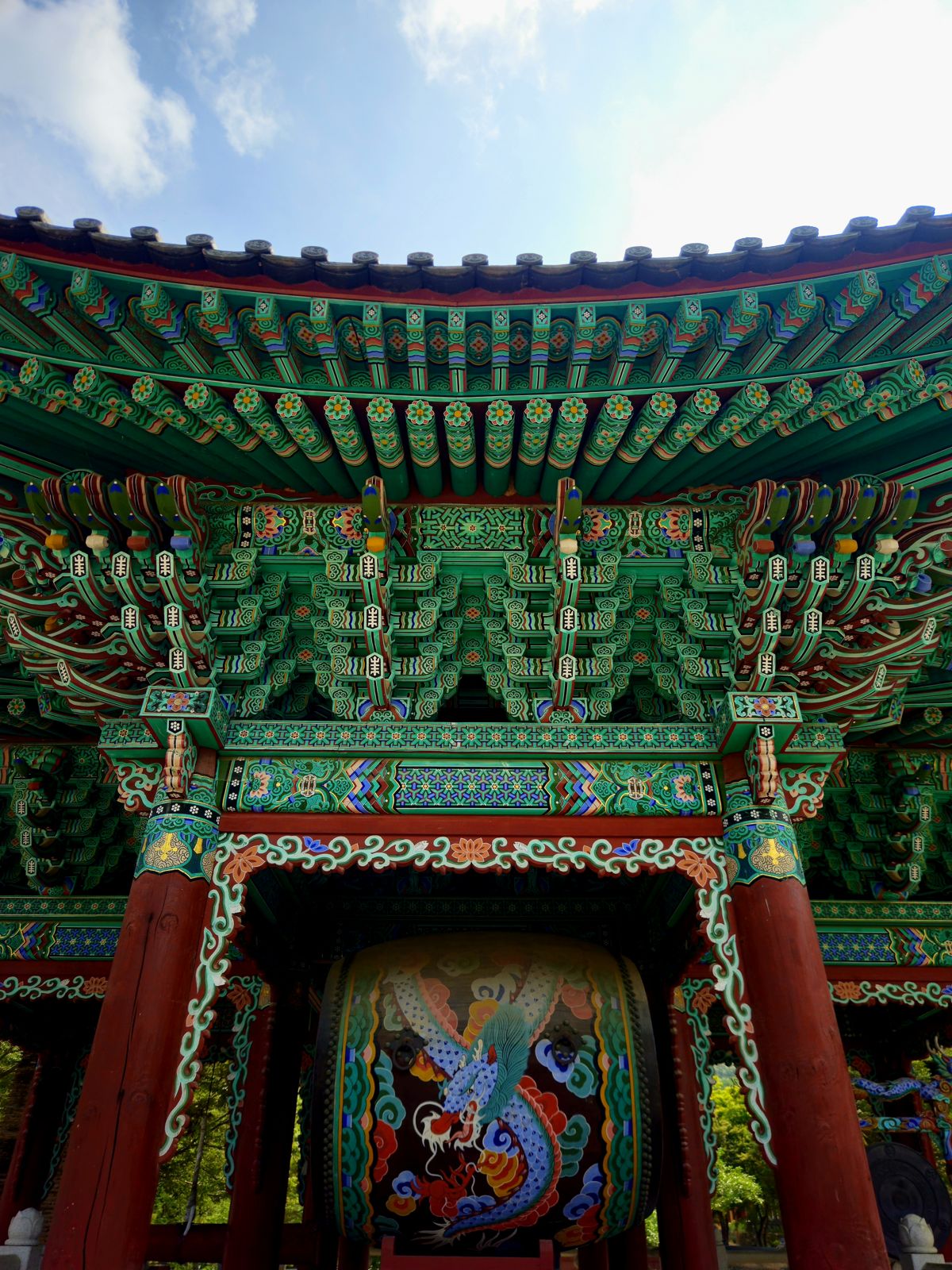
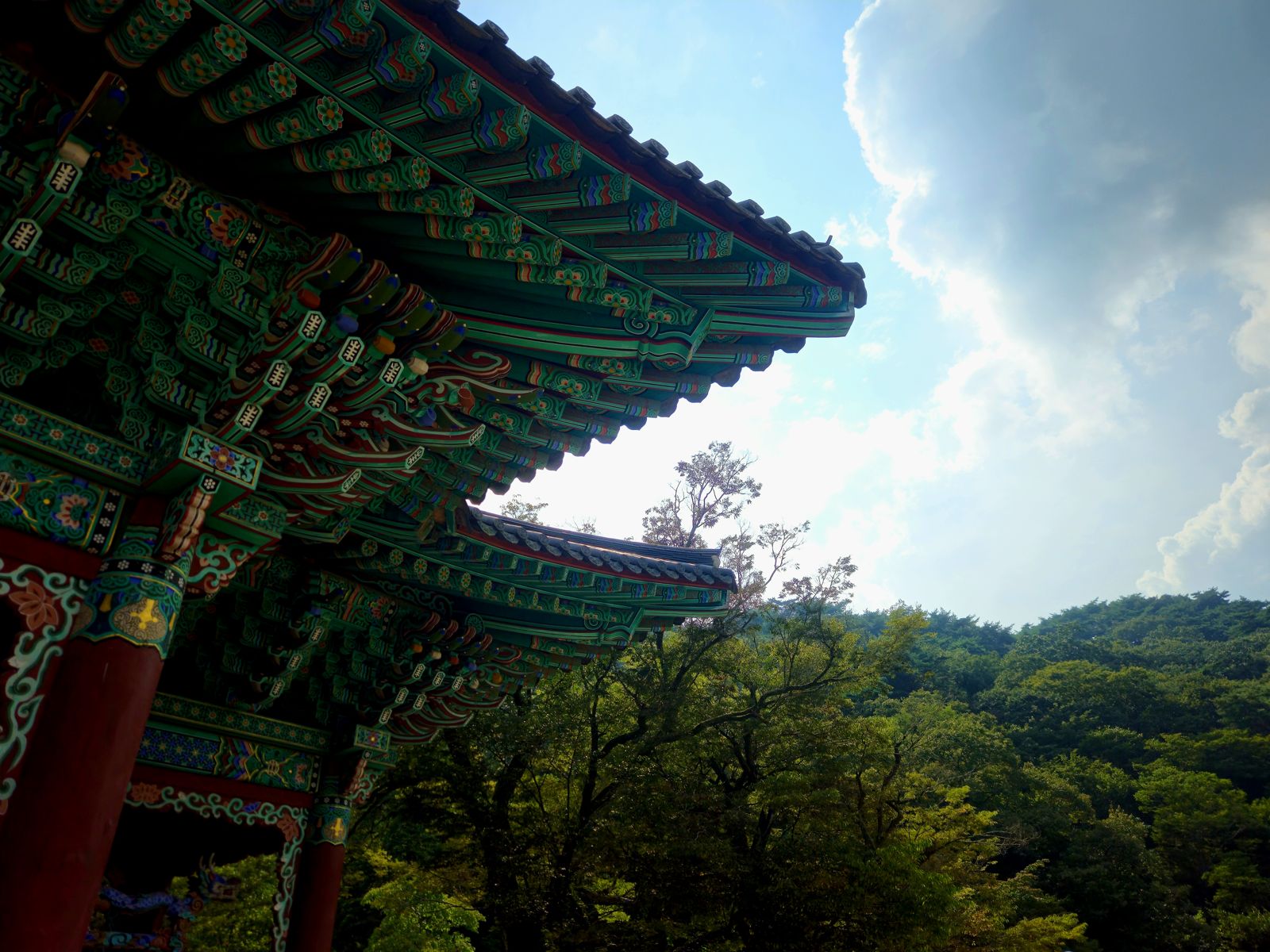
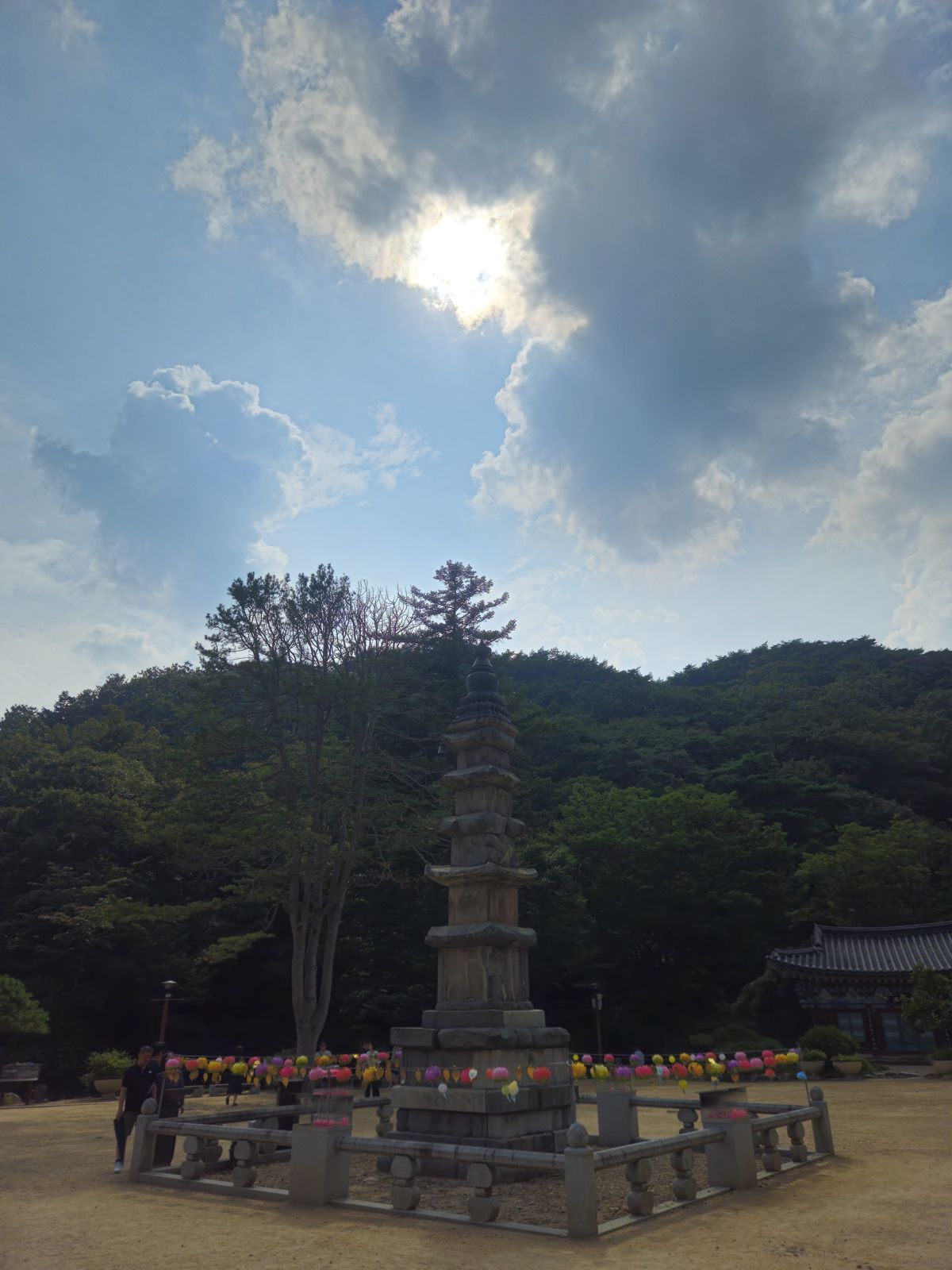
Clémence is a very curious child who keeps up with our pace almost without ever complaining, and to reward her we try to make the most of kids' cafés whenever there's one within reach. Gongju has a tiny one, enough for an hour of fun jumping on trampolines and building with Kapla blocks. It closes early, though, so we go back to the hotel to wash before heading out again for local dishes and putting Clémence to bed a little later than usual.
Monday 1 September
Today is back-to-school day in France… but just another day for us in South Korea. It's hard to take in that for everyone in France, today marks the real end of summer and the holidays, while for us the holidays go on and summer is still very much here. We've been living with constant humidity and temperatures above 30 degrees for three months now. We're lucky, really, because the rooms we sleep in always have air conditioning. Without it we'd certainly have had more bad nights than good, as the temperature rarely drops below 26 degrees, even at night.
The forecast said rain, but it was clearly wrong, because the sun is beating down when we leave the hotel to start today's stage. The first twenty kilometres to Sejong, the administrative capital, go by at a good pace despite a headwind and a few small climbs. Sejong is a new town: it was built from scratch and officially inaugurated in 2012. The planning project was first launched in 2002 to give the country a new capital and counter Seoul's gigantism. It then ran into conflicting political and economic interests, and it was decided to move only some ministries and other government and public bodies to Sejong, making it an administrative capital.
So the city is of course spotless and well laid out, with wide avenues, pavements and cycle paths, tall buildings… It feels like an Australian city. The difference that jumps out when you arrive is the complete absence of noise and passers-by. It feels as if nobody lives here. And yet it has 400,000 inhabitants. The explanation is that Sejong doesn't attract Koreans, because there are few if any festivities, little nightlife, few cultural or sporting events, and housing is very expensive. It's also aimed mainly at Koreans working in government institutions, so people with a certain standard of living and salary. That considerably holds back young people from moving there, even though they're the soul of a city and what makes it lively.
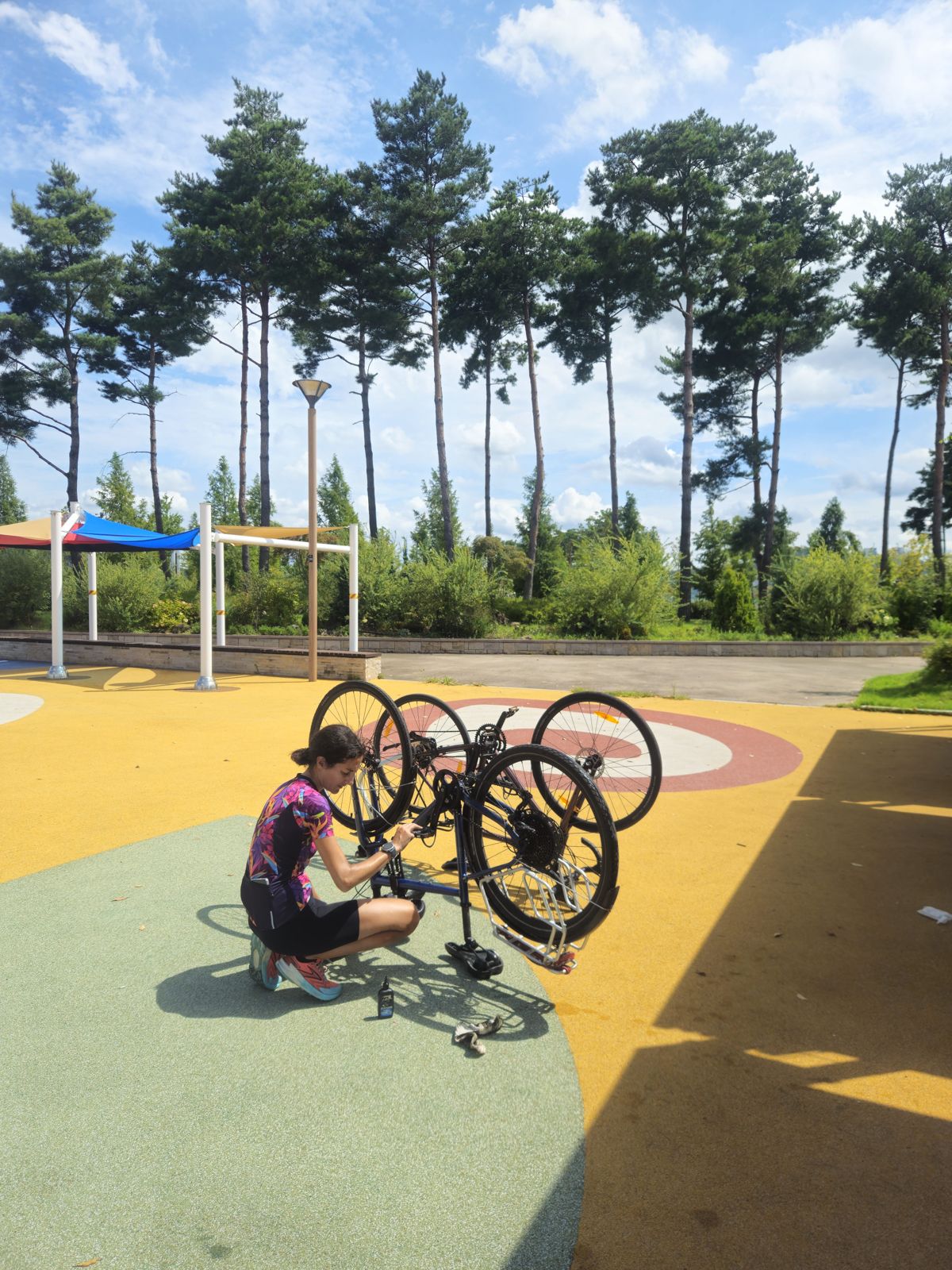
The city has only four hotels and they're unaffordable, so we won't stay. Still, it's intriguing to wander the immaculate streets of such a new city. Sejong Central Park is huge; it would take a good day to walk all the way round. Of course it has a superb playground, which prompts a long stop. The facilities are brand new and as clean as a four-star hotel. There's even a small air-conditioned shelter with cold-water fountains. We take the opportunity to clean the bikes' chains, which are also suffering from the climate. On the whole, we're very happy with our bicycles, which are holding up well throughout this journey.
We've been playing tag with the storm since this morning and it can't catch us. We do have to shelter for a few minutes after leaving Sejong, though, as a curtain of rain pours down before our eyes. Fortunately it closes again quickly and we dodge the drops all the way to Jochiwon, our destination for tonight. We're 40 kilometres from Sejong, and this little town isn't really a town as such but rather a district of Sejong. Korean towns can be very different from one another, and this one leaves us with an odd impression. People stare at us, cars drive fast and are parked everywhere, and we don't feel like hanging around.
We take the bikes to do another load of washing, then go to eat at a dak-galbi restaurant. It's one of the first dishes we tried in our first days in Seoul: pieces of chicken marinated in a spicy gochujang (chilli paste) sauce, stir-fried with vegetables like cabbage and sweet potato and rice cakes (tteok). You can also add melted cheese, fried rice… The staff cook it on a burner set right on the table, which makes it a very convivial experience. Koreans have a particular notion of spicy, because even when you ask for a dish that isn't hot, the food still attacks your palate. We head back to the hotel fairly late, but on purpose: we're trying to shift Clémence's body clock ahead of our flight on 9 September, to soften the jet lag as much as possible.
Tuesday 2 September
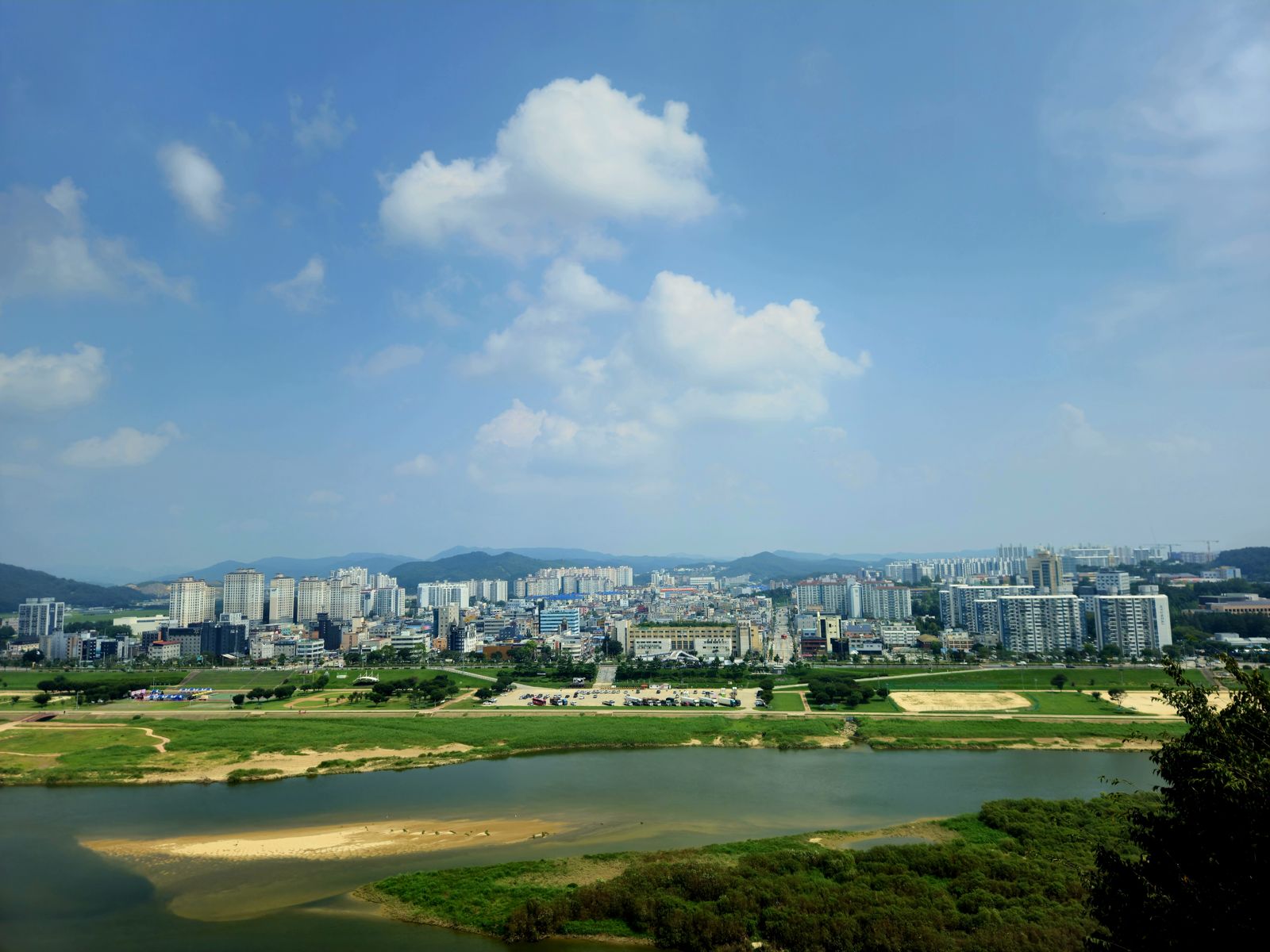
South Korea has a very different approach to urban planning from ours. There's no urban sprawl or detached houses with gardens. Cities are very dense and compact, with big tower blocks whose numbers are painted huge on the façades, probably to help everyone find their way. These big estates often concentrate lots of facilities in the middle, and we've often enjoyed their playgrounds. This compact layout gives the landscape character, because a few pedal strokes take you into open countryside.
We wind along a small river between the hills, with the ever-present rice paddies for company. We often see old women working in the fields, sitting on little rubber stools strapped around their waists. It gives them a funny look when they walk, with that bump at the back, but it looks comfortable when they're sitting on it. The weather hasn't missed the switch to September, as it's miraculously less hot today. In fact it isn't hot at all; the air we stir up as we pedal is cool, which amazes us.
We're less enchanted by the string of bridges under construction that we pass. Since leaving Seoul, we must have seen at least fifty, sometimes only two hundred metres apart, like this morning. You'd think building bridges is what people do here when they're bored. What annoys us most is that the lorries often wreck the cycle path, and the one we're on is no exception. It's actually destroyed: the machines have smashed the tarmac and we have to ride through mud for several hundred metres.
That's not going to stop us, and we reach a small village where we have Western food for lunch before carrying on to today's hotel. The location isn't great, right beside a major trunk road. Part of this country's magic is that hotel rooms are often ready very early, in our case before 2 pm. We can recharge before visiting the Independence Hall of Korea three kilometres away. It's not in any guidebook, yet its sheer scale is worth the detour. The whole site is devoted to the glorious day when the independence fighters finally got the better of the Japanese, with help from China and the international community: 15 August 1945.
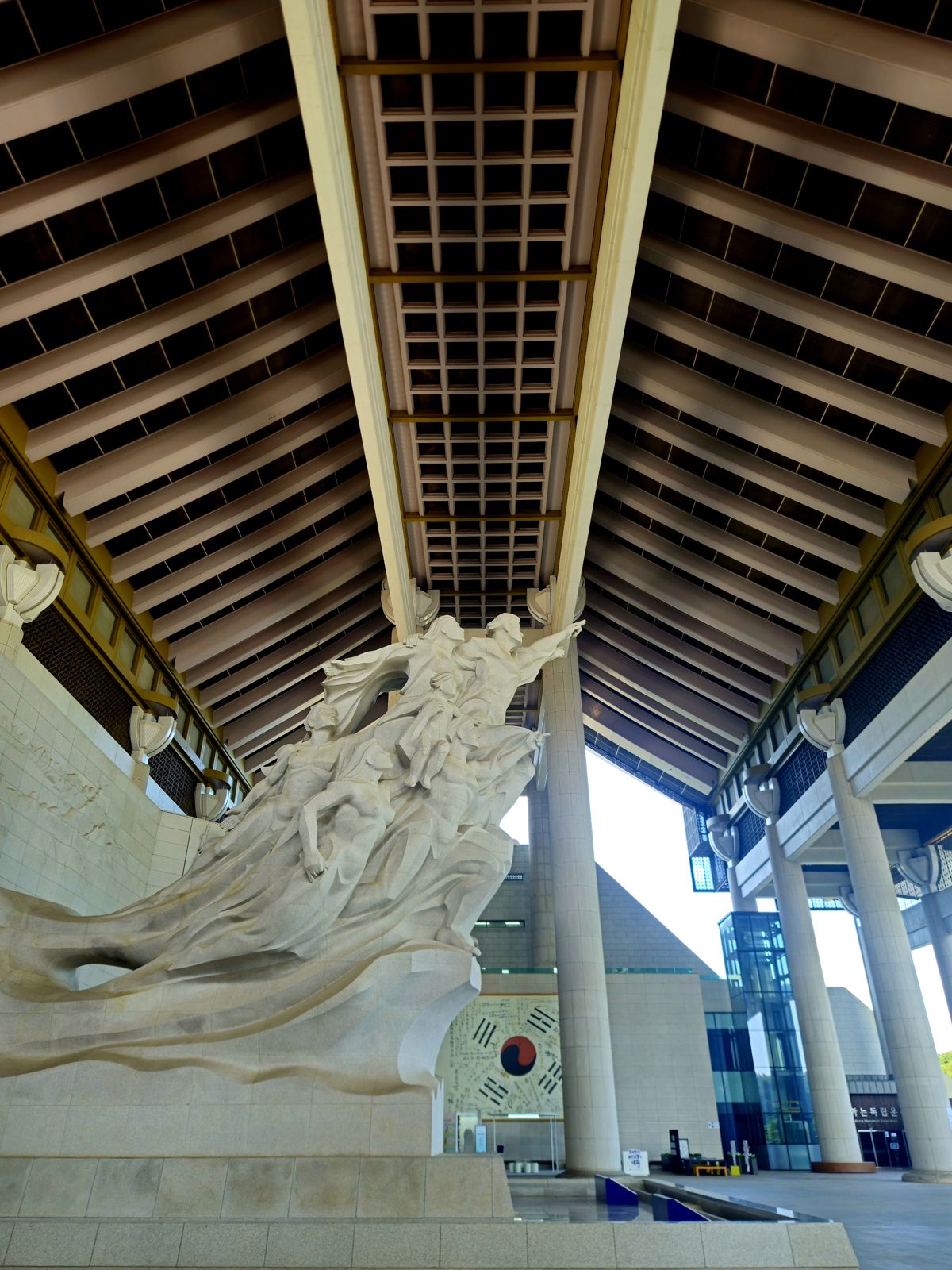
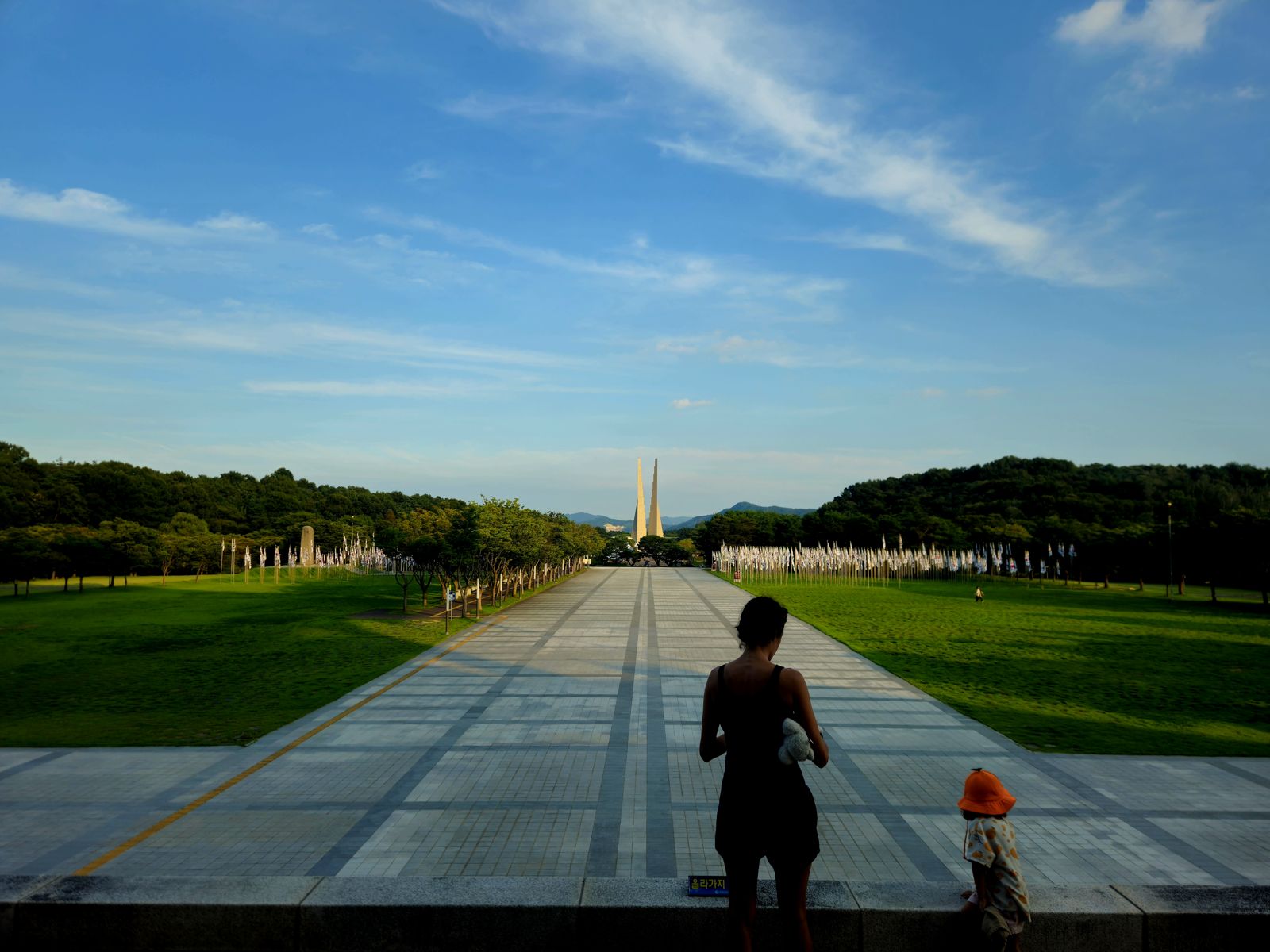
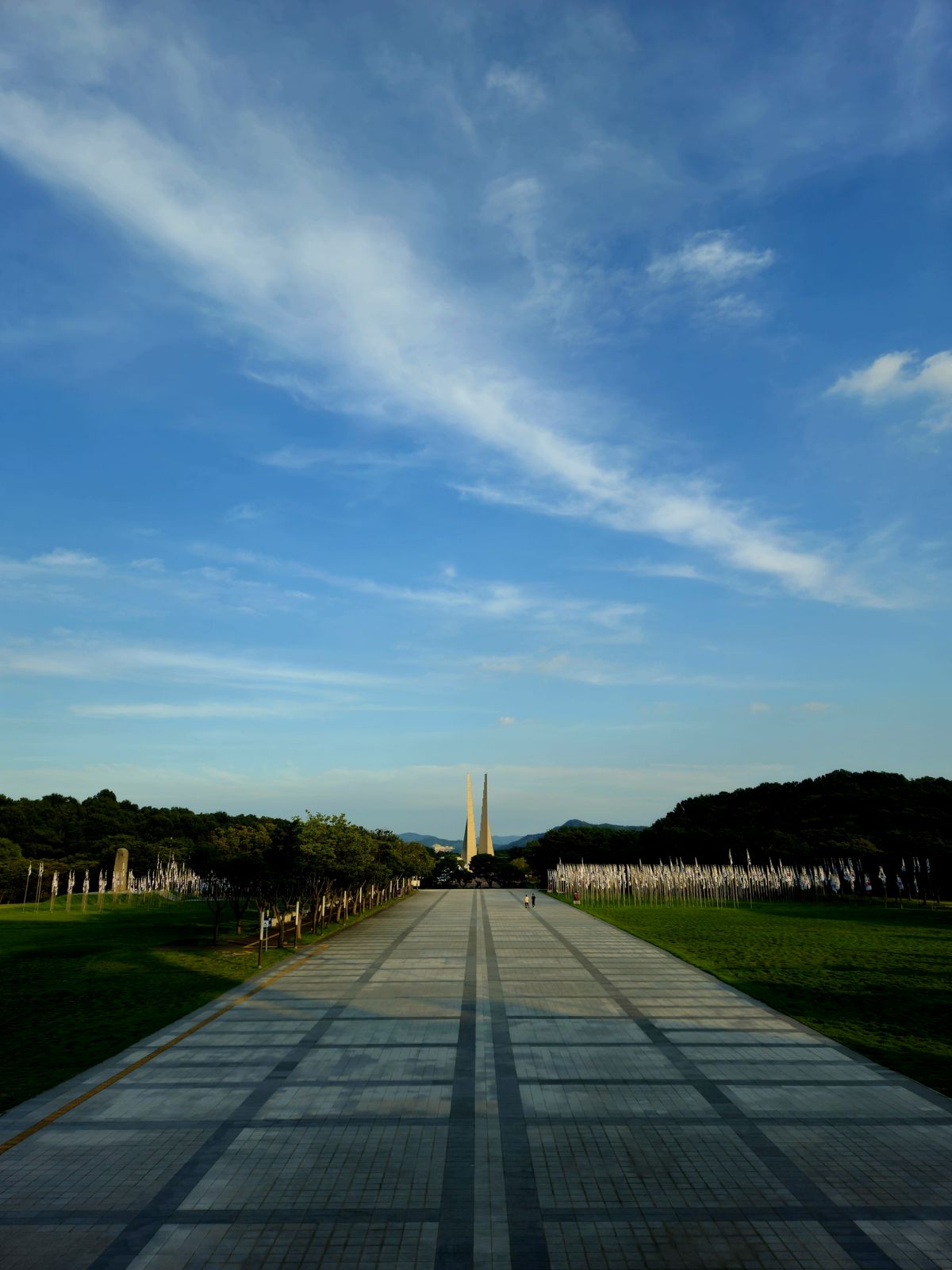
Of course we don't have time to see everything, but we learn a lot about the birth of the various independence movements, the origin of the Korean flag, the establishment of democracy and the unfortunate division of the country. There's even a garden for unification, a sign that the South hasn't forgotten its northern neighbour. The vast majority of South Koreans support a return to a single country. Remember that the peninsula was united for more than a thousand years before Russian and American interests split it in two in 1948. But history sometimes takes surprising turns, and in the Land of the Morning Calm, people always allow themselves to dream.
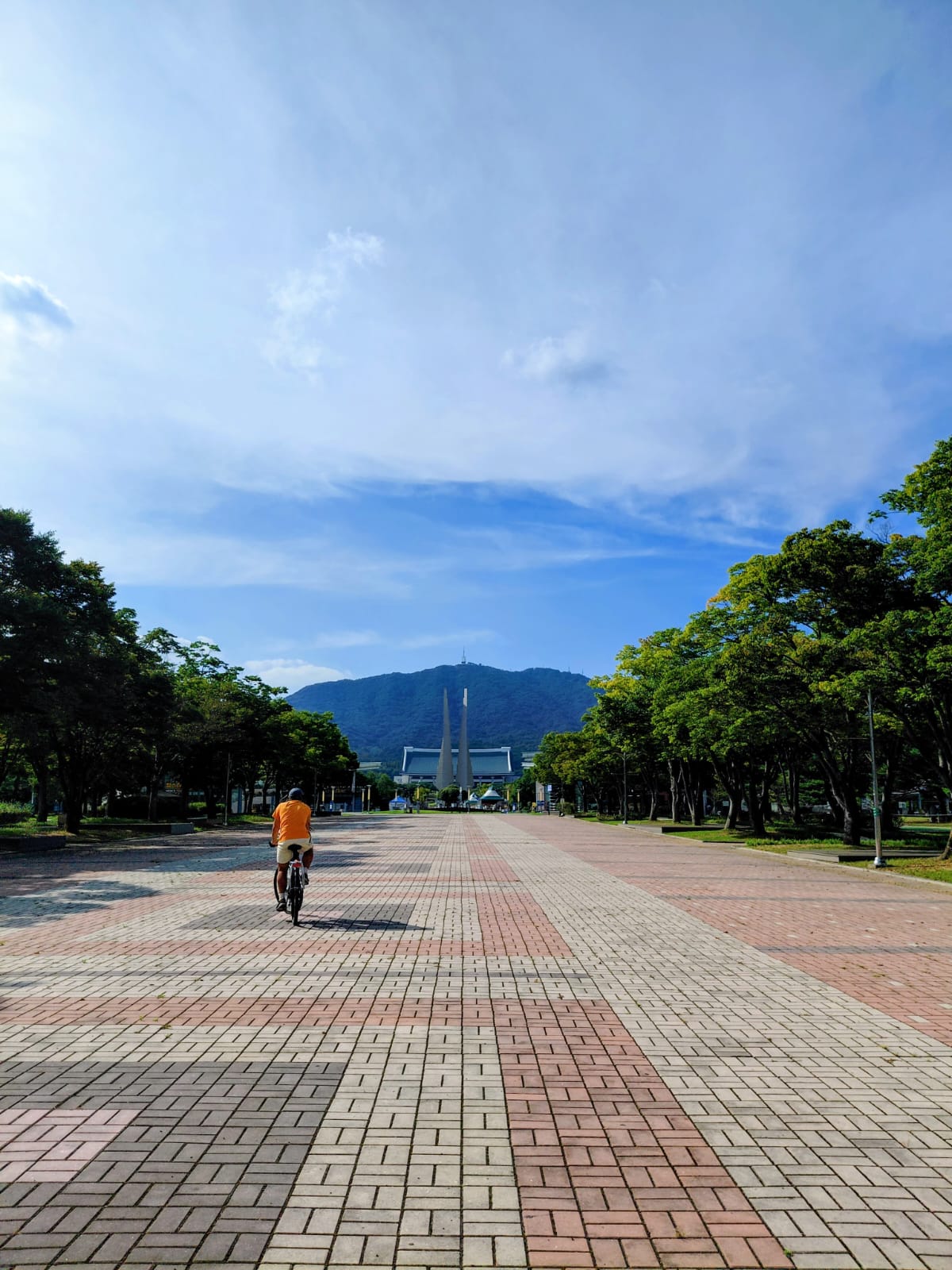
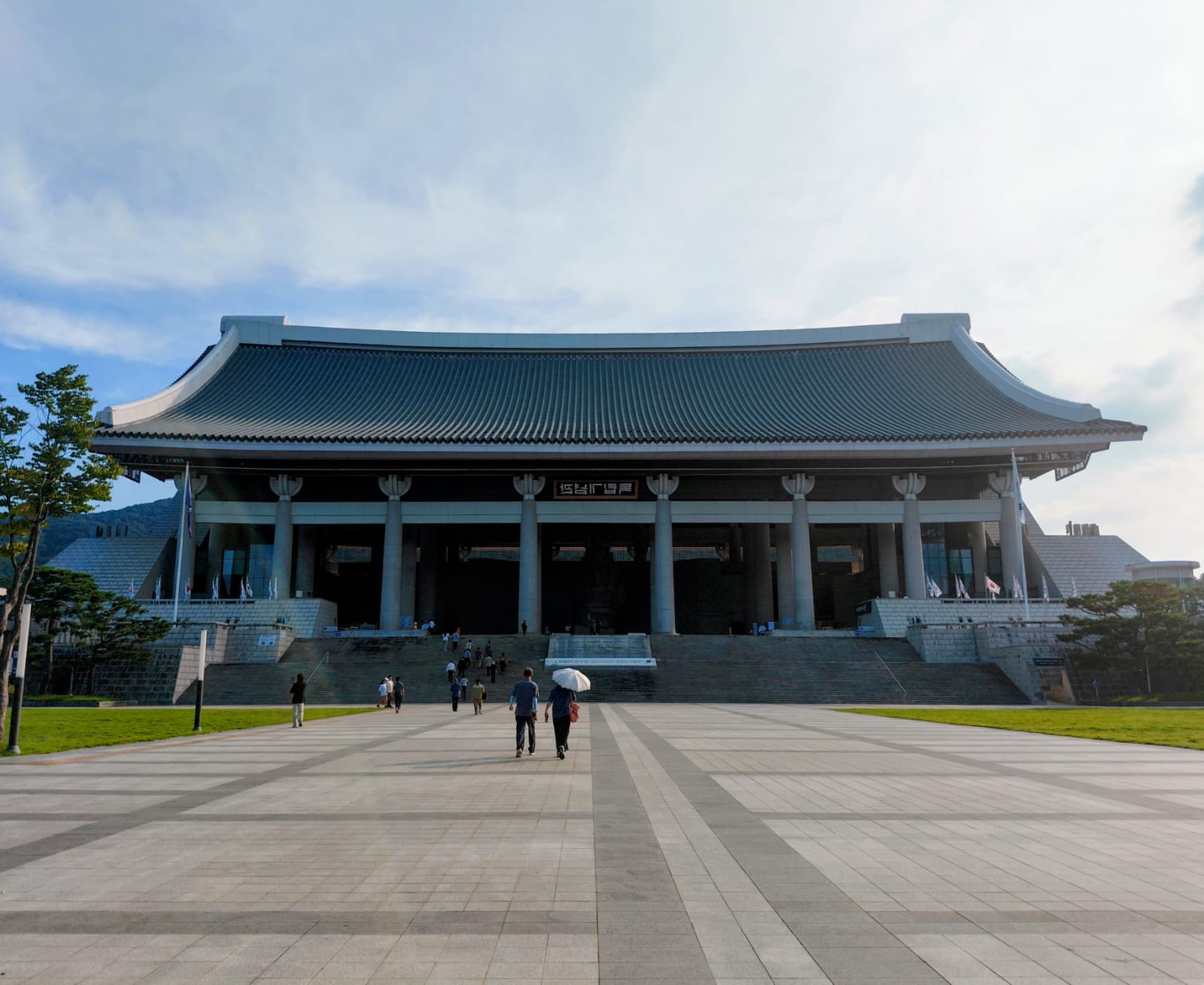
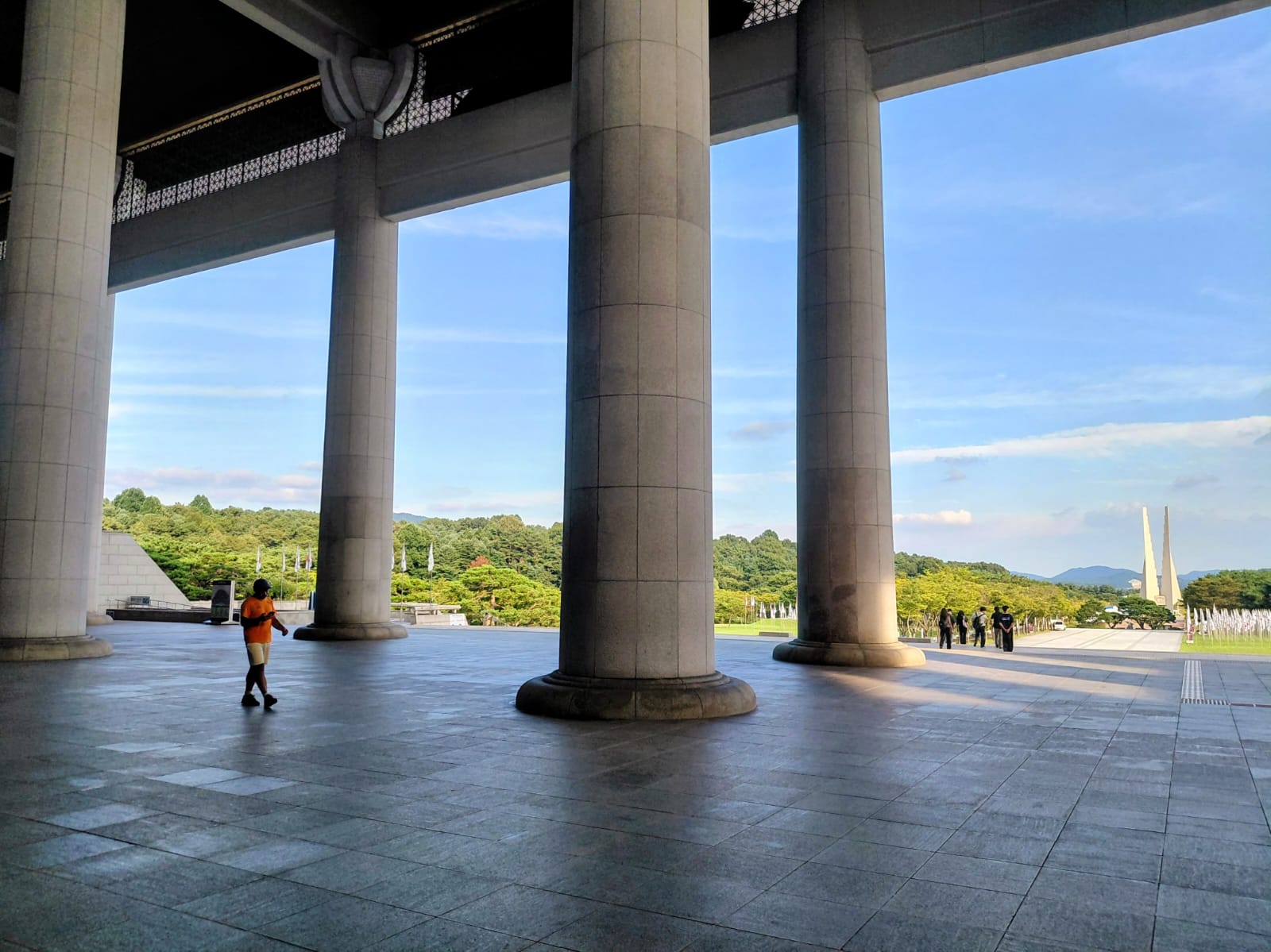
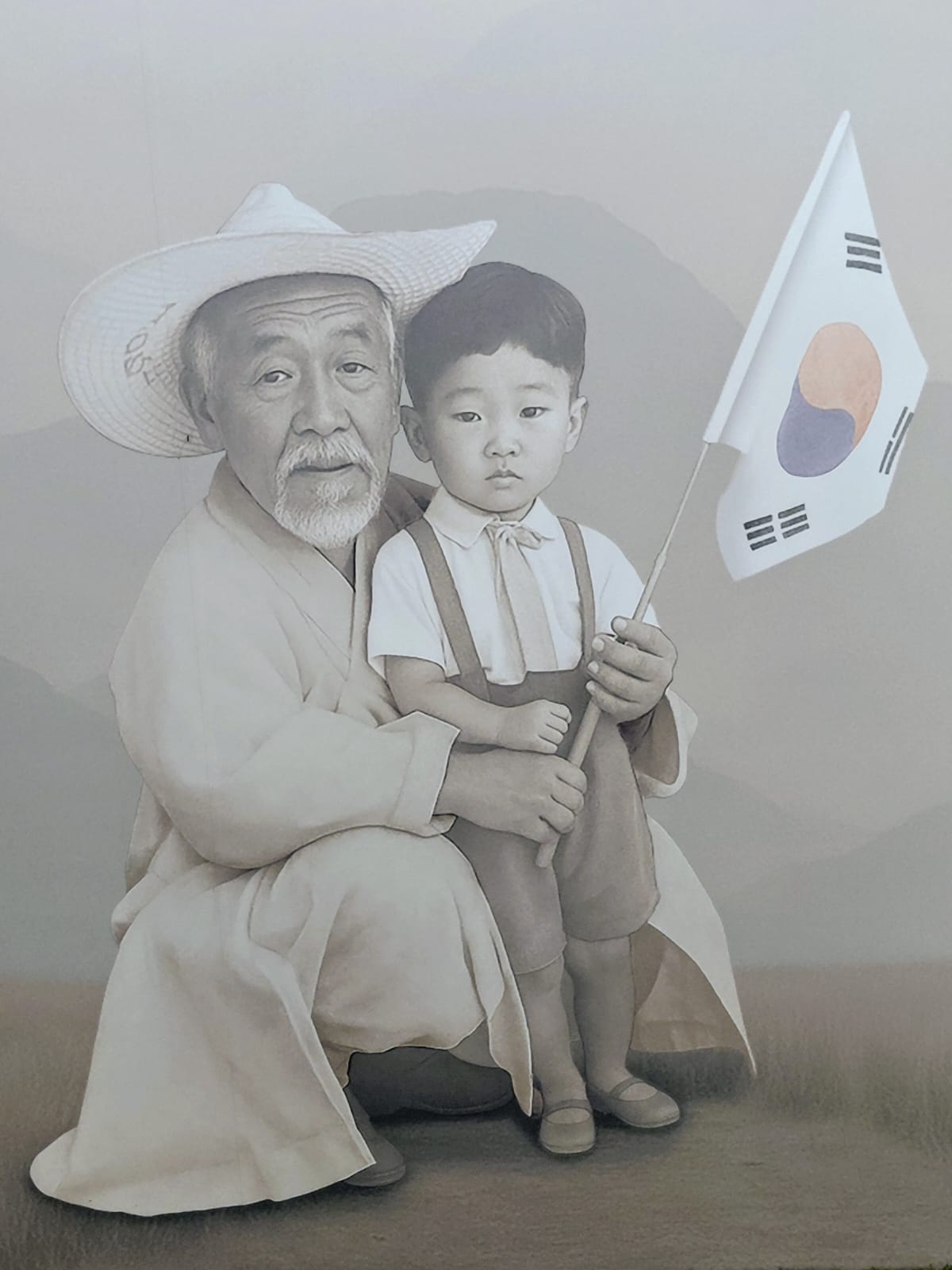
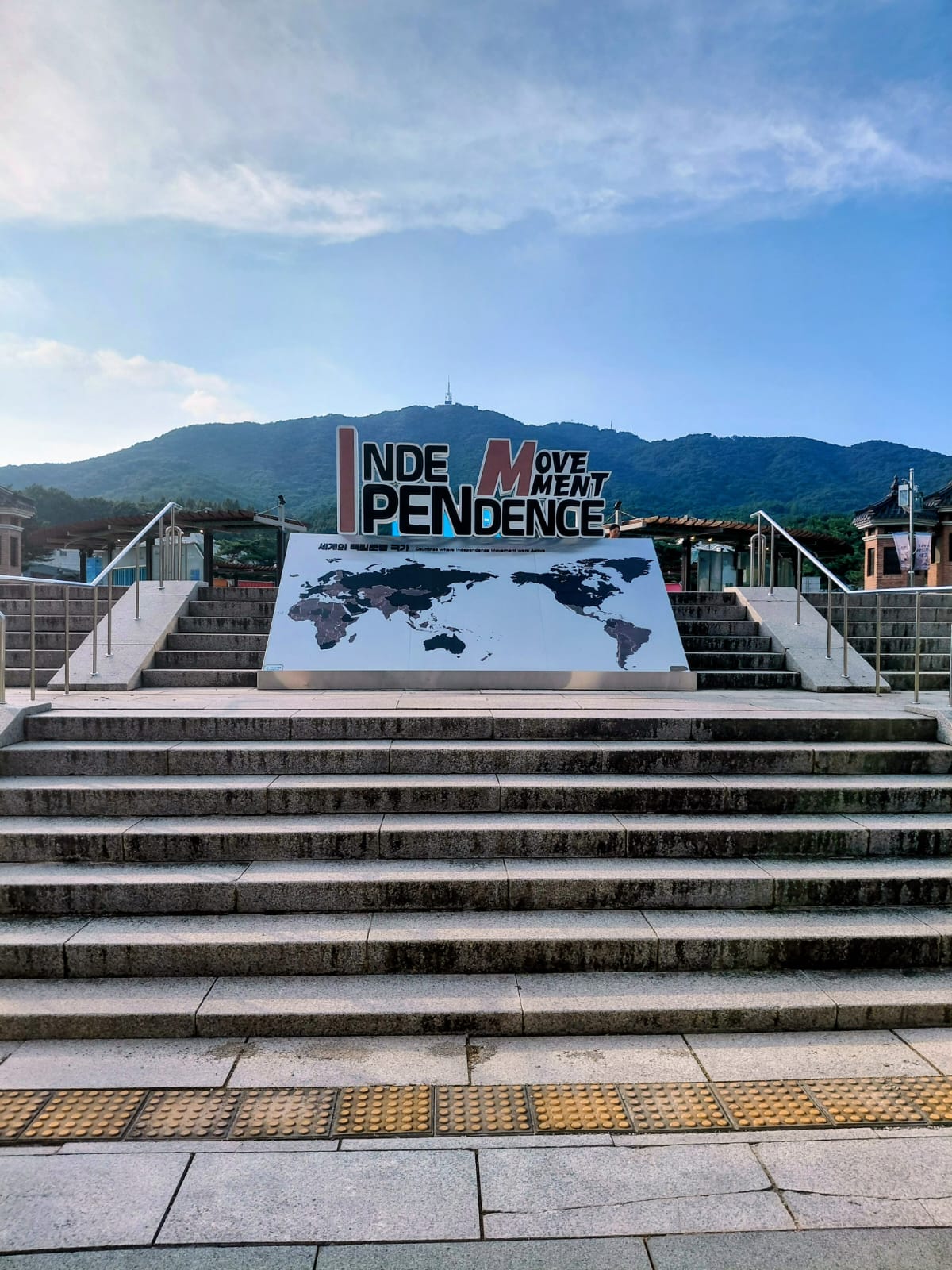
The site also has a big playground, a large pond full of gigantic carp, a fountain with water jets, an exhibition hall just for children… All of which means you could easily spend the day there. At closing time, we get back on the bikes to return to the hotel and shower before eating at the local KFC.
On the road