
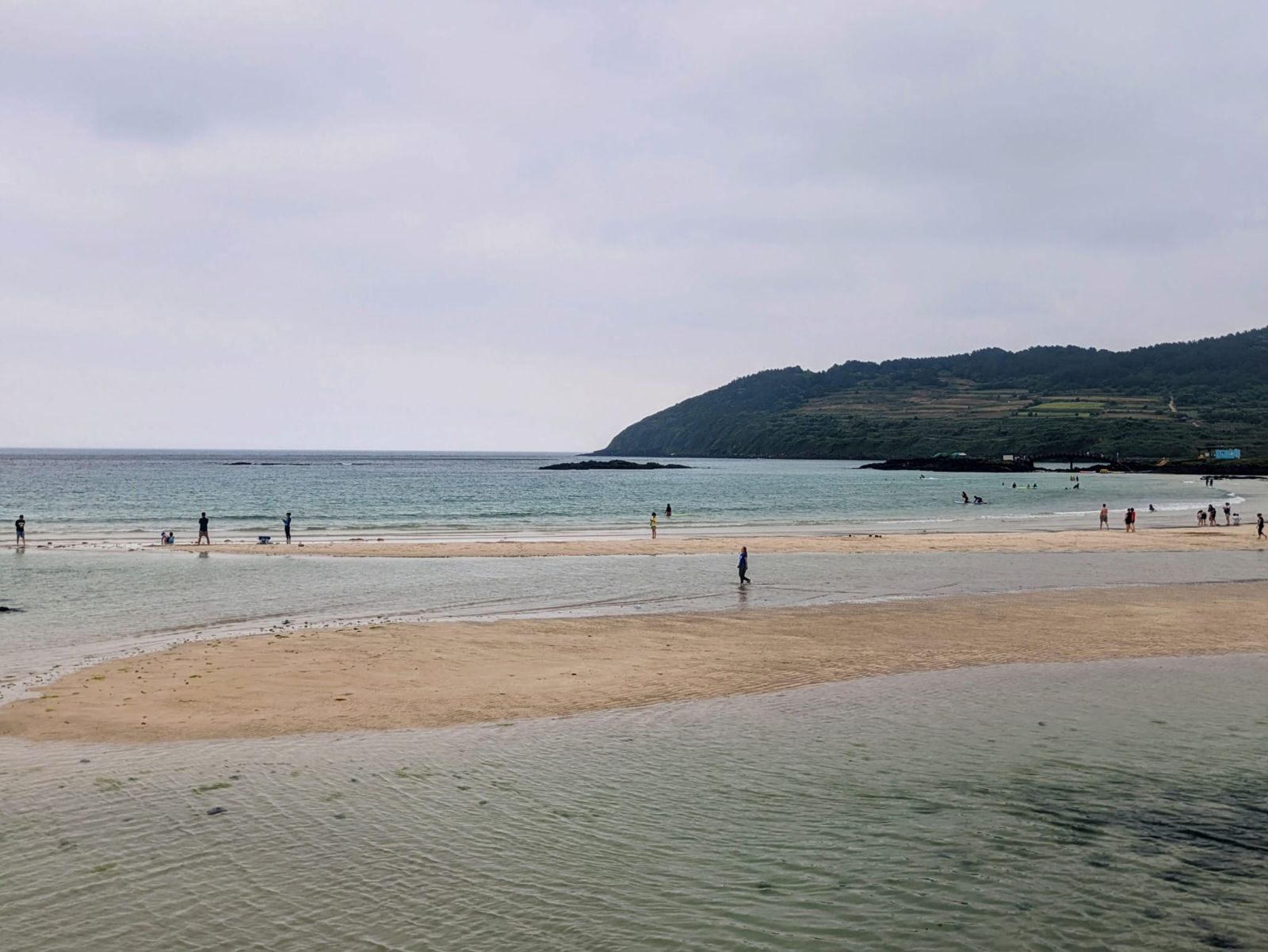
 ← PreviousJeju, continued and concluded
The day ferry from Fukuoka in Japan to Busan in South Korea has the immense good taste to leave at 12:30. For a while now we've been doing our best to ban early-morning departures, as they cause tiredness and insomnia. Instead, we wake up naturally and let Clémence surface in her own time. Lately she's been asking after every journey whether we're in South Korea; she can't wait to go back either. We have breakfast in the room and delay leaving a little, as the rain returns at ten.
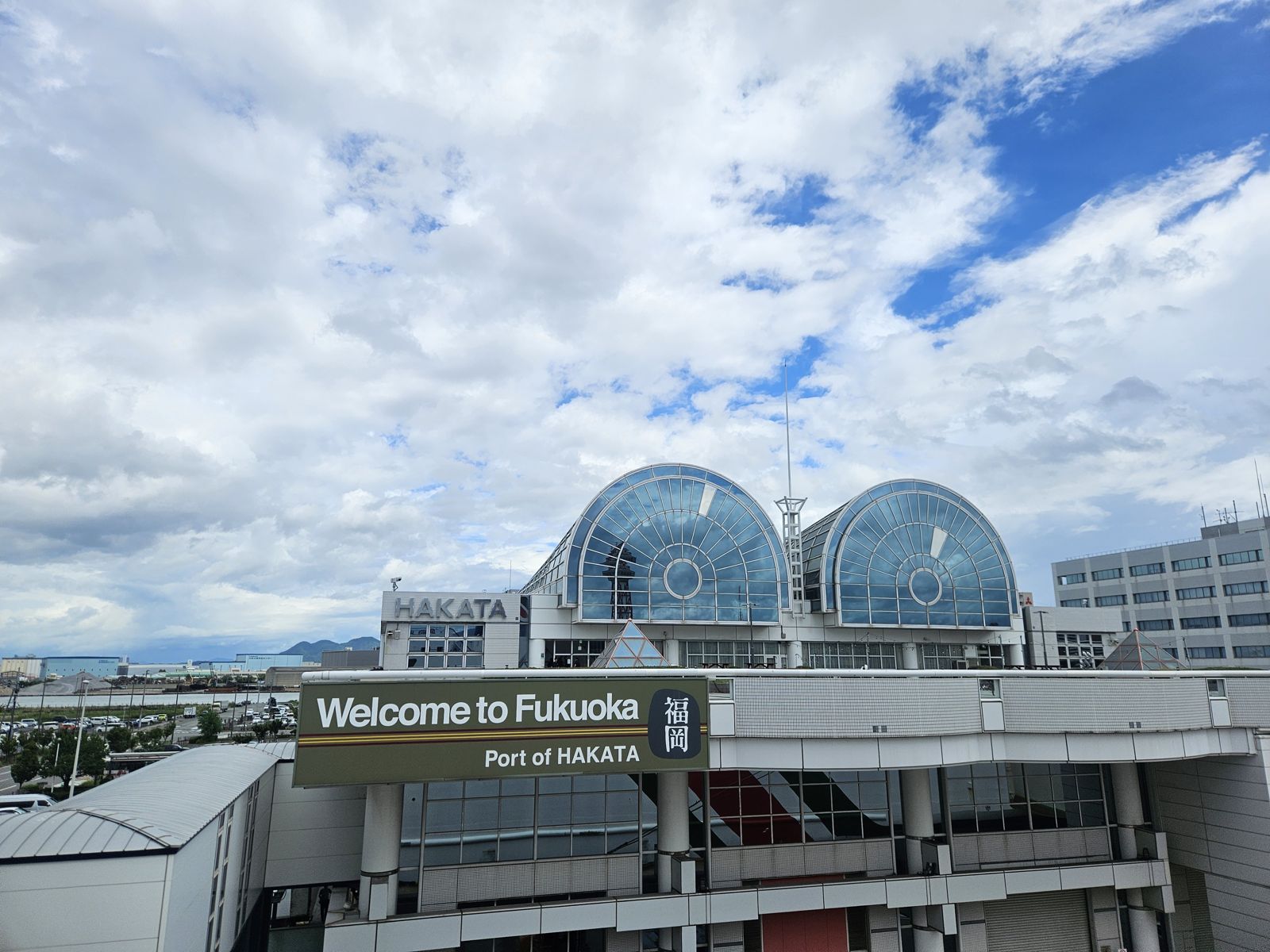
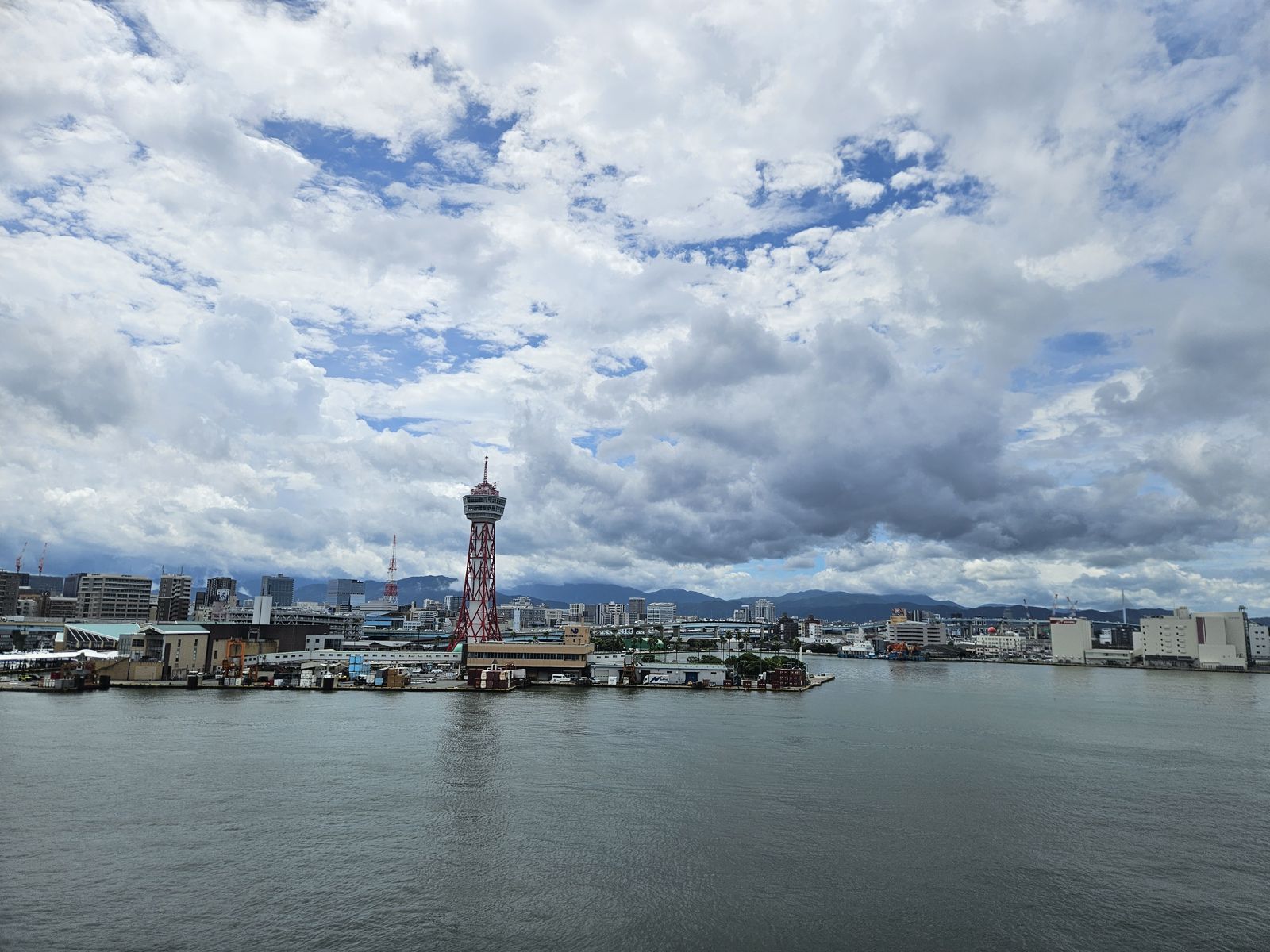
It's only a passing shower, and soon we're on our bikes heading for the port, just two kilometres away. Signs in Roman letters aren't great, and it takes us a while to find the exact location of the terminal. When we walk in, a medium-sized queue has already formed for check-in. Our tickets are already booked, and when our turn comes we only have to hand over our passports to get our physical tickets. Checking in the bikes goes smoothly too: we take them to a counter where a young man takes them in exchange for 3,000 yen (€15). It's infinitely simpler than flying, and our buggy-trailer goes free, which still leaves us baffled about Amakusa, where we had to pay 1,000 yen for a fifteen-minute crossing.
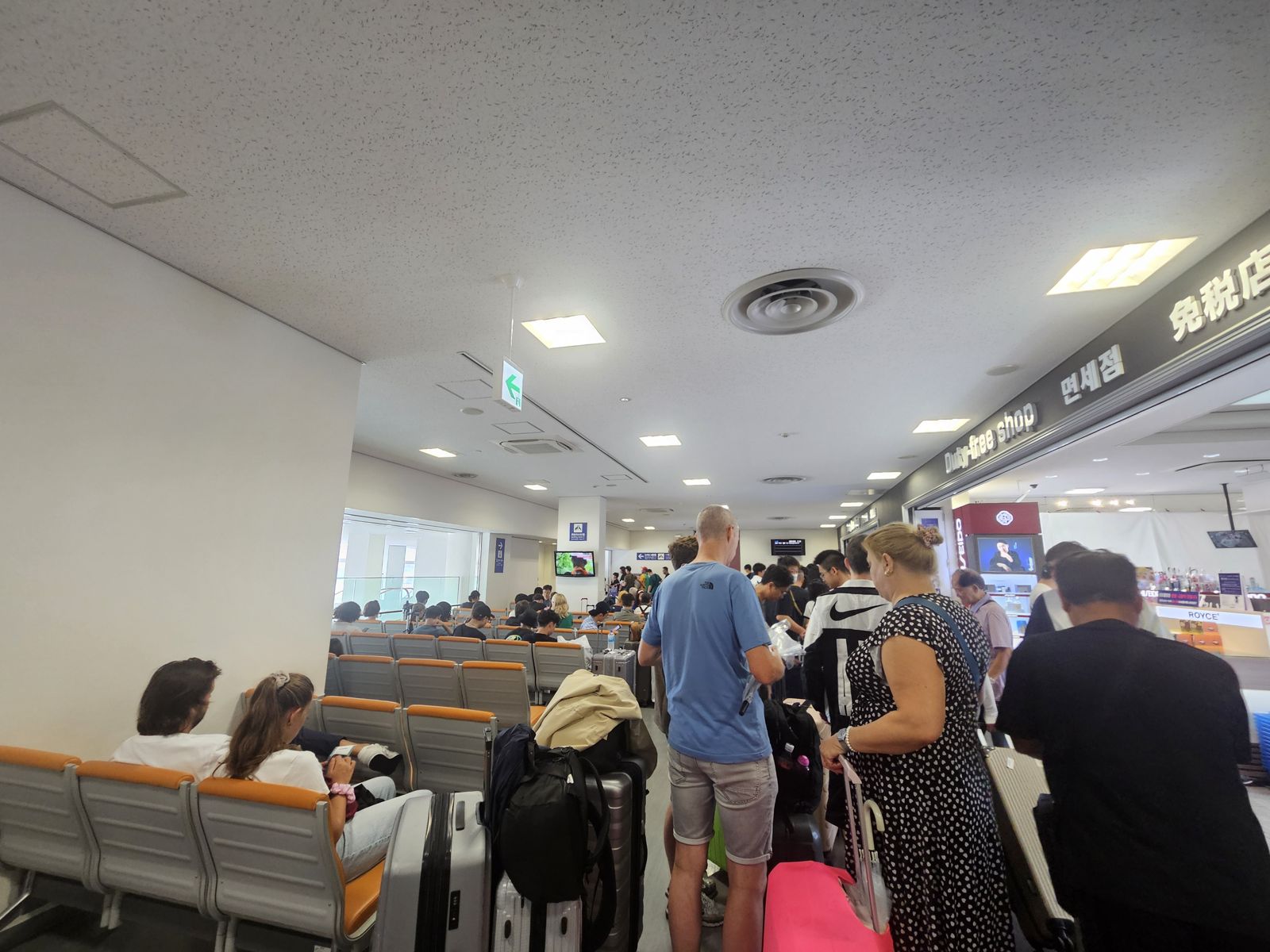
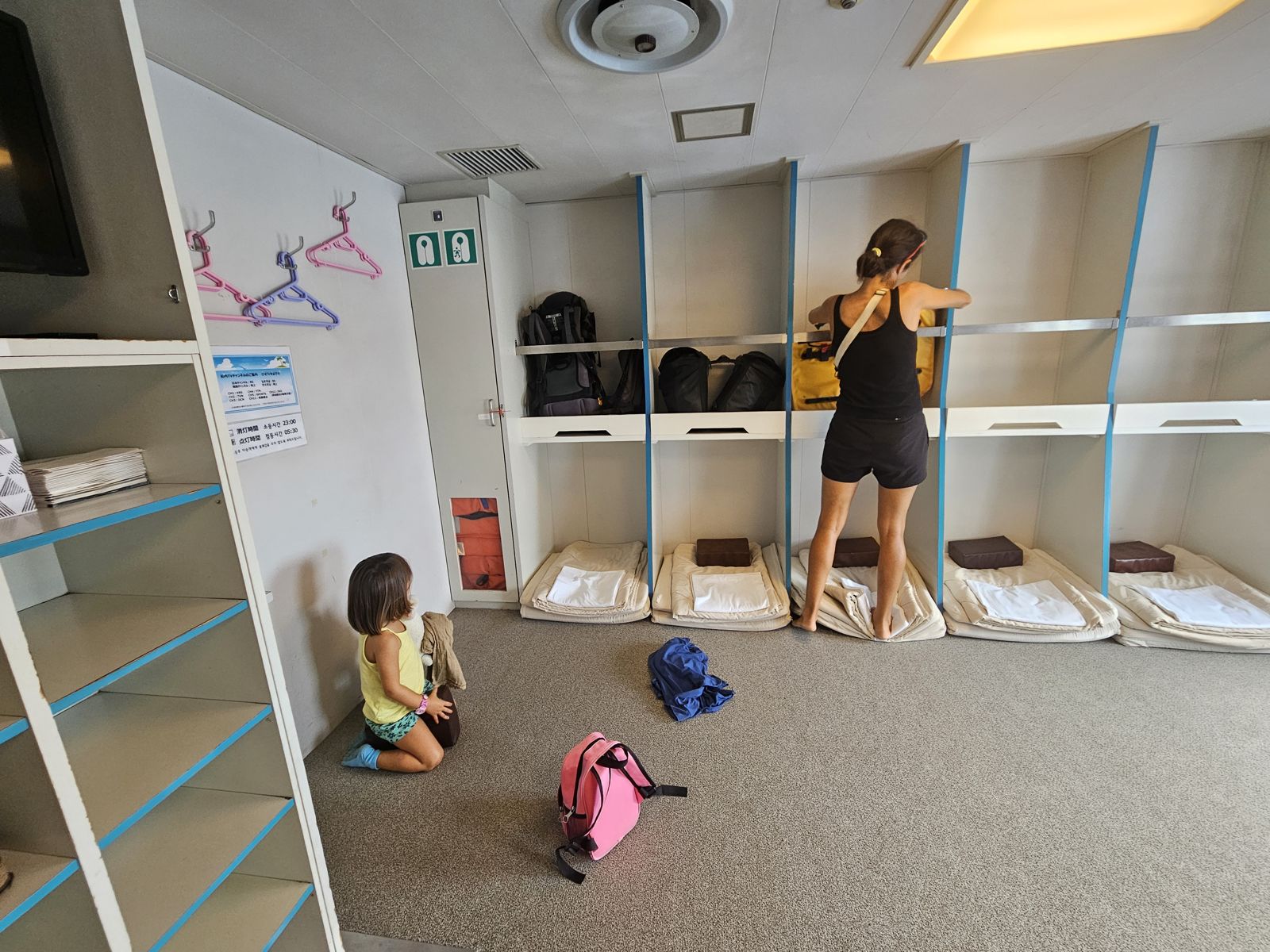
The boat is very big, and with our cheapest tickets we have three spots with small mattresses to lie down on in a dormitory cabin if we want. There are ten places in our room, but only a young tourist couple is with us. In any case we don't hang around and go to explore the ferry. There isn't much in the way of entertainment: a tiny arcade and several lounges with sofas. We discover that the onboard restaurant is closed on day crossings. This boat shuttles constantly between Busan and Fukuoka, and the opposite crossing is at night.
We still struggle to understand the logic of not offering meals to passengers who have to be at the port by 11 and are therefore bound to be on board at lunchtime, and we're not the only ones. Koreans and Japanese seem better informed, as they all have ready meals that they heat up. A tiny shop sells crisps, biscuits and noodles, so we set nutrition aside, to the great delight of Clémence, who loves crisps.
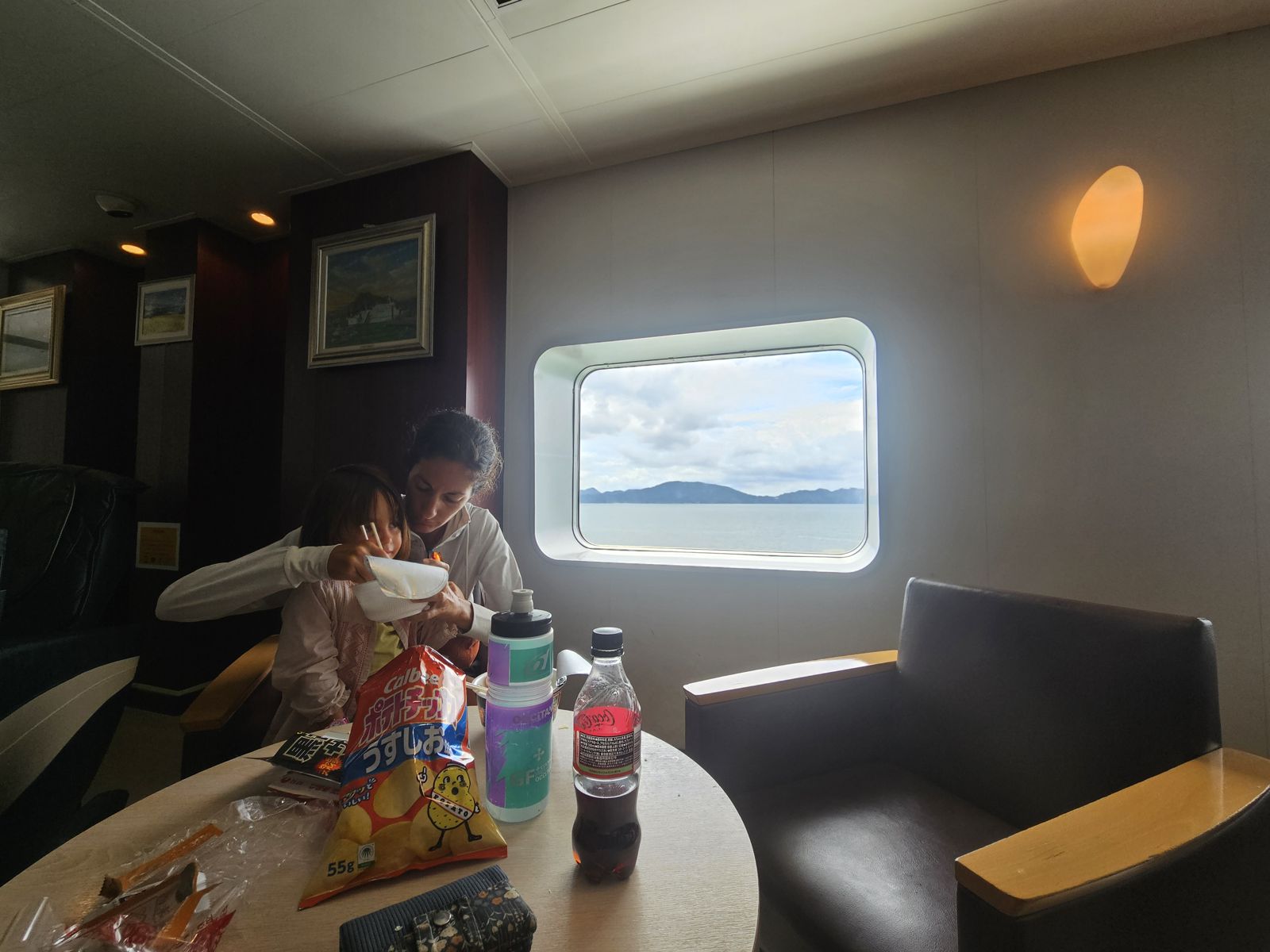
Time passes slowly at sea and there's no internet on board. Boredom is written on people's faces, and we try as best we can to keep Clémence busy. We go through our whole repertoire of games. Out at sea, the boat, huge as it is, starts to really roll and Stéphane doesn't feel too good. We go and lie down, hoping Clémence will nap. She rests for half an hour, quietly under her little sheet, but doesn't fall asleep. Our dormitory is empty for now, so she takes the opportunity to do somersaults, tickle Cassandre and run in all directions.
When our roommates for the day come back, we move to the panoramic lounge at the front to leave them in peace. And after almost six hours of monotonous travel, we finally make out Busan standing out among the hills in the distance. Excitement spreads through the passengers, who all start bustling about. With a single staircase and a single lift, getting everyone off isn't fast, but it's efficient. We go through customs as at an airport and collect our bikes, waiting patiently behind. The whole process still takes almost an hour. By the time we've put the panniers and trailer back on, we're almost the last out of the terminal, only to discover… that it's pouring cats and dogs. The rain really won't leave us alone. We feel cursed and sigh at the thought of riding in it soaked to the skin yet again. Luckily it soon eases, and when we start pedalling it's raining relatively little.
Fortunately, Koreans deserve credit for their urban planning. A pedestrian bridge connects the ferry terminal to the main station, almost a kilometre away. We have to take a lift down to the cycle path below. It takes three trips to get everything down, but the lift is wide. The cycle path drops us 200 m from our hotel, where they're expecting us. When we arrive, the old man shows us where to park our bikes, then hands us the room key card. We'd forgotten things could be this easy. In Japan we had to show our passports, fill in paper forms and always give a Japanese address and phone number. Sometimes we even had to do video checks.
The room is huge, almost the size of a flat. We're back to the comfort and cleanliness of Korean hotels. Here they always provide free coffee, water, tea and lots of toiletries. After a quick shower and hanging up our rain gear to dry, we go to the pub next to our hotel for pizza. It's a strange feeling, like coming back to familiar ground. Despite our trials with the rain, we're very happy to be back in Korea. It's late for Clémence, so we don't linger and head back to our room around 10 pm.
Wednesday 13 August
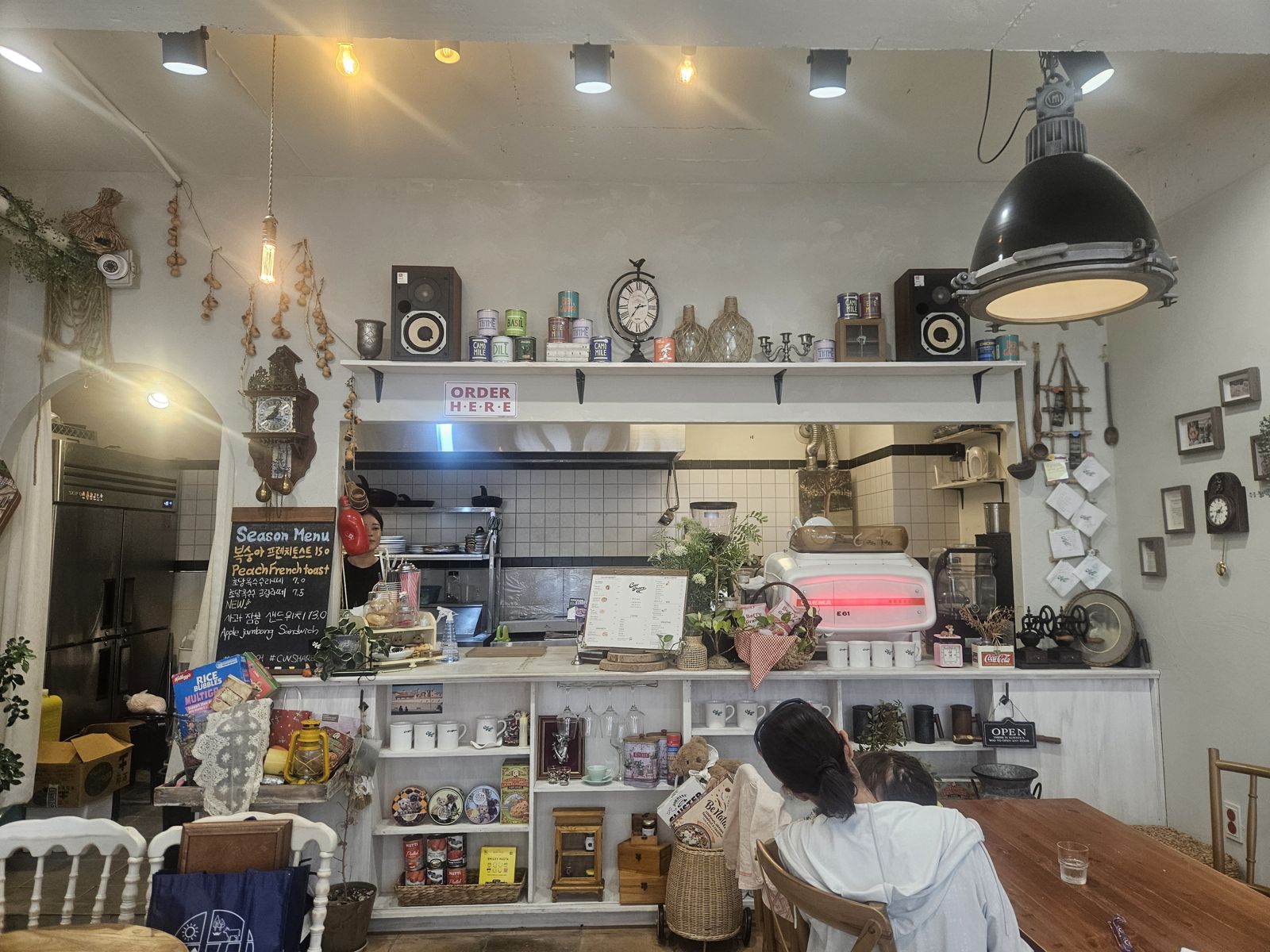
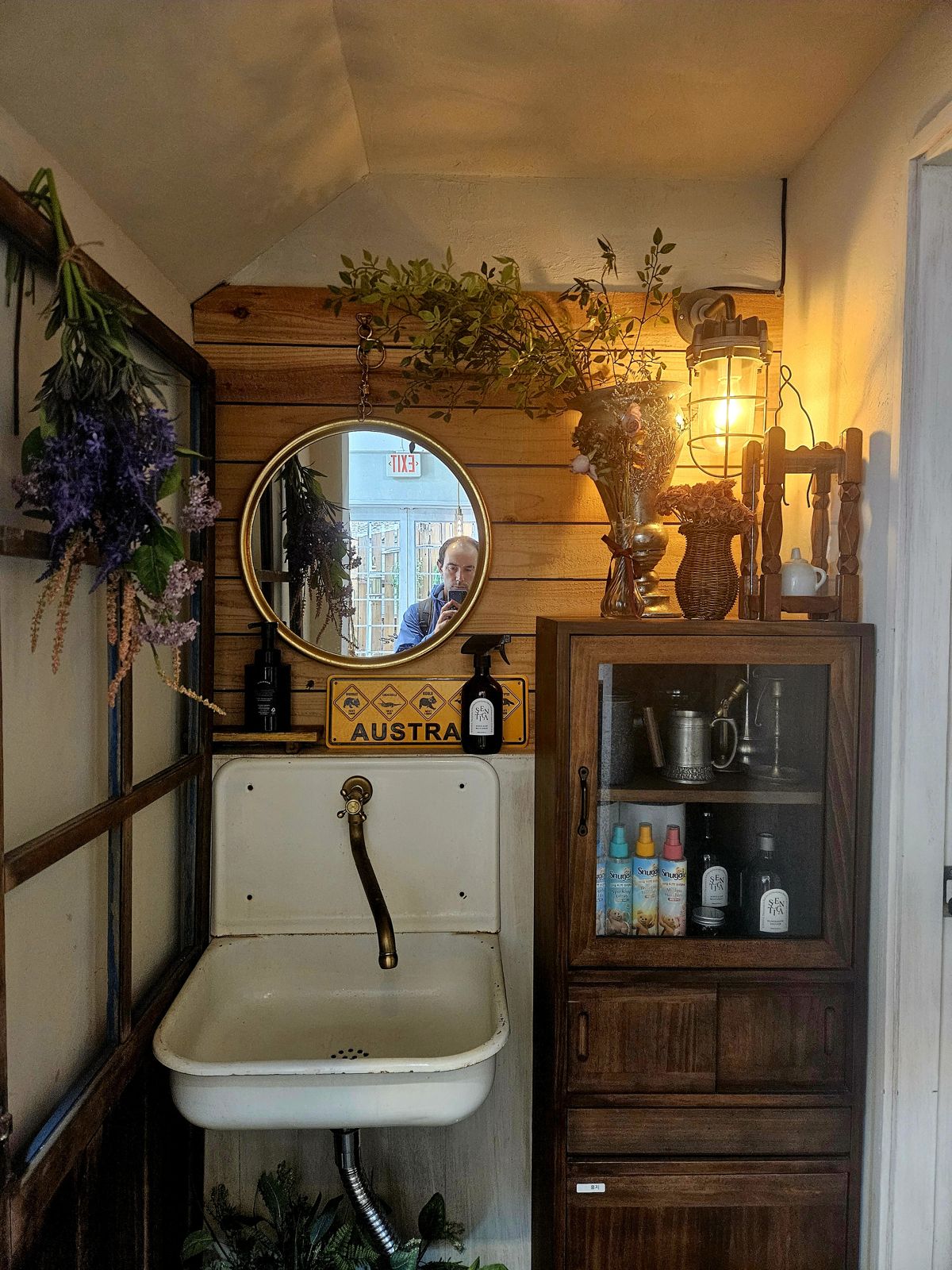
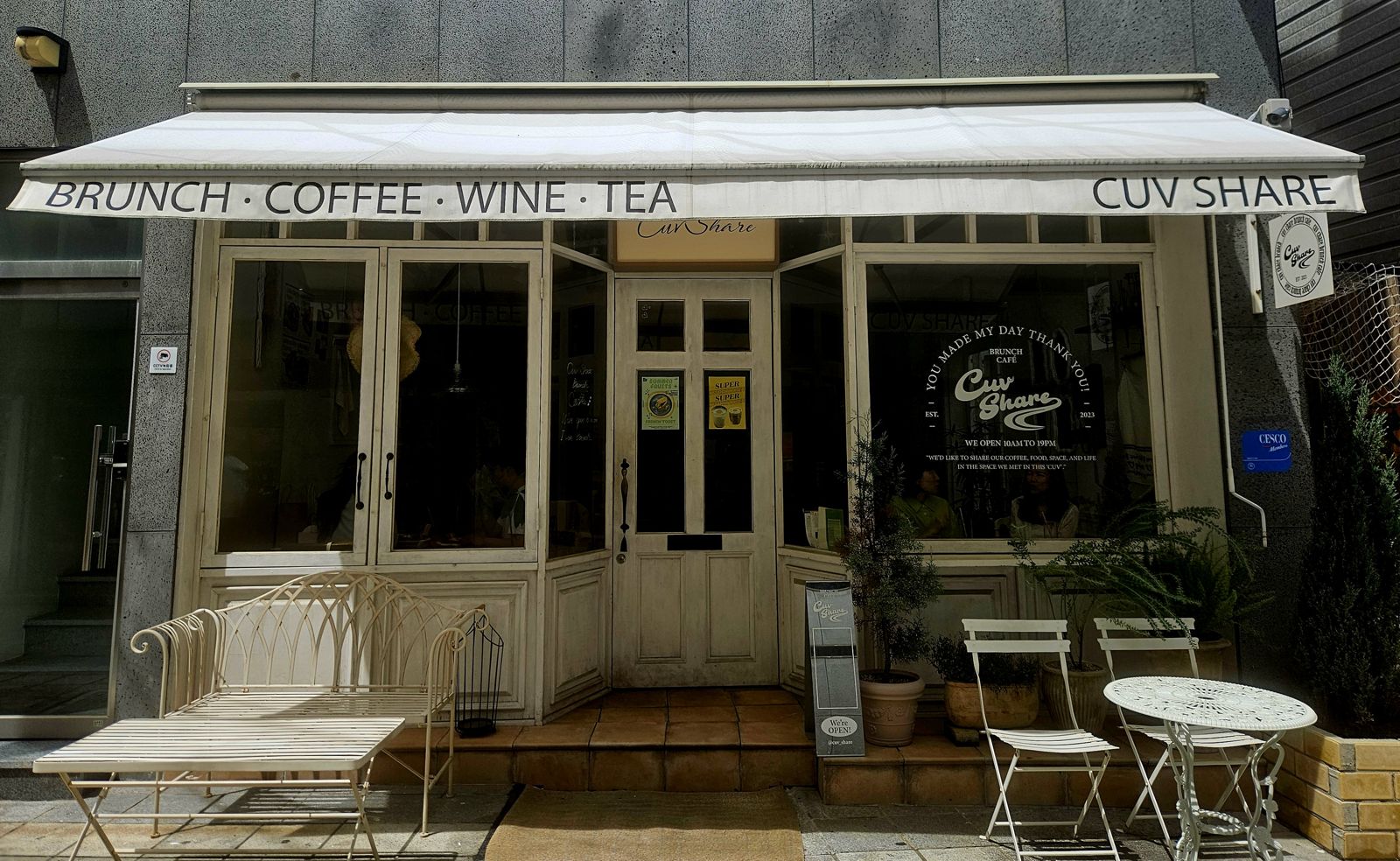
It's past 9 when we surface. No particular plan today, so we take our time. Stéphane and Clémence have a bath, and we only leave our room around 10:30 to have a brunch-style breakfast in a very cosy café in our neighbourhood. We're also very happy to be back in pretty Korean cafés. In Japan they were often small, rather dark and narrow. What's more, Japanese cafés very rarely serve hot chocolate, much to Clémence's dismay. We feast on French toast, an American breakfast plate and hot drinks.
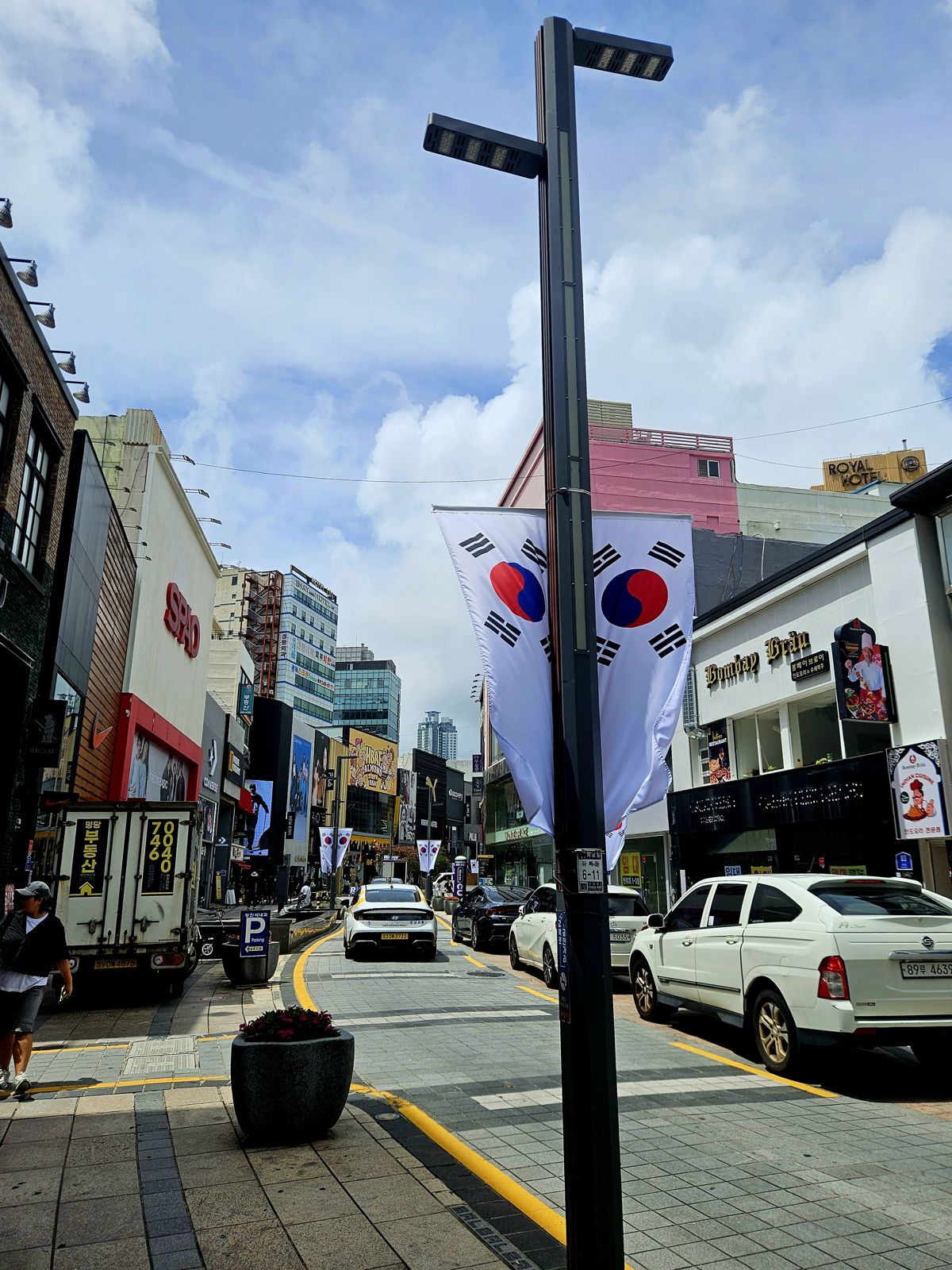
One of the notable differences between the two countries now jumps out at us. The Japanese like to shut themselves away in individual enclosed spaces, so you can rarely see inside places from the outside. In South Korea, cafés and restaurants almost always have big picture windows and little terraces, a concept that doesn't exist in Japan. It immediately gives a friendly, welcoming feel that we're happy to find again. The endless kindness of Koreans towards children isn't long in coming: the café waitress gives Clémence a sweet.
We then go round the shops to find Cassandre a phone. If you've been following our adventures, you already know hers didn't survive the deluge we had to face two days earlier. Specialist shops only sell the latest models, which doesn't suit us at all. She doesn't need the very best, just a phone that works. We find what we're after in a big Samsung store where the saleswoman speaks almost perfect English. To pass the time, Clémence and Stéphane draw in a colouring book bought that morning. One of the sales assistants, seeing this, gives Clémence a little set of coloured pencils.
It's a strange feeling: coming back to Korea feels like returning to our comfort zone. The country's culture probably suits us better. We eat in a restaurant, then Cassandre takes Clémence to play in a kids' café. After yesterday's monotonous day, we've decided to dedicate today entirely to her. For her age she really adapts perfectly to every situation, and she's made huge progress in managing her emotions in three months. She now fully expresses her needs and wishes, and she has to be very tired to cry for no good reason.
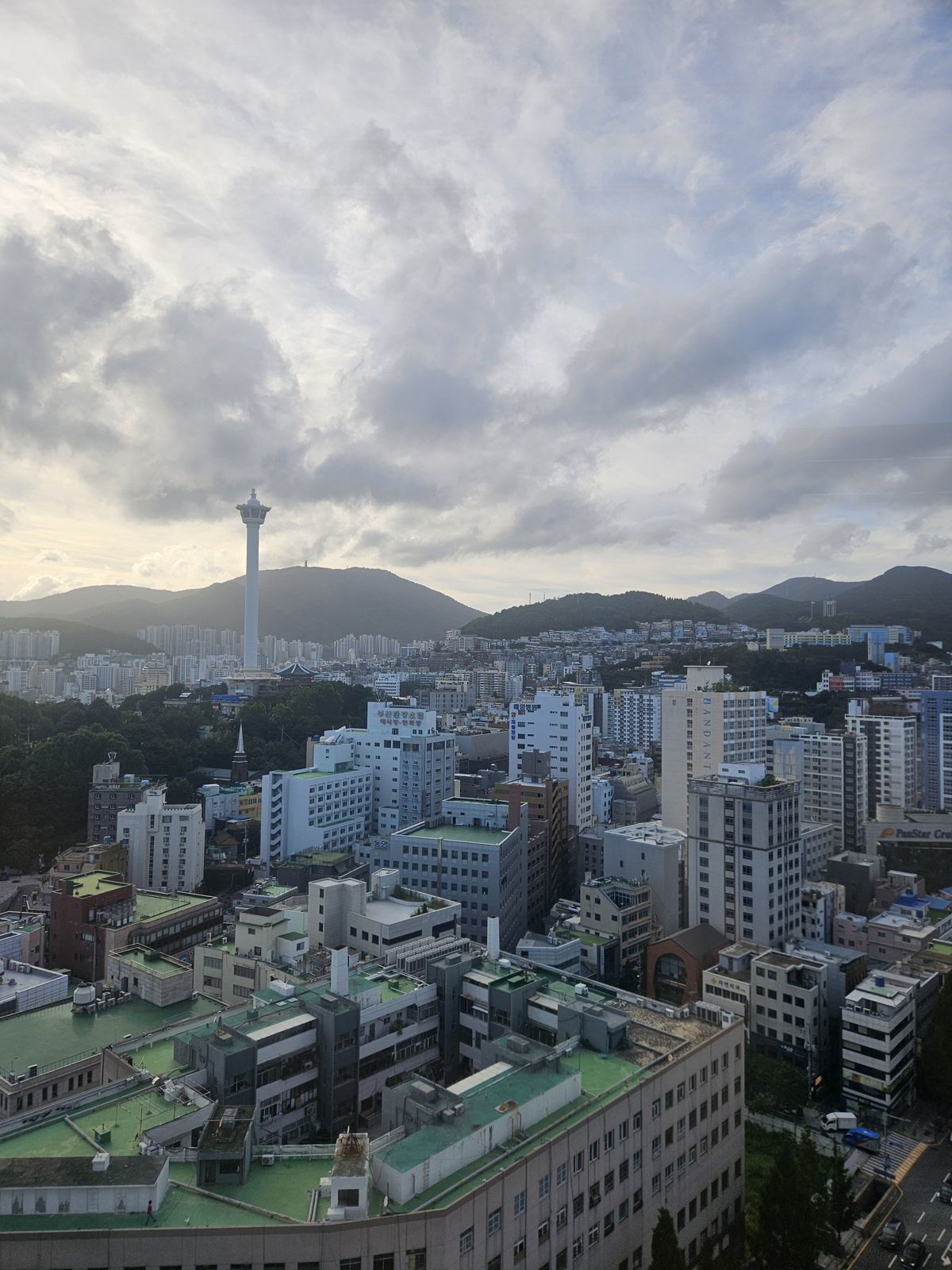
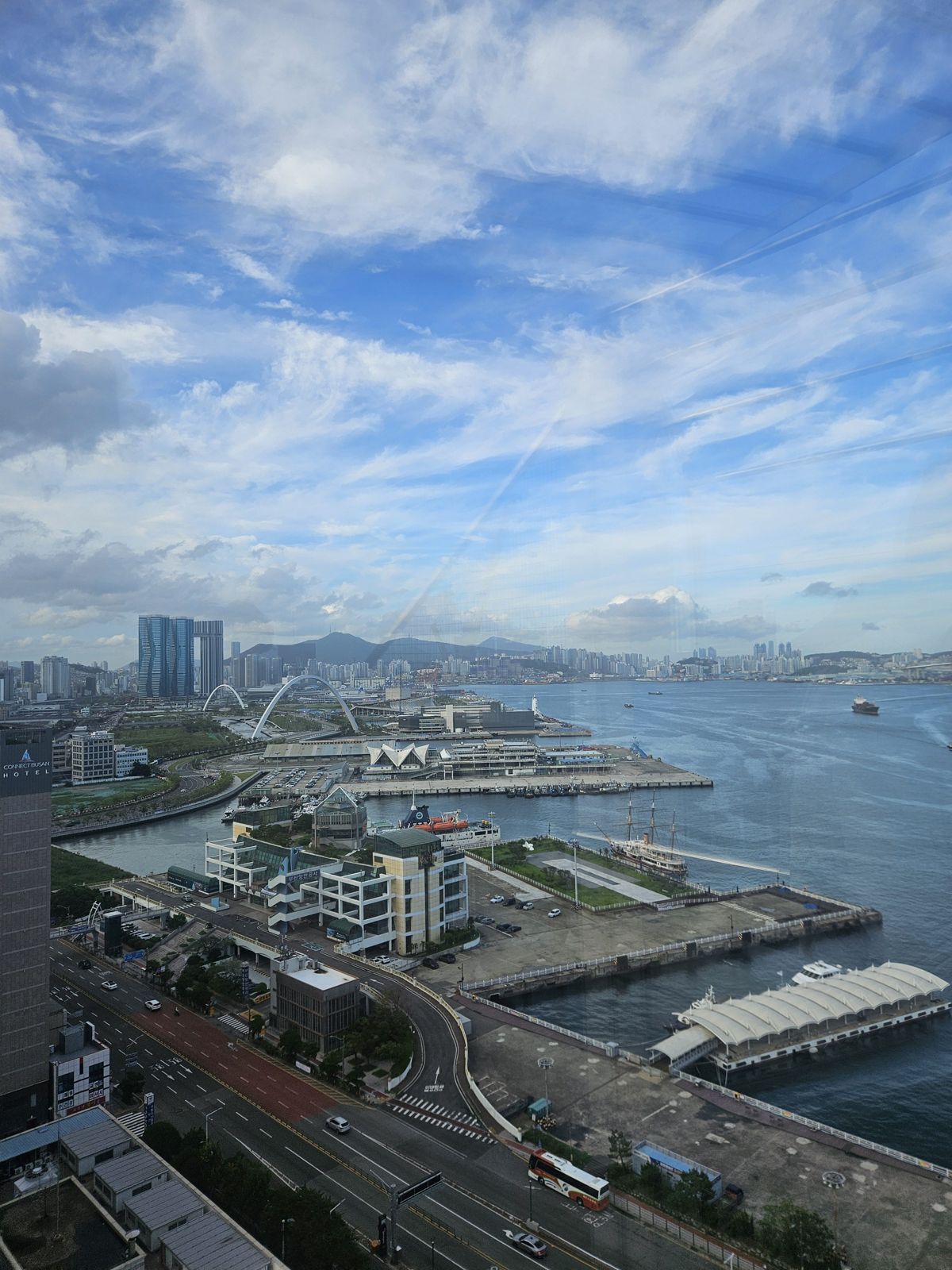
Stéphane uses this time alone to go and write in another café we'd tried during our stay in Busan two months ago. We meet up for a snack on the roof of the neighbourhood shopping centre, which has a superb rooftop garden with a viewpoint and a café (sumptuous, as usual). We'd already been at night, but the panorama is really beautiful by day too. You can clearly see the different Busans: the industrial one with its hyperactive port, the mountainous one with its huge green hills and the urban one with skyscrapers piercing the clouds on all sides. We then head back to the hotel to break up the day. Cassandre goes for a run while Clémence gets twenty minutes of T'choupi on TV. We then go out to eat at another pizzeria in the neighbourhood, where Clémence steals the show again. No doubt about it, we're back in South Korea.
Thursday 14 August
We already visited Busan in June, so there's no question of lingering too long. It's a very endearing seaside city with a vibrant atmosphere, though. We have breakfast in one of the many little cafés in the area before packing our bags and bikes and heading for the bus terminal. The city sits on countless hills, so we had to study the route carefully to avoid impossible climbs. When we rode into Busan at the end of May, we had to face a hellish slope with colossal climbing that forced us off our bikes to push them for 20 minutes. So we'd like to spare ourselves going that way again. We think we've found a doable route with reasonable climbing. There are so many hills everywhere that the Komoot navigation app doesn't know about the few public lifts built to cancel out the slope. At the top of a climb we find ourselves facing a dead end, but with a lift, which takes us up thirty metres or so without effort.
We haven't ridden three kilometres and we're already drenched and out of breath. We haven't really cycled much lately, and we greet the top of the climb with joy. The rest is downhill on a big avenue, but we never feel in danger. Despite the traffic, no car comes close, buses keep a respectful distance when they overtake, and despite the apparent chaos everything is under control. We rejoin the cycle route we rode into Busan on two months ago and reach the terminal.
Like all public buildings in the country, it's well thought out, spacious and easy to navigate. Our tickets to Gwangju, in the west of the country, are bought in a minute, and we have lunch in one of the many restaurants there. But one worry is nagging at us. 15 August is a public holiday; in fact it's the only public holiday shared by the two countries of the Korean peninsula. South Korea and North Korea hate each other, but they manage to agree on hating another country even more: Japan. So it's the anniversary of the country's liberation by the USA, 80 years ago today. And since Koreans aren't working, we're afraid our bus's hold will be full to bursting.
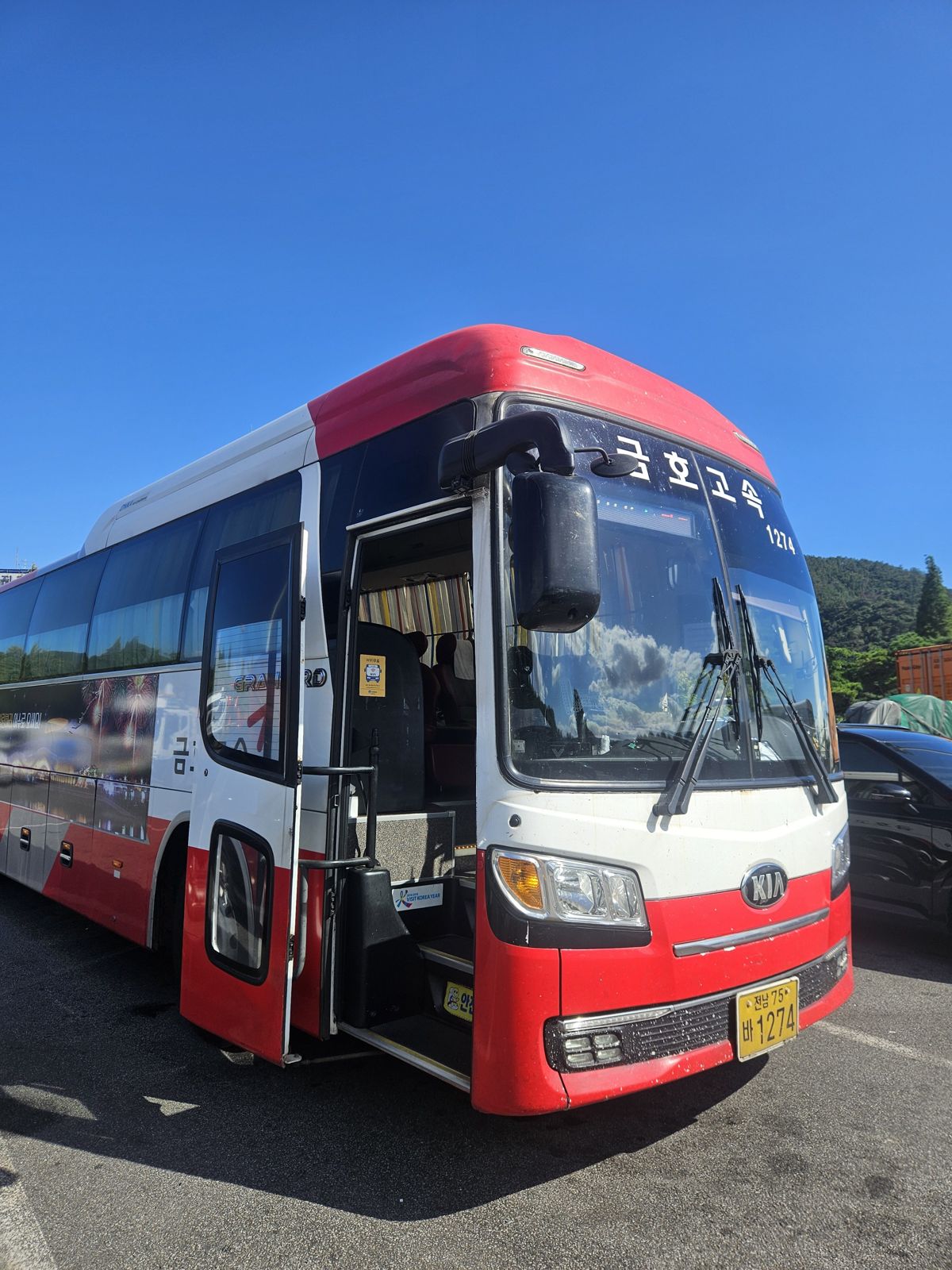
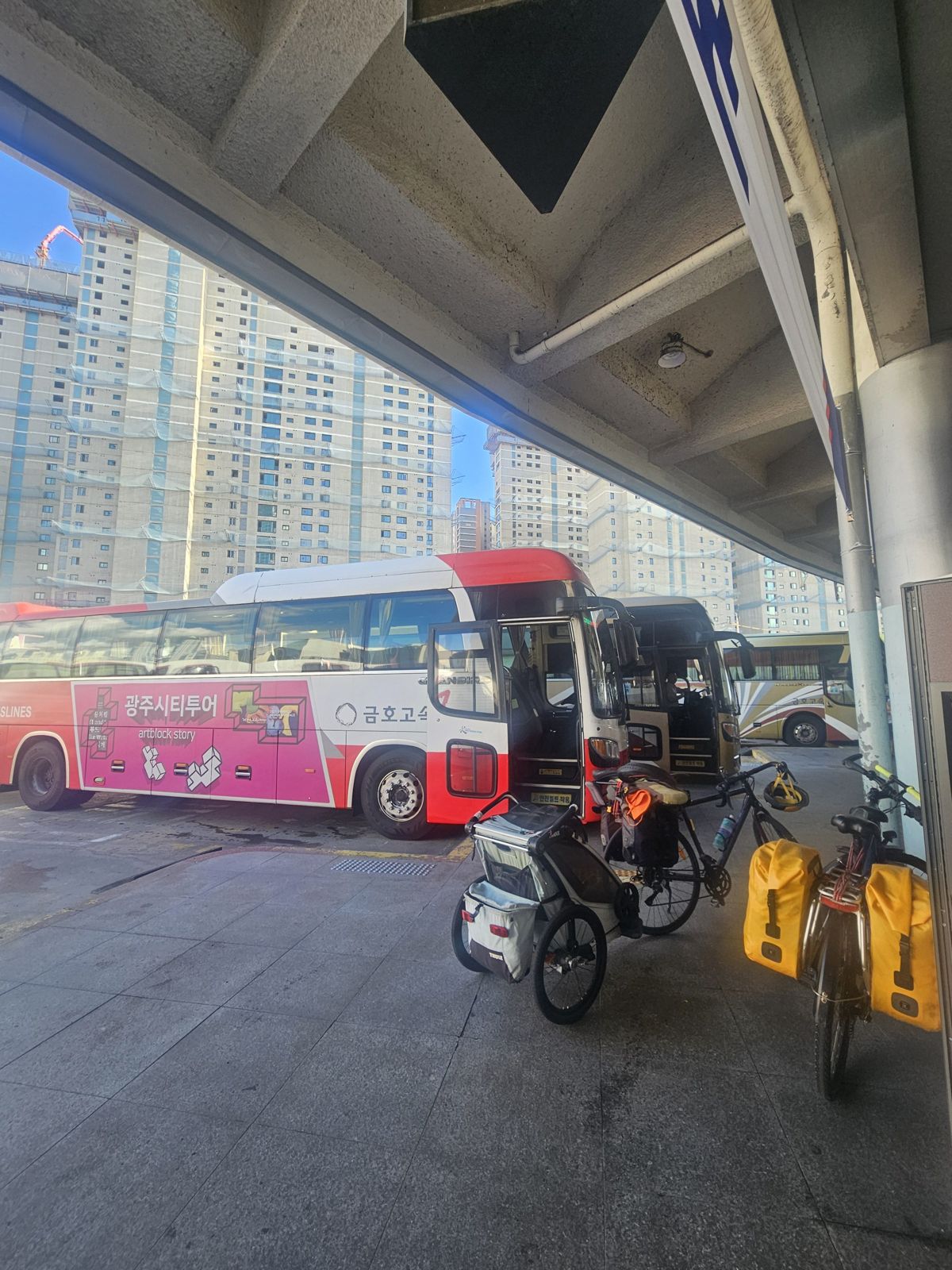
Sure enough, when our coach pulls in, passengers fill one whole side in a split second. We show our whole outfit to the driver, who pulls a face meaning "oh no, why me?". He nonetheless stacks all the suitcases on one side, and Stéphane stacks the two bikes and the folded trailer on the other. The driver didn't really believe it would work, nor did we, but in the end everything just fits. We breathe a sigh of relief and thank Koreans' impressive adaptability. It's three hours to Gwangju, which we spend reading, listening to nursery rhymes and watching the scenery roll by on the motorway.
In Gwangju we put the panniers back on the bikes, reattach the trailer and ride off through this city of over a million people. The hotel is only three kilometres away, but it takes us ages to get there. When we arrive, the man at the desk doesn't seem to have our booking. It's not the first time this has happened, and Stéphane gives him more details to help him find it. He's not going to find it, since Stéphane has simply got the wrong hotel. We are at a Brown Dot hotel, just not the right one. The right one is seven kilometres away on the other side of the city. After a minute's dithering, we decide to stay here. It's already late and we're not going to put Clémence through another ride. After all these adventures, we go out to eat at a poke-bowl restaurant, where we're back to overly spicy food. South Korea has dozens of advantages, but not that one.
On the road