
 ← PreviousA summer in Sokcho
Adventure is stress and discomfort disguised by the tranquillity of memory. After years of travel, we've come to understand that the events that stay with you longest are rarely restful. And we know in advance that this day will be anything but comfortable.
Since we're on the north-eastern tip of the country, we don't have a thousand ways to reach the south-west, where the journey continues. We have to take the bus. We hesitate a lot between the direct bus, which takes six and a half hours with breaks, or changing in Seoul to do "only" five hours by bus with a break in the middle. We go for the second option. It lets us spend the whole morning at the playground near the hotel so Clémence can burn off energy before this transit day. After playing a lot and using this "downtime" to clean and grease our drivetrains, we head for Sokcho bus terminal, 3 kilometres away. We cross the town, which turns out to be very pleasant by bike, and reach the little bus station.
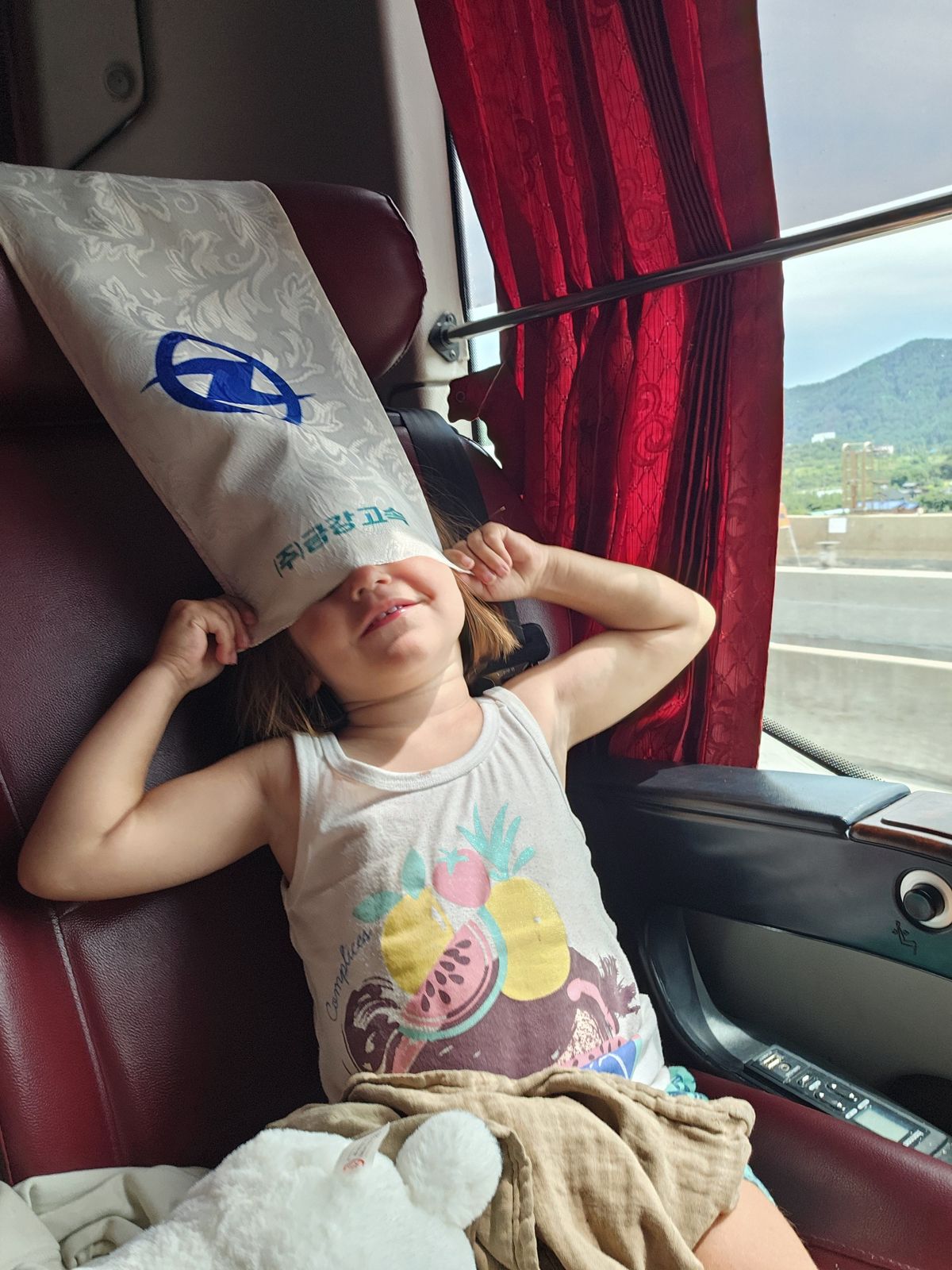
Clémence uses bus curtains as her guide. If buses don't have any, it's a short trip. If they do, we're in for a long ride. In the "curtain bus" terminal, we discover the buses to Seoul are generally quite full. There's one every 30 minutes; we were aiming for the 1 pm, but there are only two seats left, so we can't take that one. So we must either take the 12:30, leaving in 15 minutes, or wait almost an hour and a half. Without a second thought, we buy tickets for the first bus, which has four seats left, without knowing whether our bikes, panniers and trailer will fit in the hold. It just about works; we have to stack the buggy on one of the bicycles. Not great for the bikes' mechanics, but we don't have much choice.
The bus is indeed very comfortable, as always. Clémence is happy and well behaved and listens to Stéphane reading her The Little Prince, which he downloaded onto his tablet to introduce her to it. The hero is depicted so often all over Korea that it has sparked her curiosity. The distance goes by quickly, except on the way into Seoul, which is jammed whatever the time of day. The journey was meant to take 2 hours 10 and ends up taking 2 hours 40, leaving us with a connection cut from an hour to 25 minutes. So we know it'll be a rush, since we have to find our way around the terminal to buy tickets and get to the right bay, all with two loaded bikes, a trailer and a three-year-old. Arriving at Seoul's Dong Seoul terminal, we're a bit lost with the signage. In this situation, we recommend doing what we did: one stays with the bags and the child while the other scouts ahead. It avoids adding stress to an already tense situation and saves lugging all the gear around for nothing.
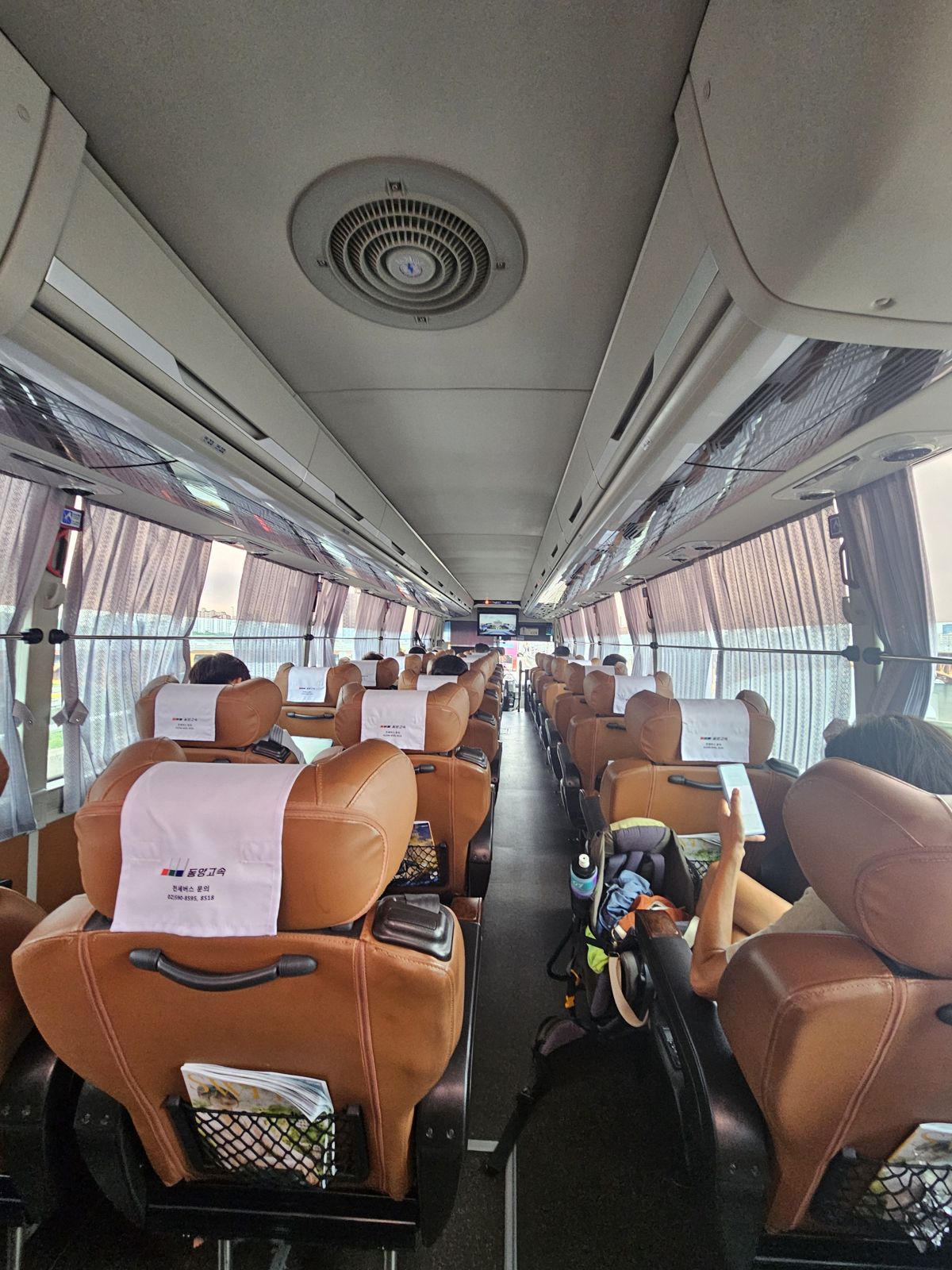
Cassandre runs off blindly to buy the tickets and comes back five minutes later with the golden ticket and the bay number. Here we go again: everything back in the hold. This time the bus is much emptier; we settle in at the back again and we're off for another two and a half hours. Clémence isn't bored: she comments on everything she sees, we talk about what we notice and play with her soft toy. Travel is formative for young children because they discover independence and sometimes see their parents struggling. At those moments, Clémence becomes very obedient, tries to help as best she can and doesn't run all over the place, which we appreciate. We use the fifteen-minute halfway break to stretch our legs at the service station. They're not very different from ours, since they serve the same purpose. Still, it feels foreign, as everything is written differently. As we've travelled on from Sokcho, the weather has changed a lot. We left under a milky blue sky, and getting off the bus at the motorway services we get buckets of water on our heads while we're in shorts and T-shirts. Just before 7 pm, after three hours on the road, we arrive at Jeonju's curtain-bus terminal. The hotel is a stone's throw away; we wash, change and go out to eat.
In a restaurant you enter through the kitchen, the atmosphere seems friendly. Heads turn as we come in, surprise in everyone's eyes. Jeonju is a tourist city, but only around the traditional hanok village (the largest in Korea), not in other neighbourhoods. We settle in our corner, savouring our meal, when a man approaches us with a bag. He shows us traditional Korean children's games, but we're not sure if he's trying to sell them to us. Our suspicious French nature comes rushing back. We think he's asking Clémence to choose one, but no, he gives her the whole bag of toys! We don't even know how to express our gratitude, and the surprises aren't over. Within five minutes, the cook-owner brings us an extra dish on the house to thank us for visiting his restaurant. He's very happy to have foreign tourists at his table. After endless thank-yous, we head back to the hotel.
Just before we get there, we spot a bank card on the ground. We pick it up without really knowing what to do with it. Right opposite is a little shop that we can't quite tell is a grocery, a restaurant or a tailor's. We knock and show the card. A tiny, very elderly lady takes it, thanking us; we gather it's hers. Anyway, she talks to us for two minutes and we don't understand a thing. Maybe she thinks we're giving it to her as a present? In any case, she's very happy. She asks us to wait and comes back with a kilo of grapes and two beers. These people really are extraordinary.
Wednesday 25 June
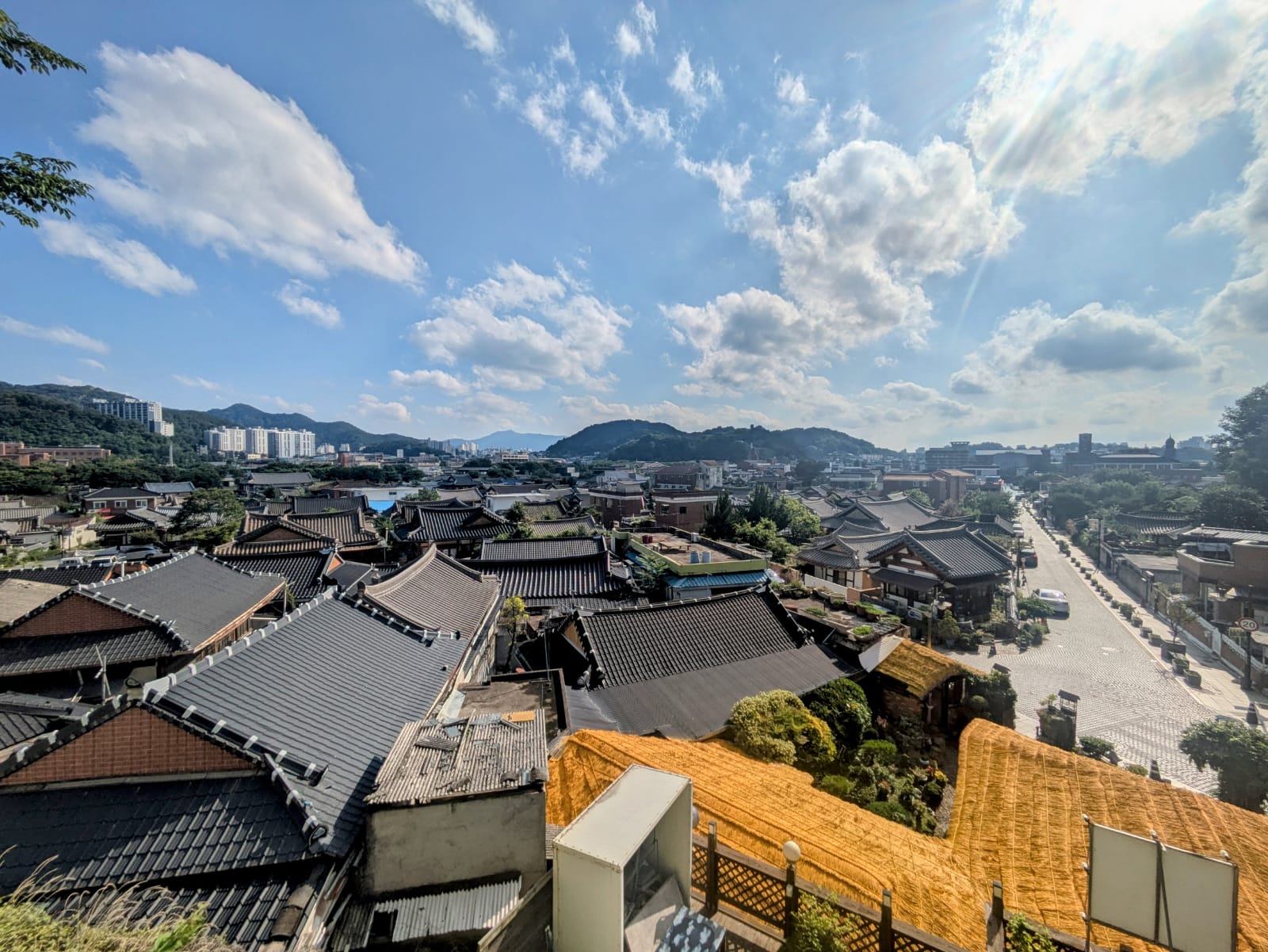
The bad weather is back. We'd managed to give it the slip in the east, but we've thrown ourselves into the jaws of the climatic wolf. It seems it rained heavily in this part of the country while we were enjoying the sun in Sokcho. Several flood icons appear on Google Maps in the affected areas. After a good breakfast and a few games at the hotel, we head out into the light rain. It doesn't last long, and we reach Jeonju's historic centre after just ten minutes on the bike. Jeonju is a historic city of resistance against the Japanese invader and the home of the famous bibimbap. It's THE food destination of South Korea.
Like all cities steeped in history, it has its royal palace, which you can visit peacefully. The little buildings are surrounded by greenery and there's a calm barely disturbed by tourists in hanbok. We stroll the paths, then go down into the depths of the royal portrait museum. Koreans are very good at engaging children: a whole room is dedicated to them. On tablets, they can colour in historical figures. Once confirmed, the figures appear on a giant animated mural in front of us. It's great fun and Clémence finds it hard to stop.
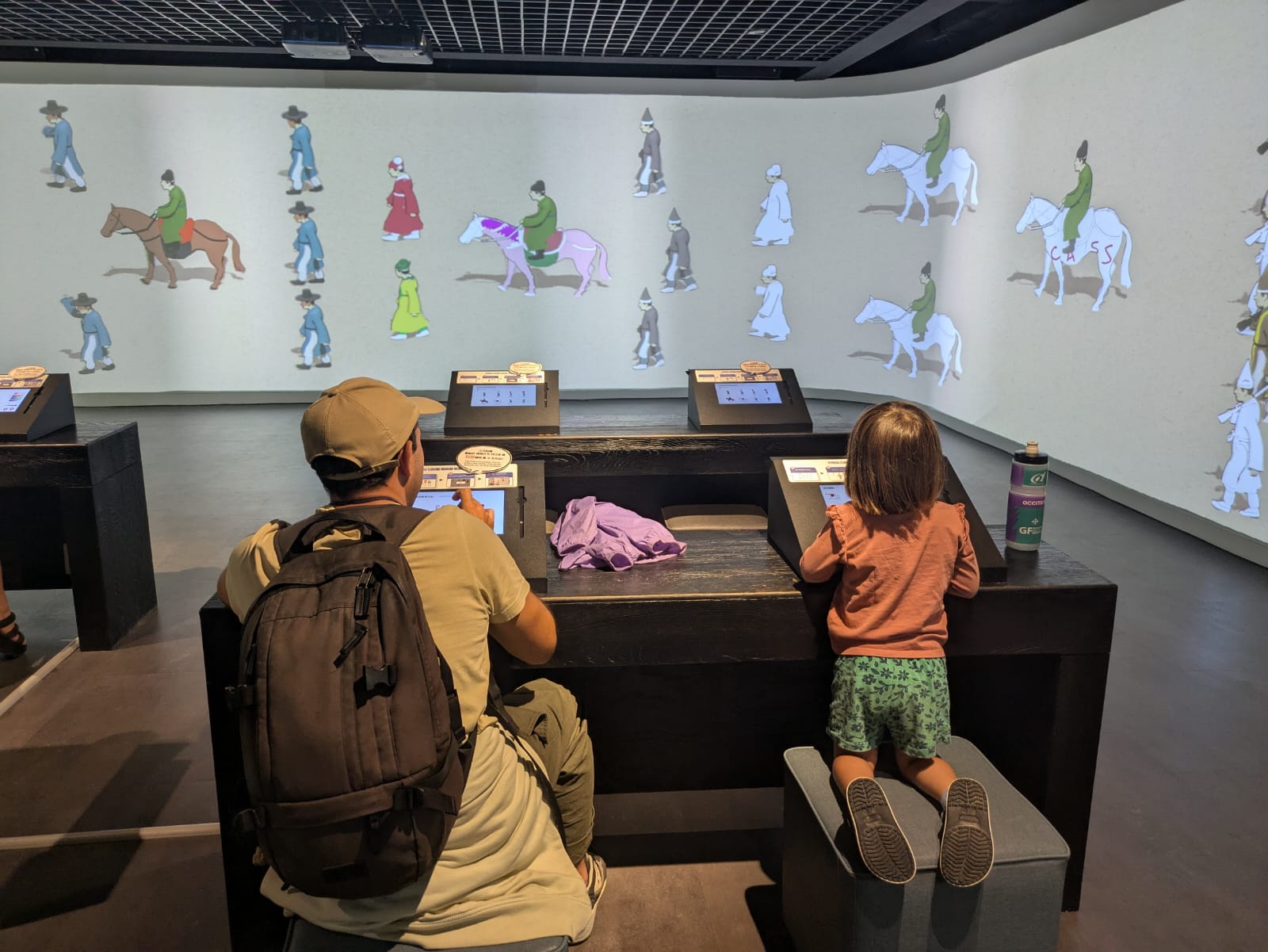
We promise her we'll come back later and hurry off to eat at one of the city's oldest restaurants. It takes advantage of its location to be overpriced while being unremarkable. Clémence has been asking for a while to dress up like all the tourists, and we can't resist any longer. We stop at a rental shop, and for a modest sum she comes out in a superb traditional outfit, a hanbok, of which she's very proud. She even amazes us: dressed like this, she calms her legendary hyperactivity to take good care of the clothes. For an hour and a half, she doesn't run and walks nicely. Extremely rare for a child who gets around almost exclusively at a run. We stroll through the streets, where she draws smiles and a volley of "yeppeoyo", literally "so pretty".
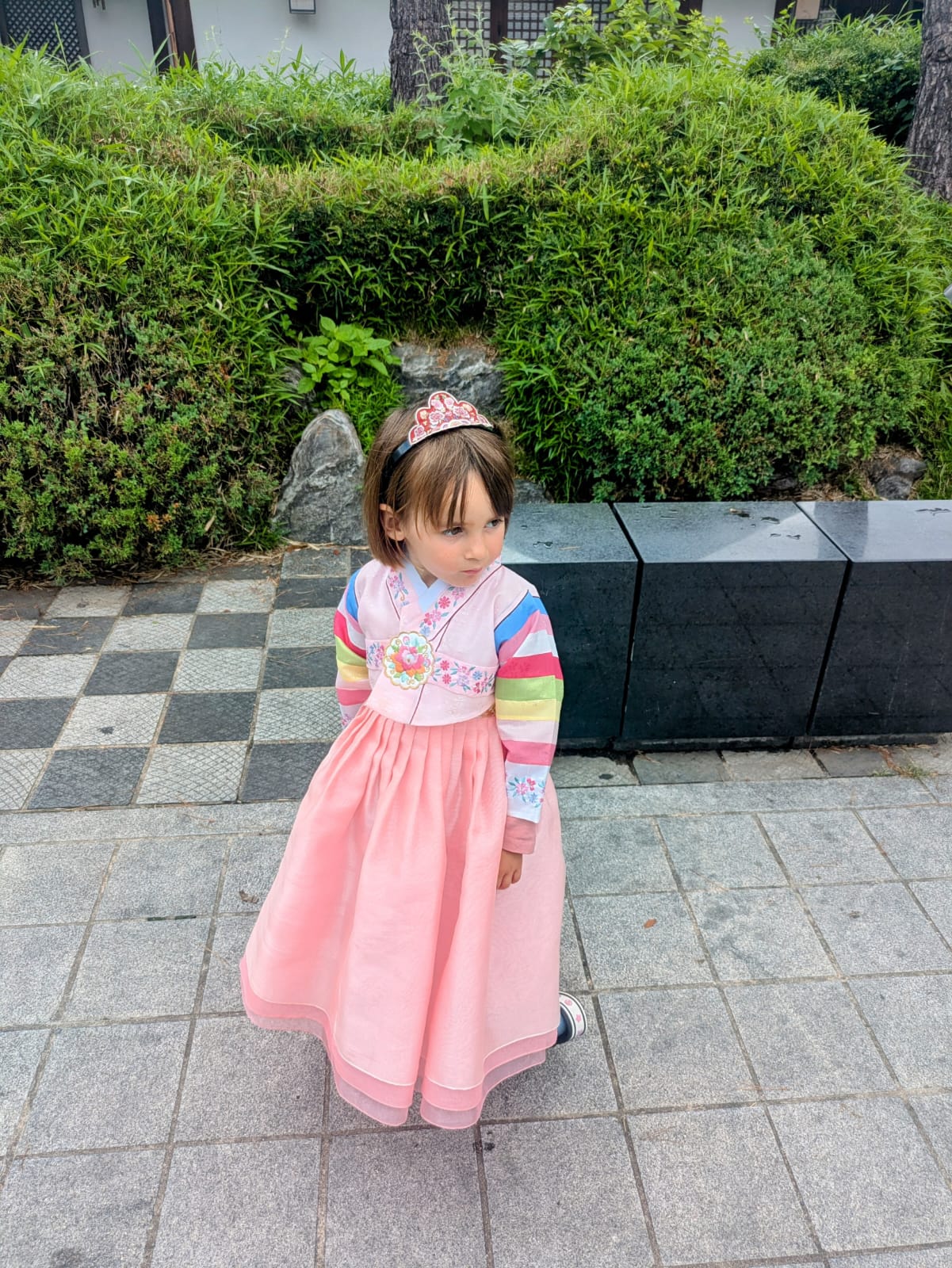
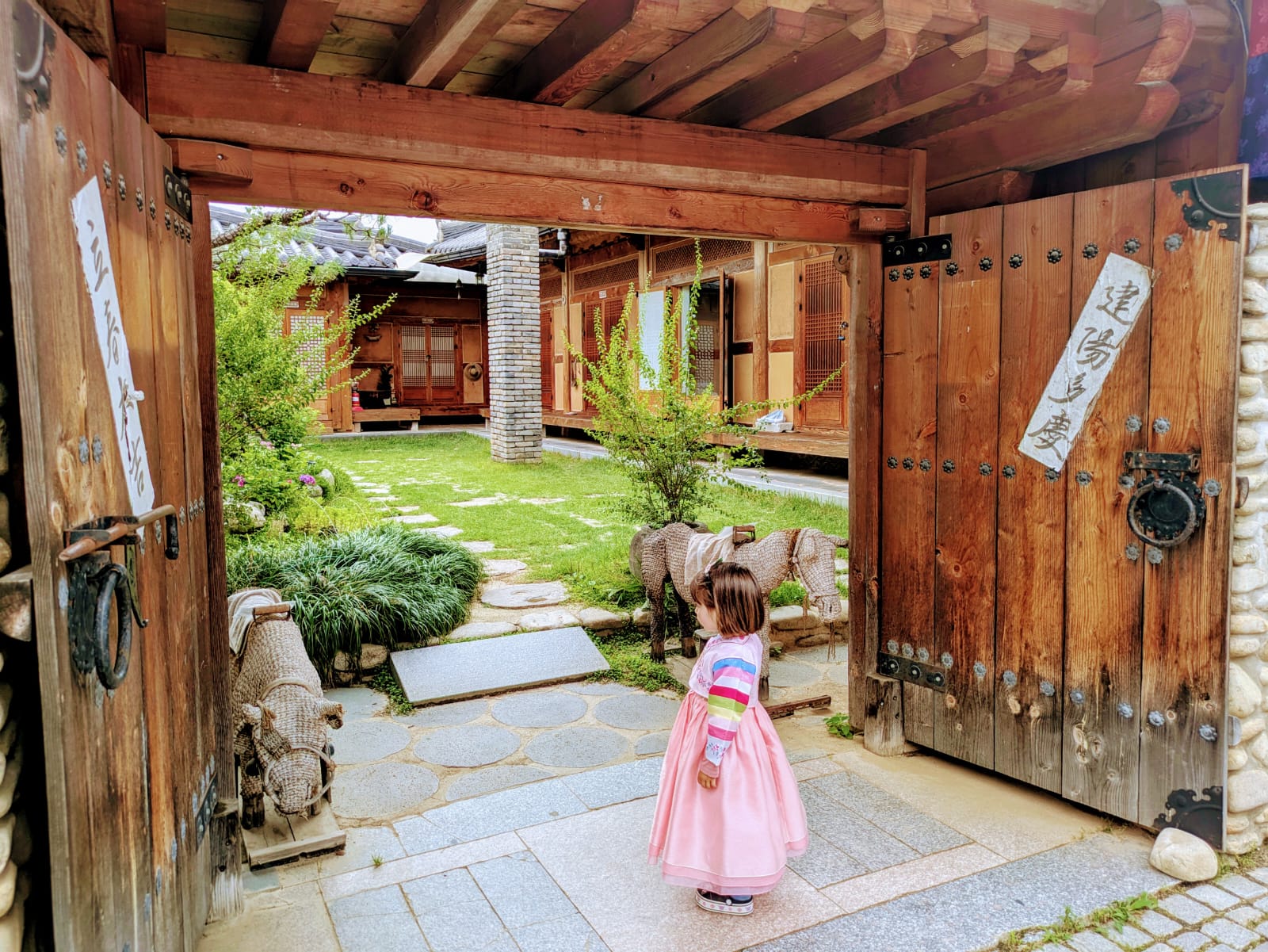
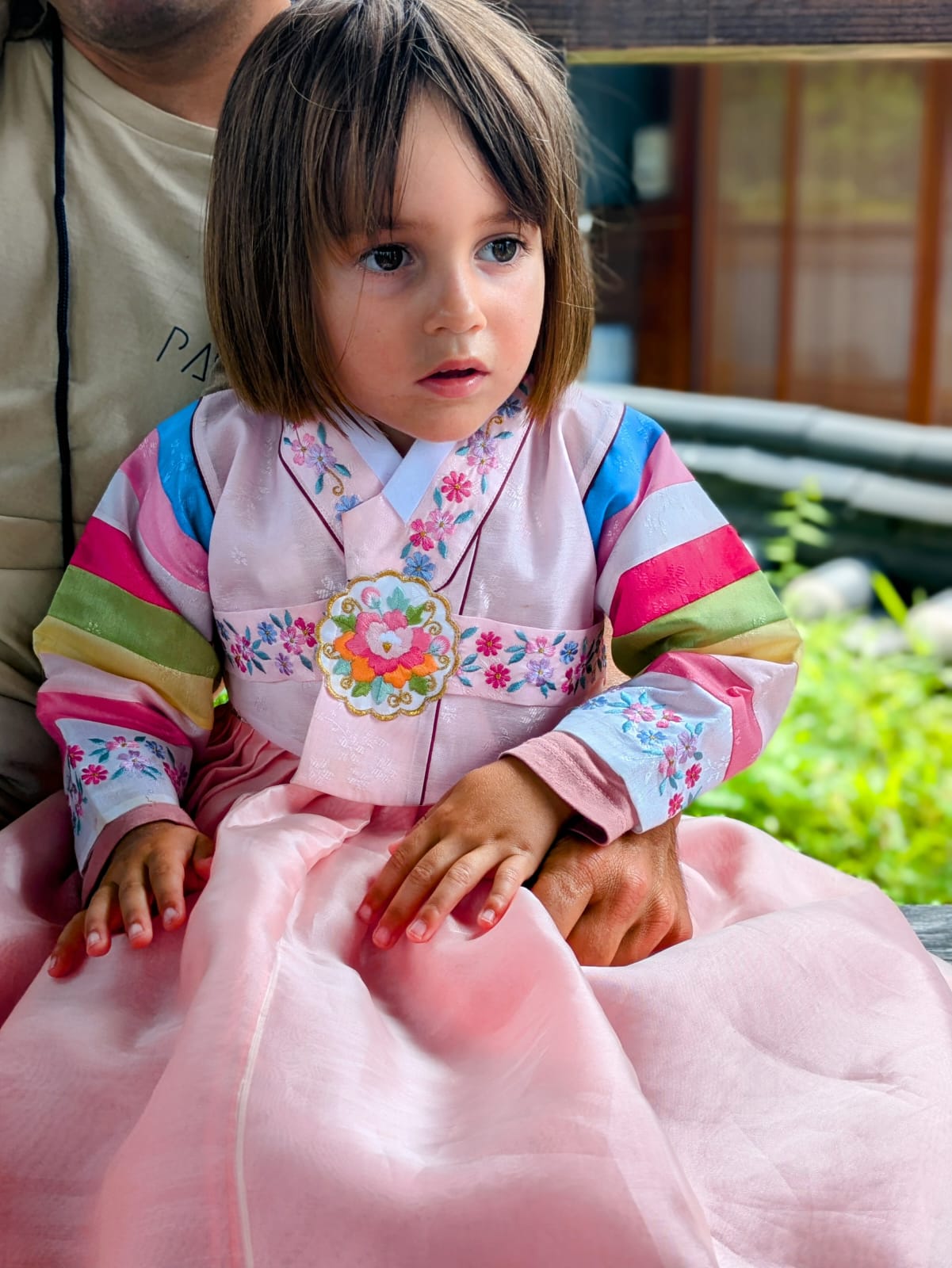
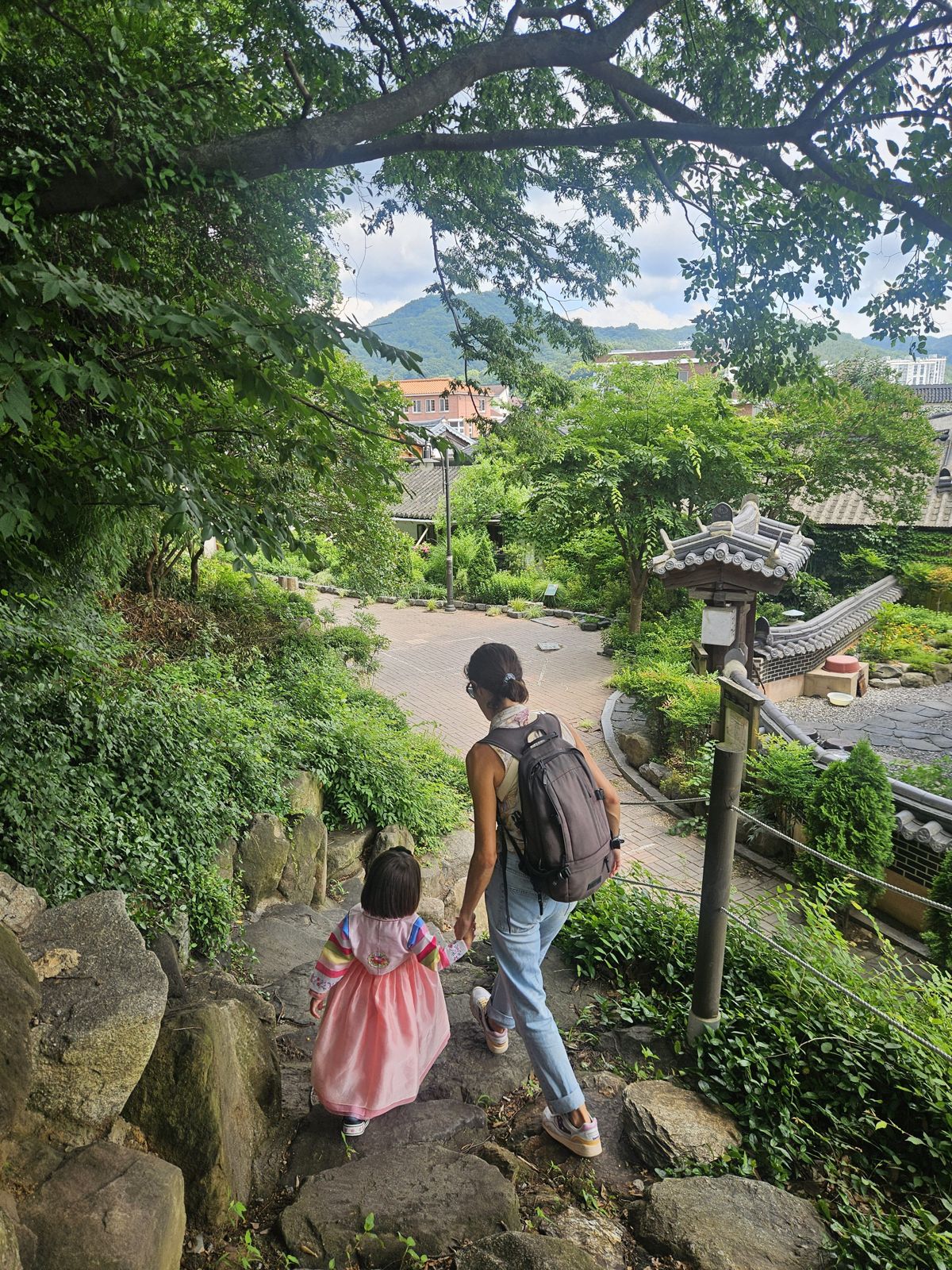
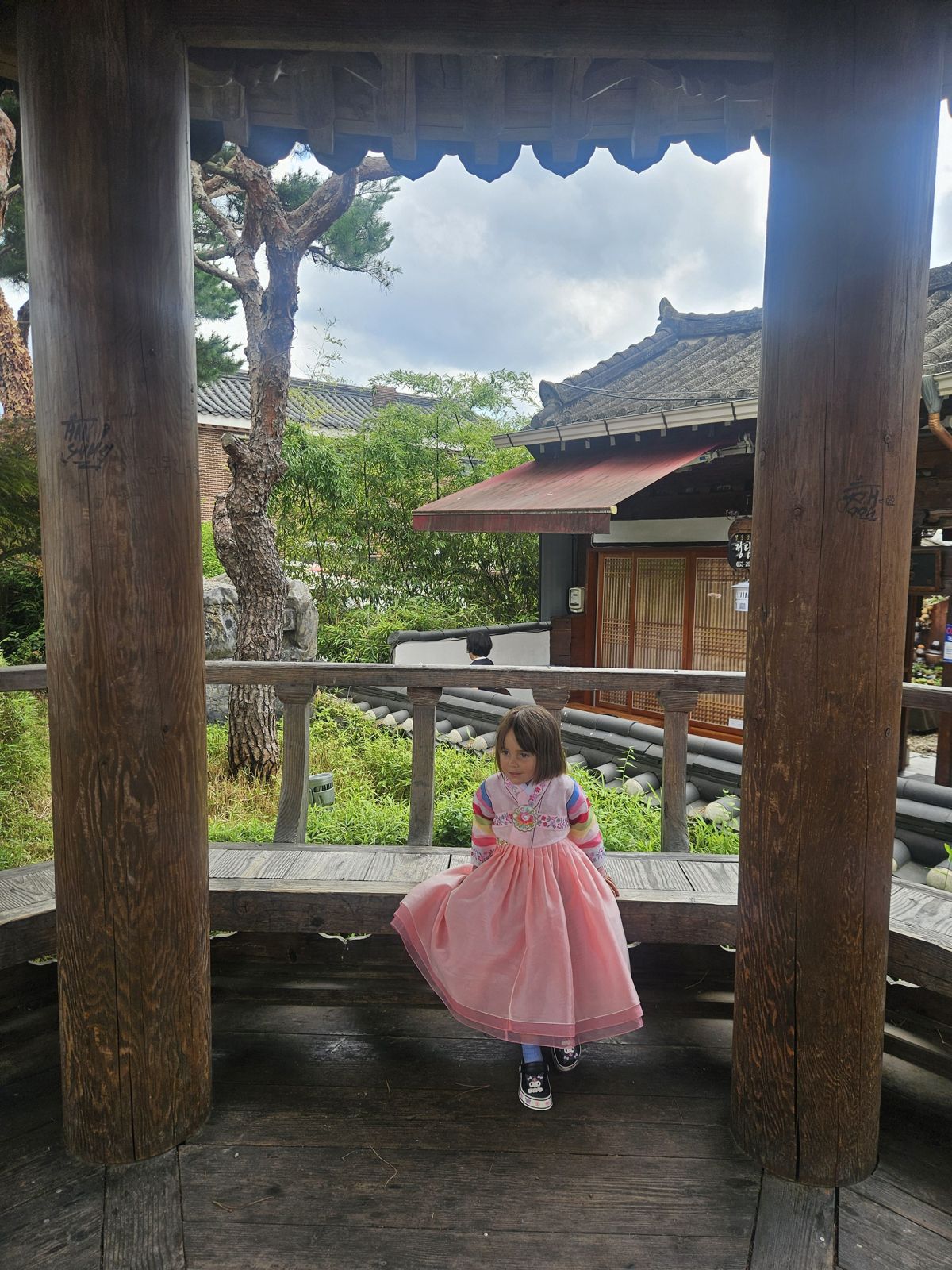
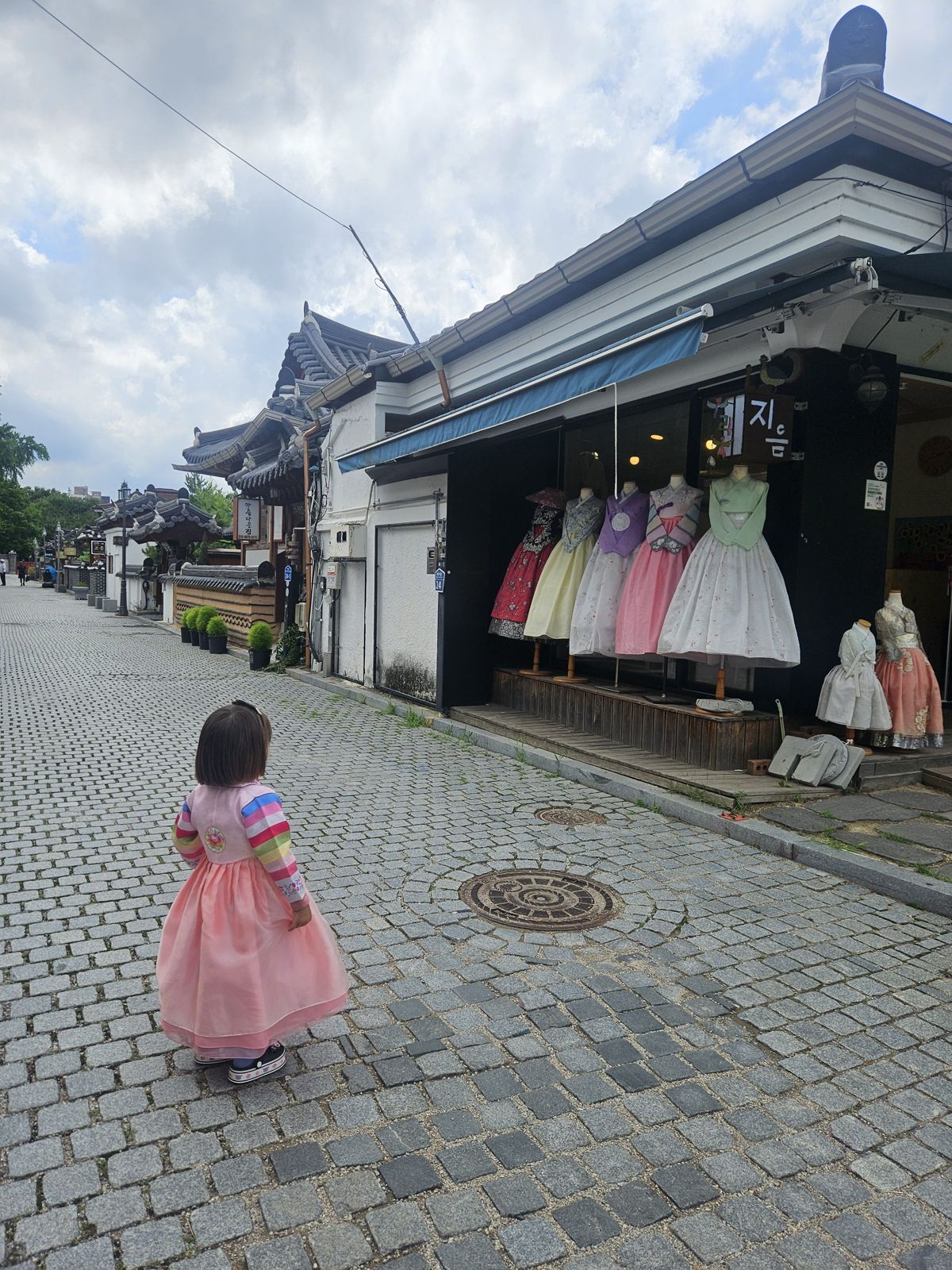
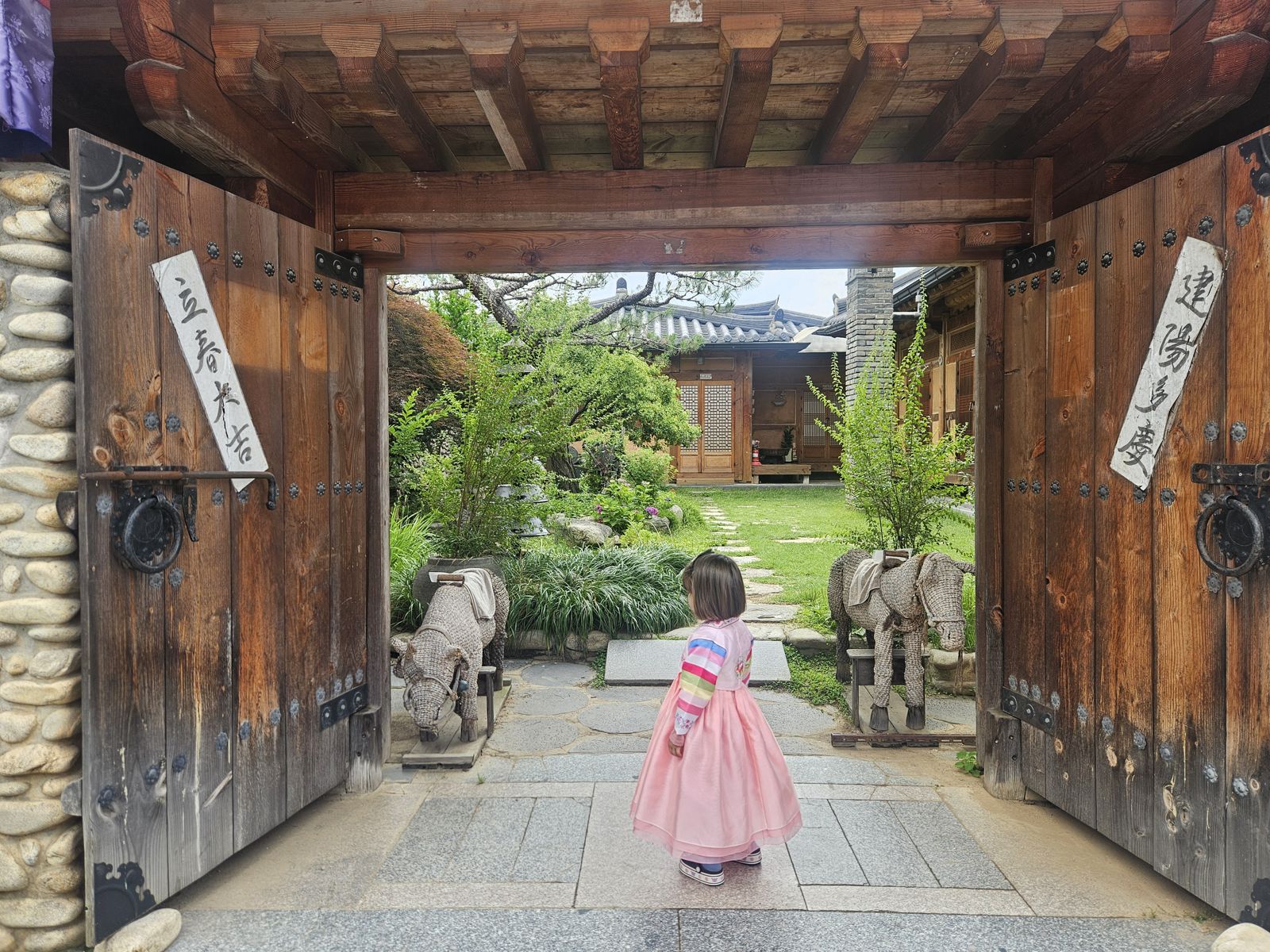
Have we fallen into the perfect tourist trap? Probably. But would we have regretted not trying? Surely too. While last night's hotel cost barely €25 for two beds and a huge room, we've booked a night in a hanok because, since we're in Jeonju, we might as well go all the way. Hanok are small traditional Korean houses, and you sleep on the floor on very thin mattresses. A Westerner would simply call it a duvet; sleeping on a yoga mat would be much the same (we're a long way from the Japanese futon). Arriving around 4 pm, we realise the room is tiny and the mattresses don't look very comfortable. While every hotel room overflows with comfort and little freebies (face lotions, creams, shower gels, shampoos, slippers, coffee, mineral water…), this one simply has mattresses, a TV and an (empty) fridge. The incongruity makes us laugh. Who pays more for less comfort, apart from tourists?
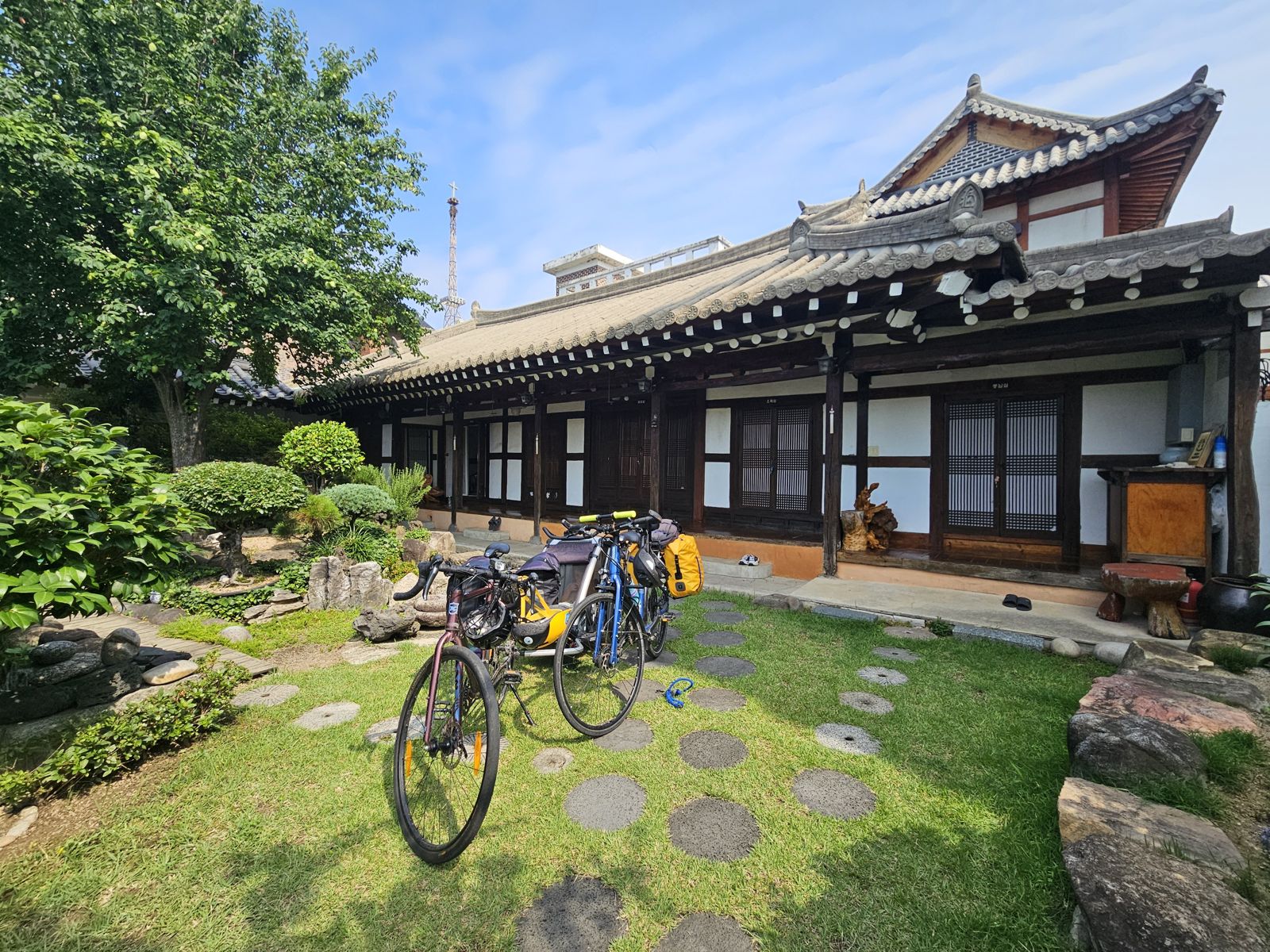
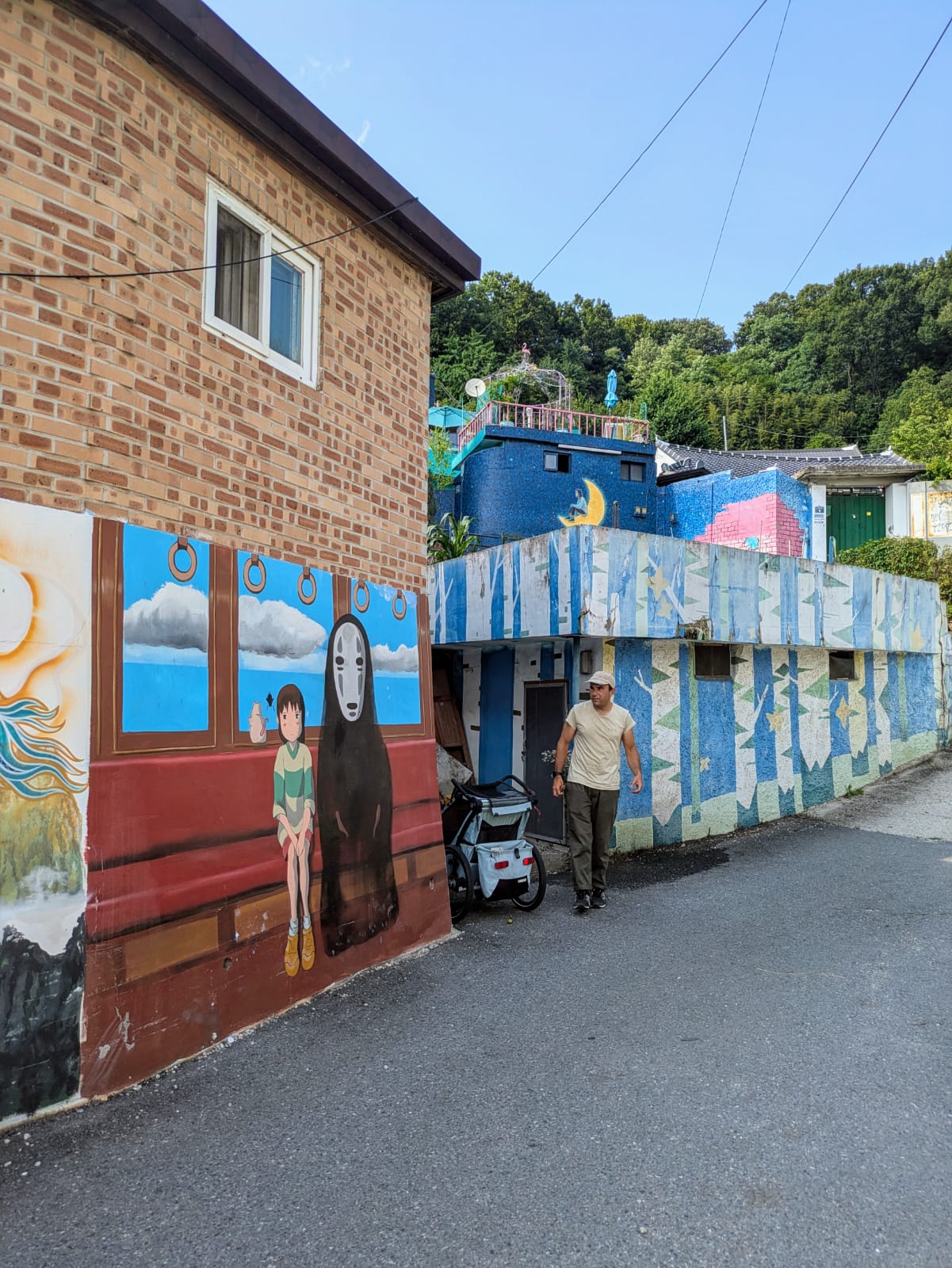
We'll make do very well all the same, as the house is still very pretty and the price reasonable (€35). Clémence was desperate to go back to the museum to colour in the animated figures on the mural, so after a little tour of the hanok village and the neighbouring Jaman village, full of pretty colourful murals, we go back to the museum. Unfortunately the experience is short-lived, as the activity closes at 5:30 pm. Clémence is a bit disappointed, but at least she got to enjoy it again.
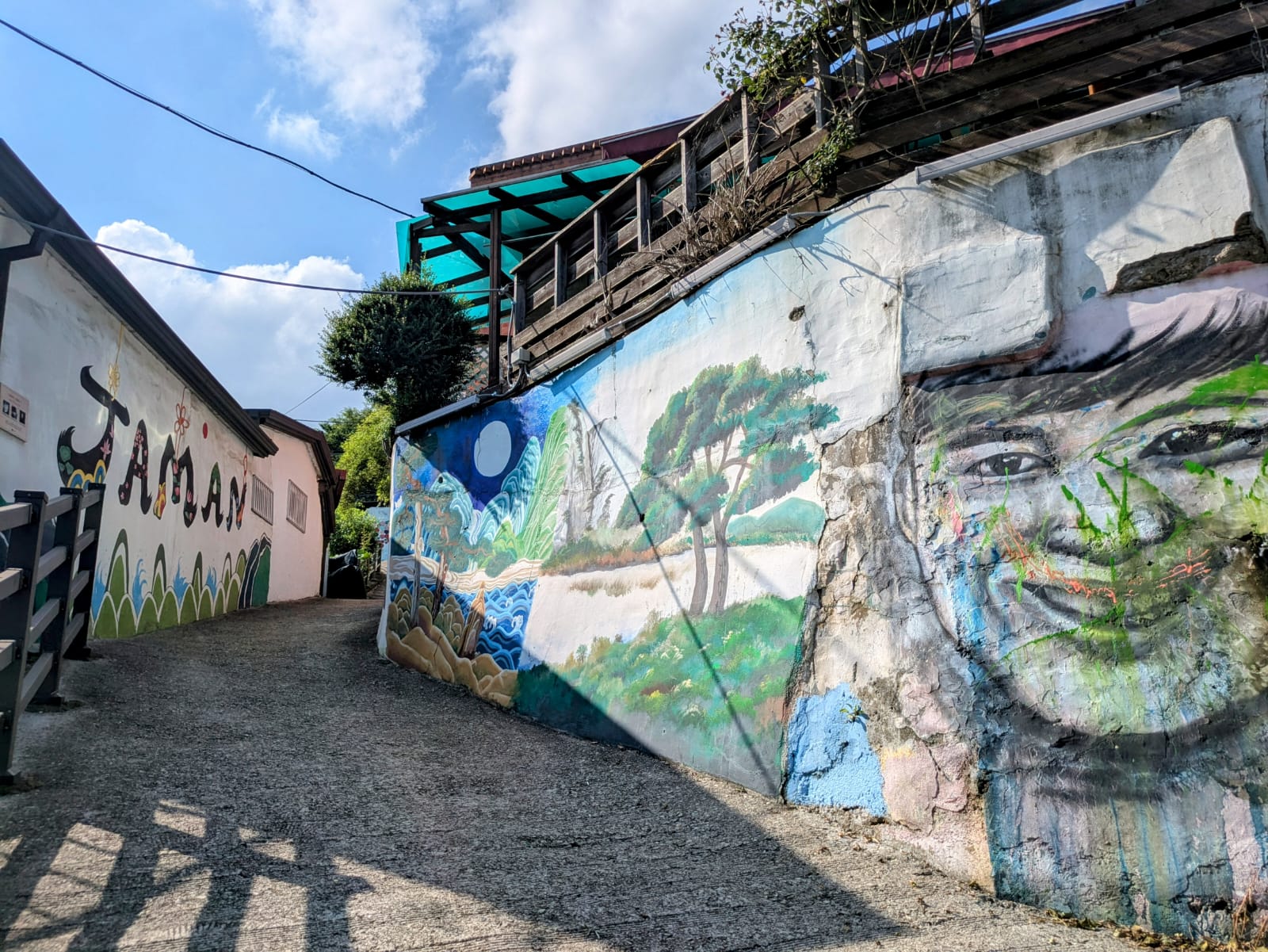
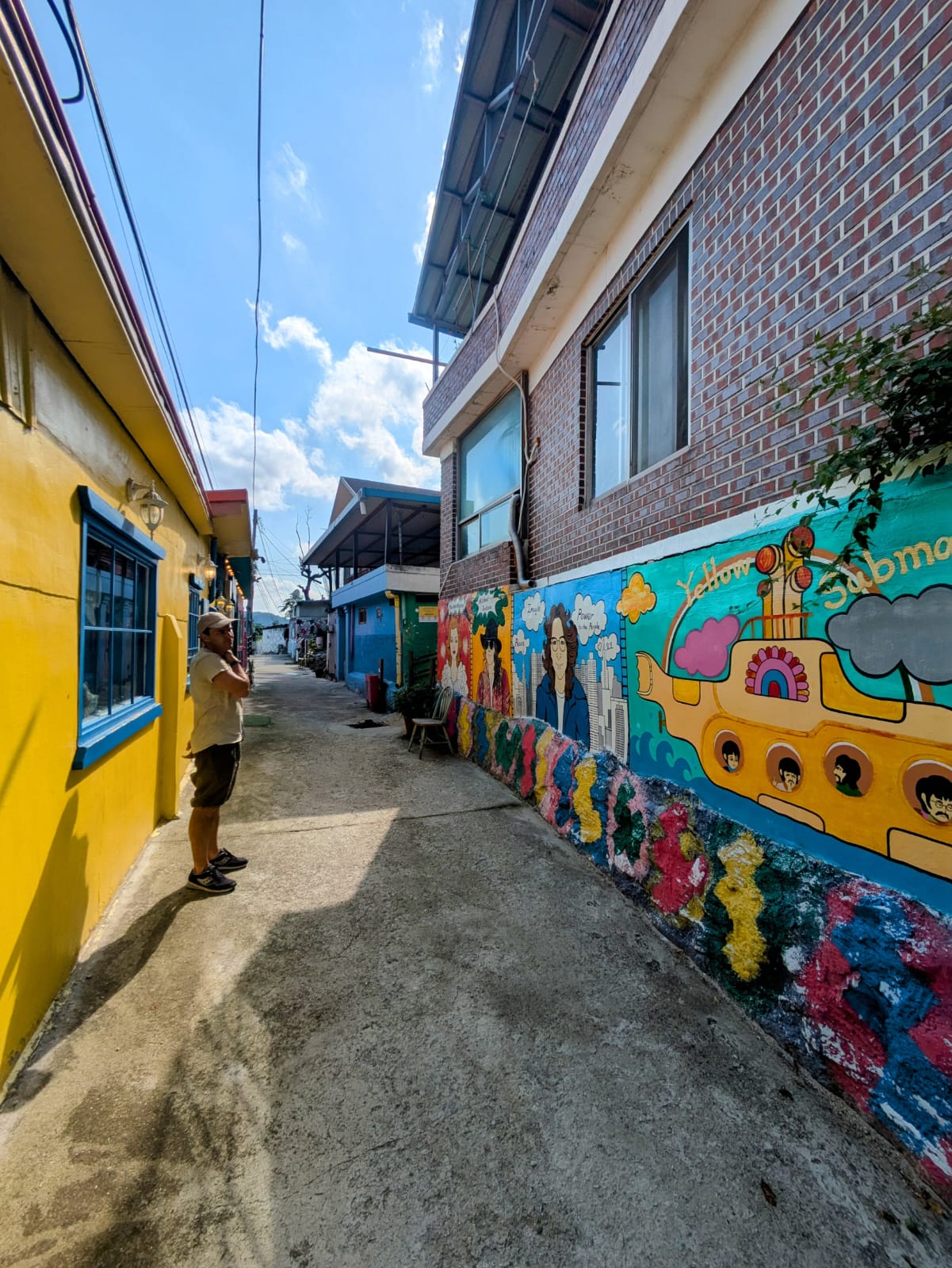
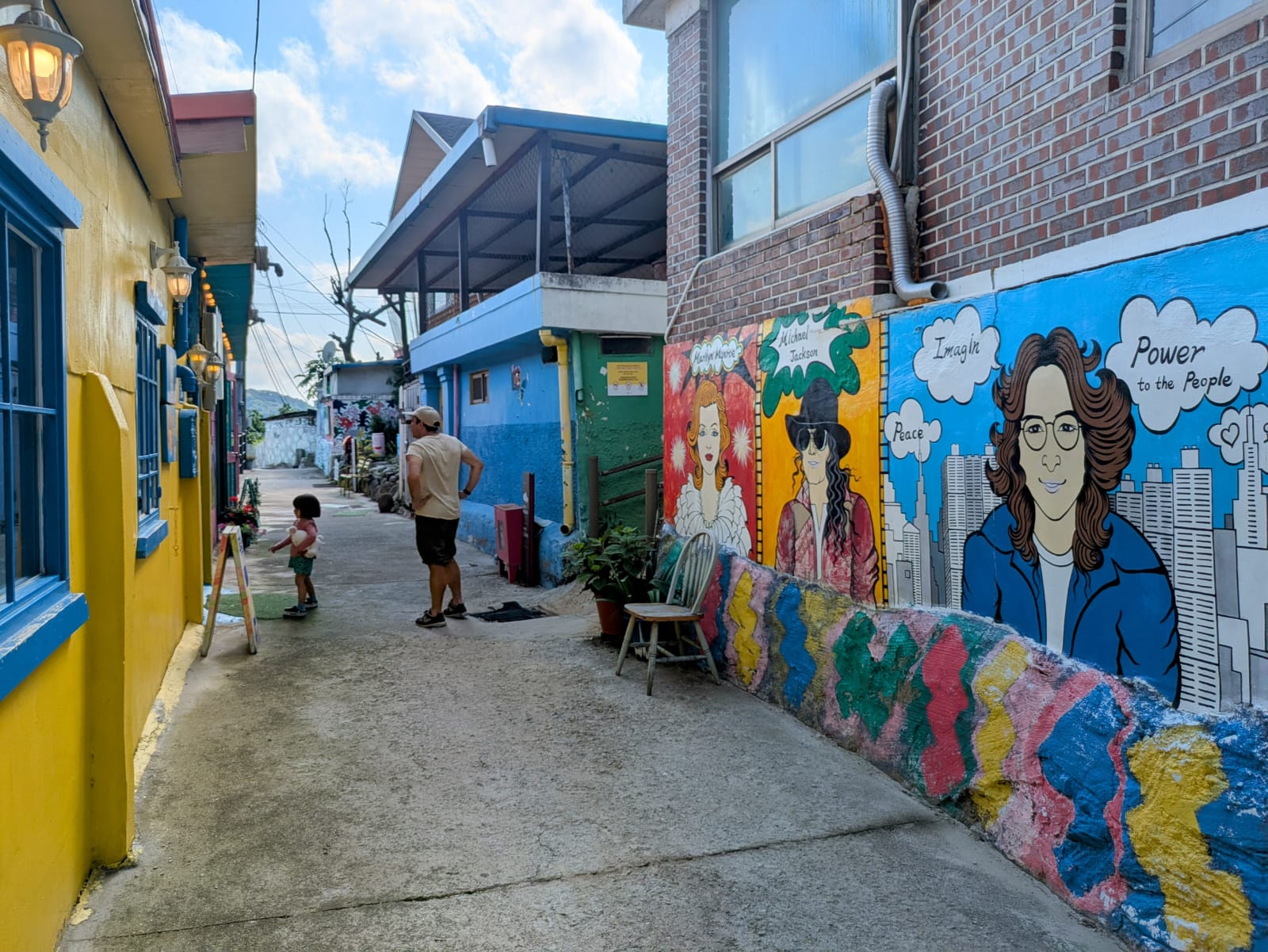
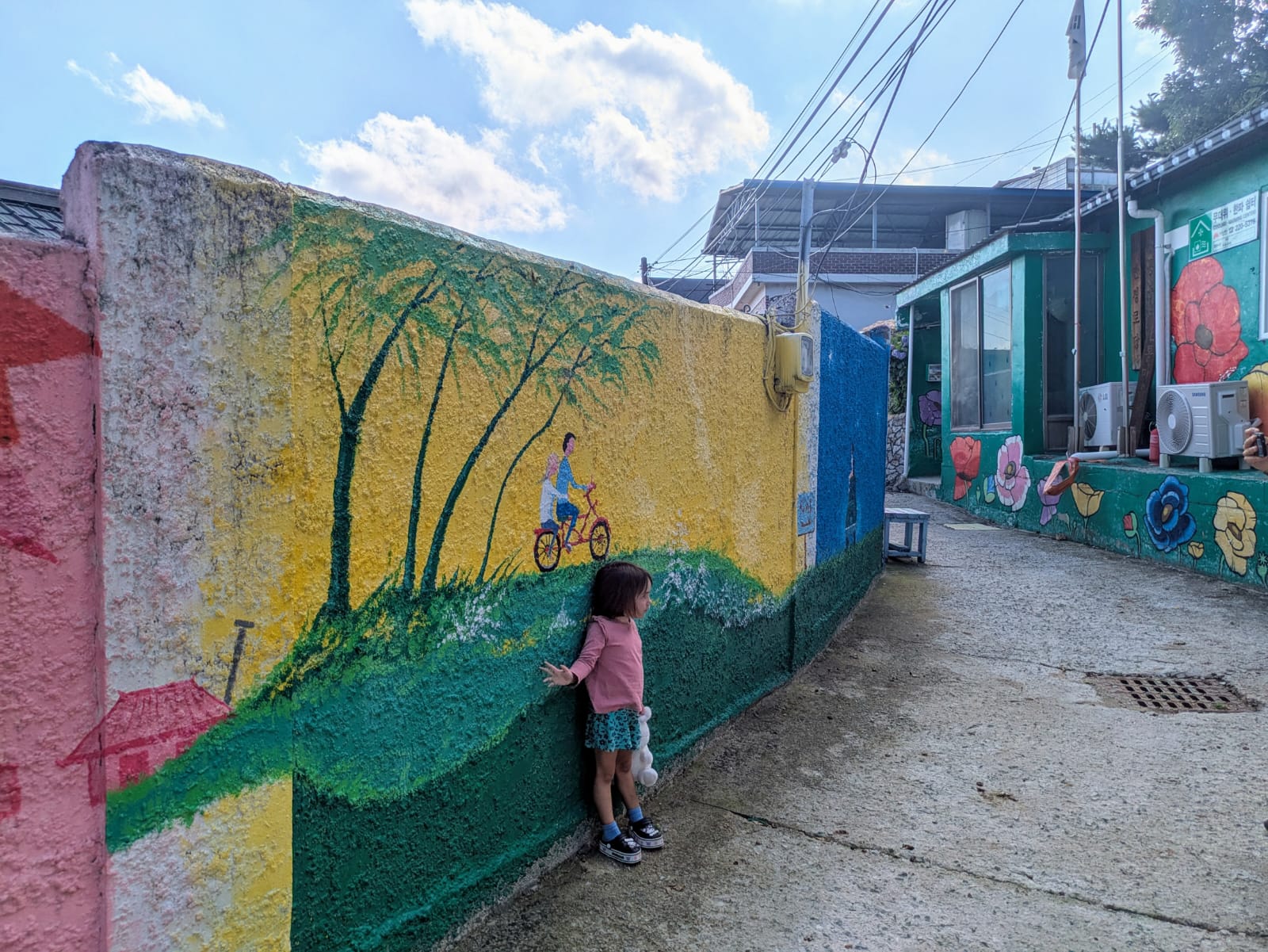
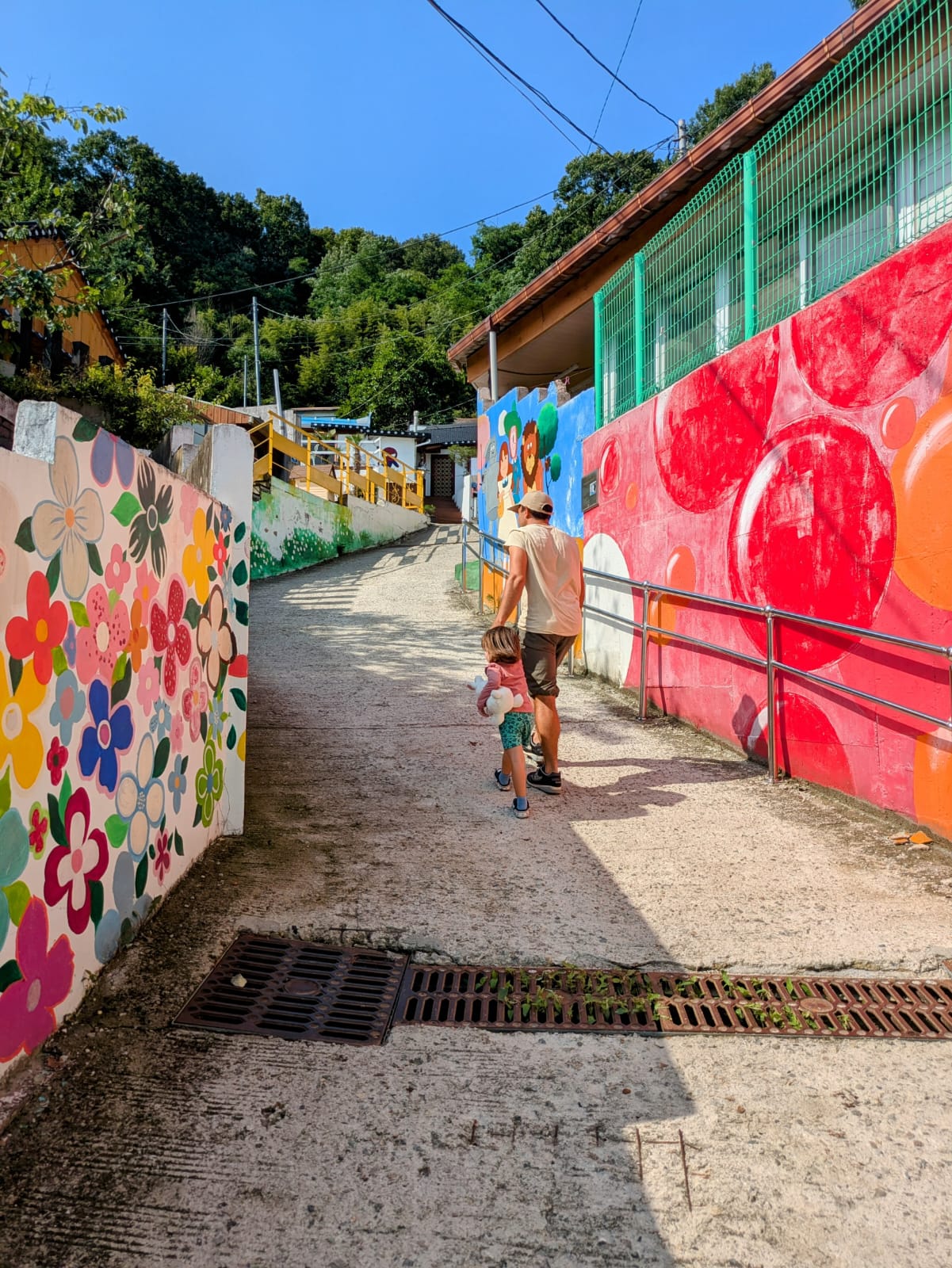
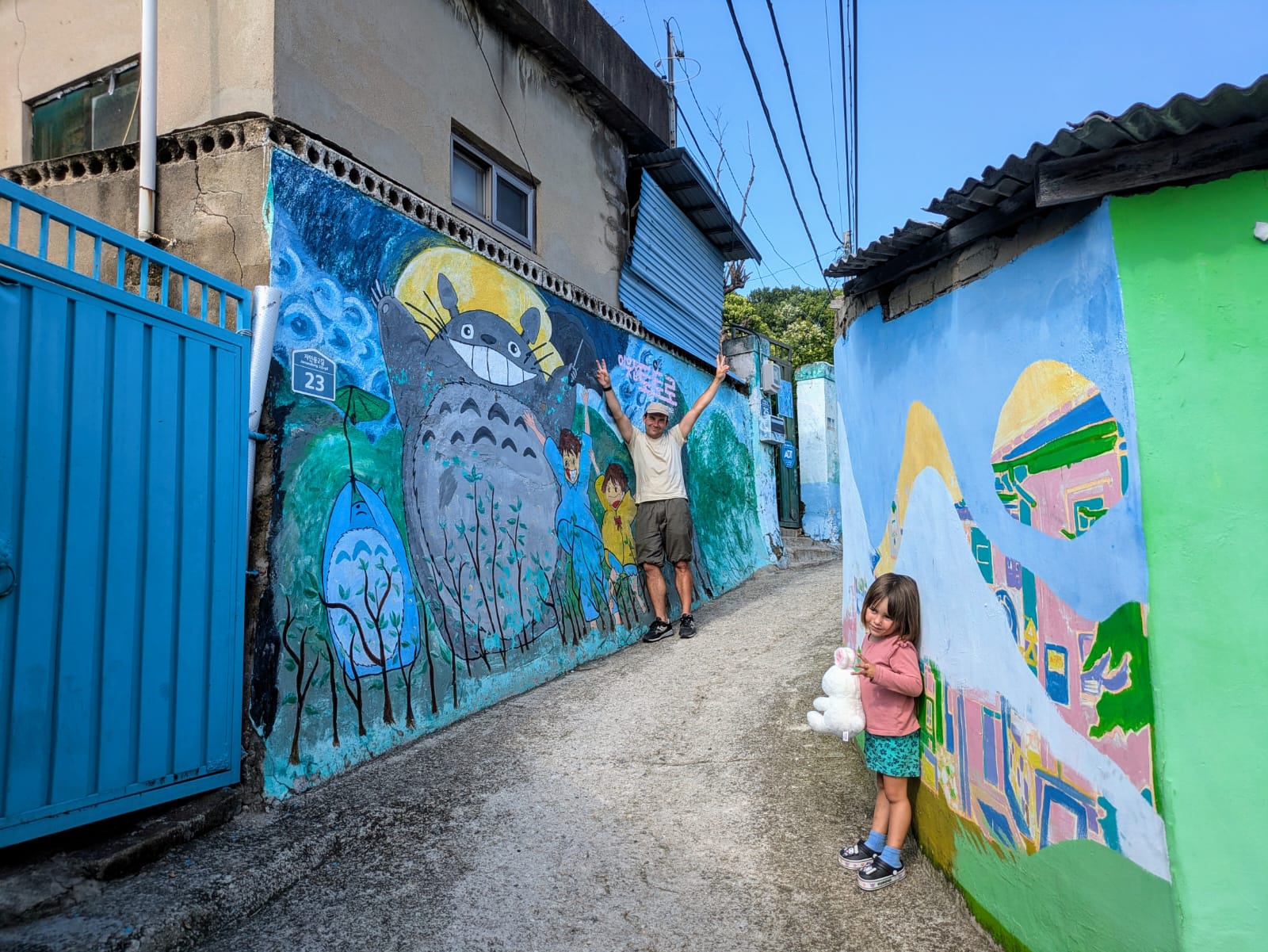
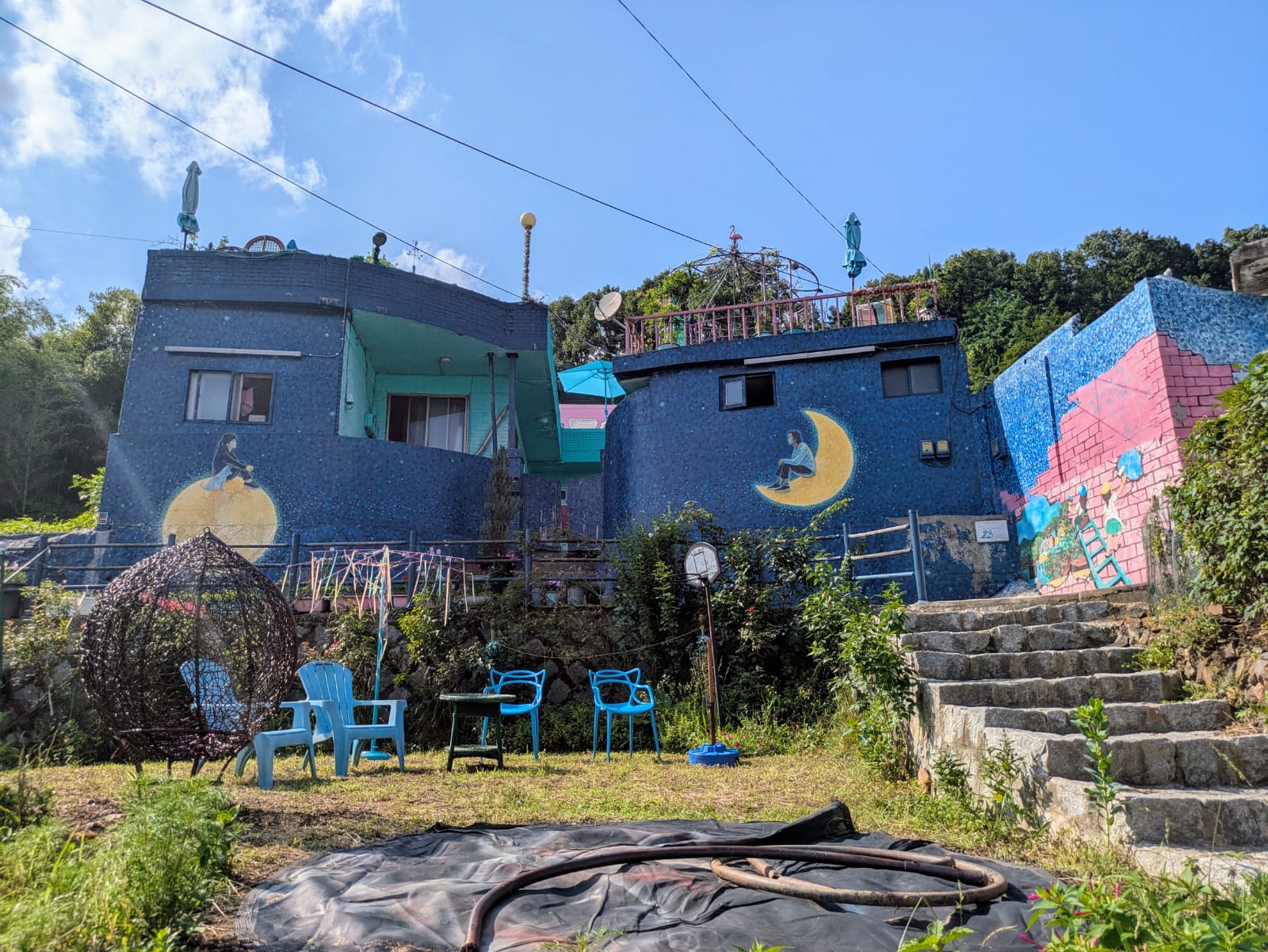
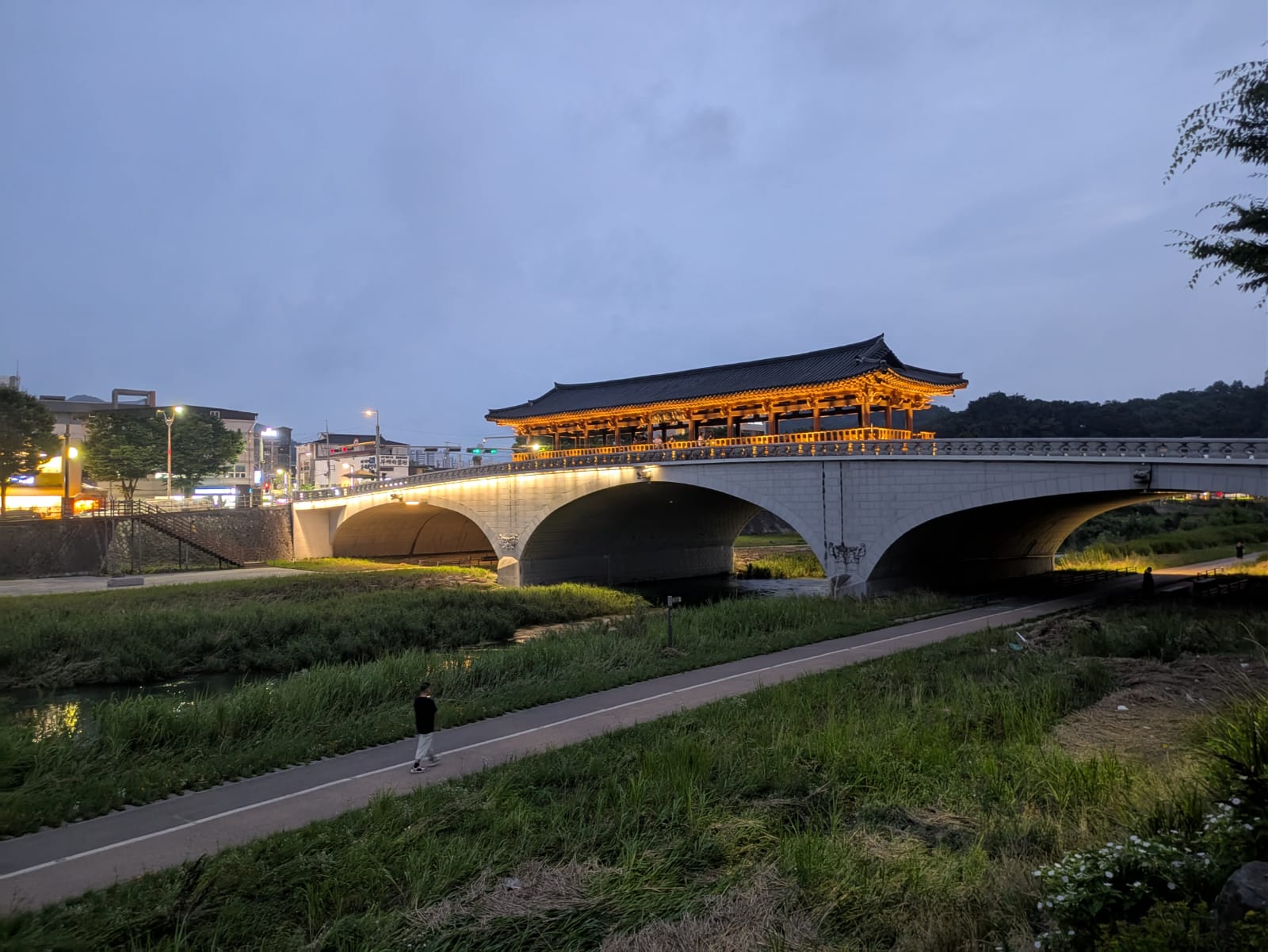
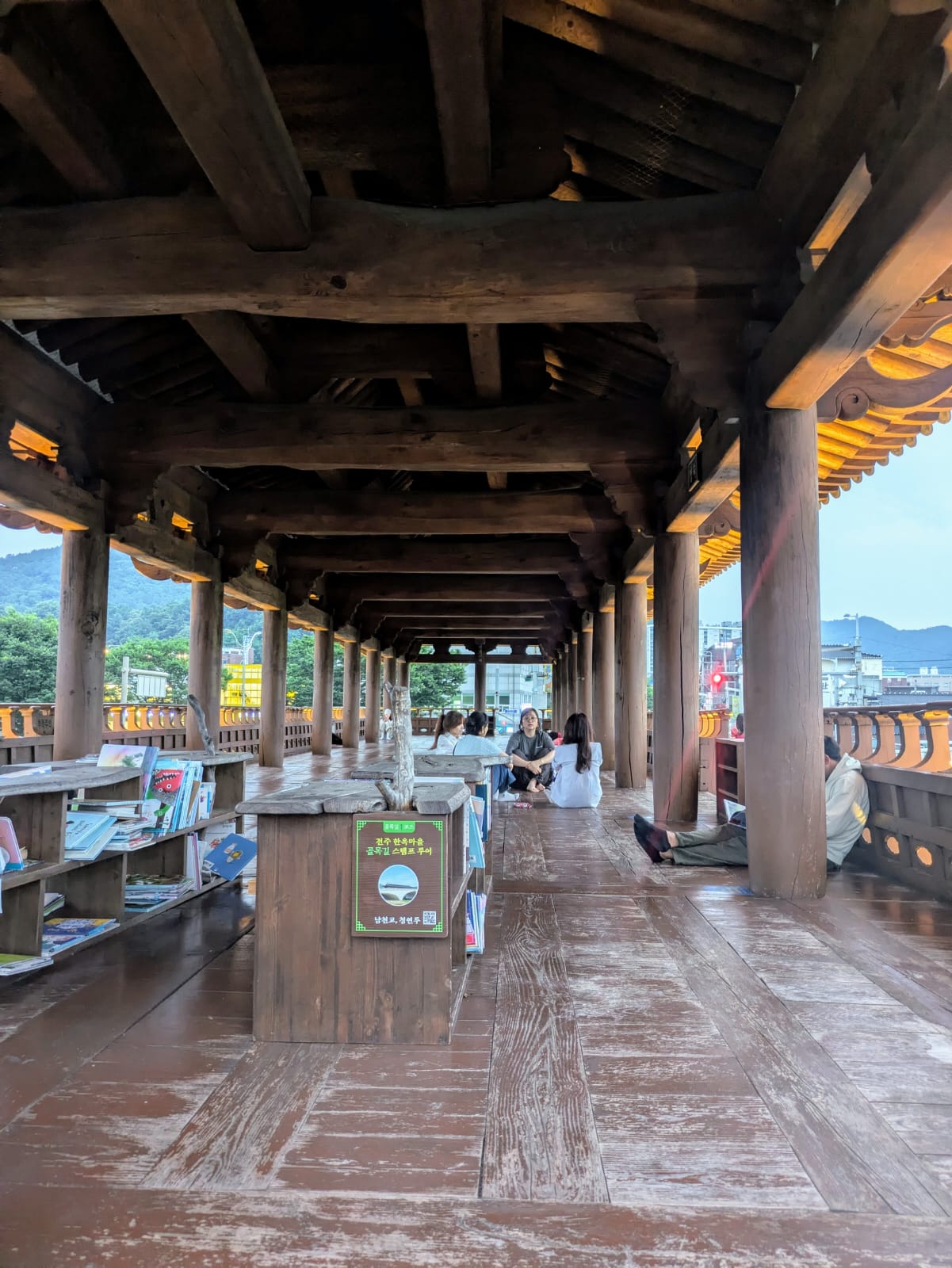
After a shower, we go out to eat at a restaurant serving Hawaiian food. Surprising, isn't it? We do sometimes enjoy eating something other than Korean food, we have to admit. Afterwards we stroll through the streets at night. As expected, the tourists have gone, as Jeonju is a day-trip destination from Seoul or Busan. Everything is calm and the orange glow of the streetlamps adds to the peaceful atmosphere. On a bridge, in a sort of long, wall-less little temple, a free library has been set up. You can sit there to read, chat or simply do nothing and watch the river flow below. We think that if the same kind of facility were offered in a big French city, it surely wouldn't last long. Clémence chooses some books and Stéphane manages to tell her the stories using the pictures, since of course they're in Korean. After a few stories, it's time to go back to our little room. The city falls asleep and we follow.
Thursday 26 June
We escape Jeonju by riding five kilometres through town. On the way we pass two bike shops, but pumping up our tyres there is always difficult. Strangely, we've developed a theorem that's proven true every time: all the unpleasant people in Korea work in bike shops. Every time we stop at one, the person is either openly rude or annoyed by our presence. In the first shop we stop at, the man struggles to get up from his armchair in front of the TV to help us with the compressor. In the second, we ask for a simple pump, but as always the employee wants to do it himself. He squeezes our tyres, doesn't pump them up and gives us a thumbs-up to say they're fine.
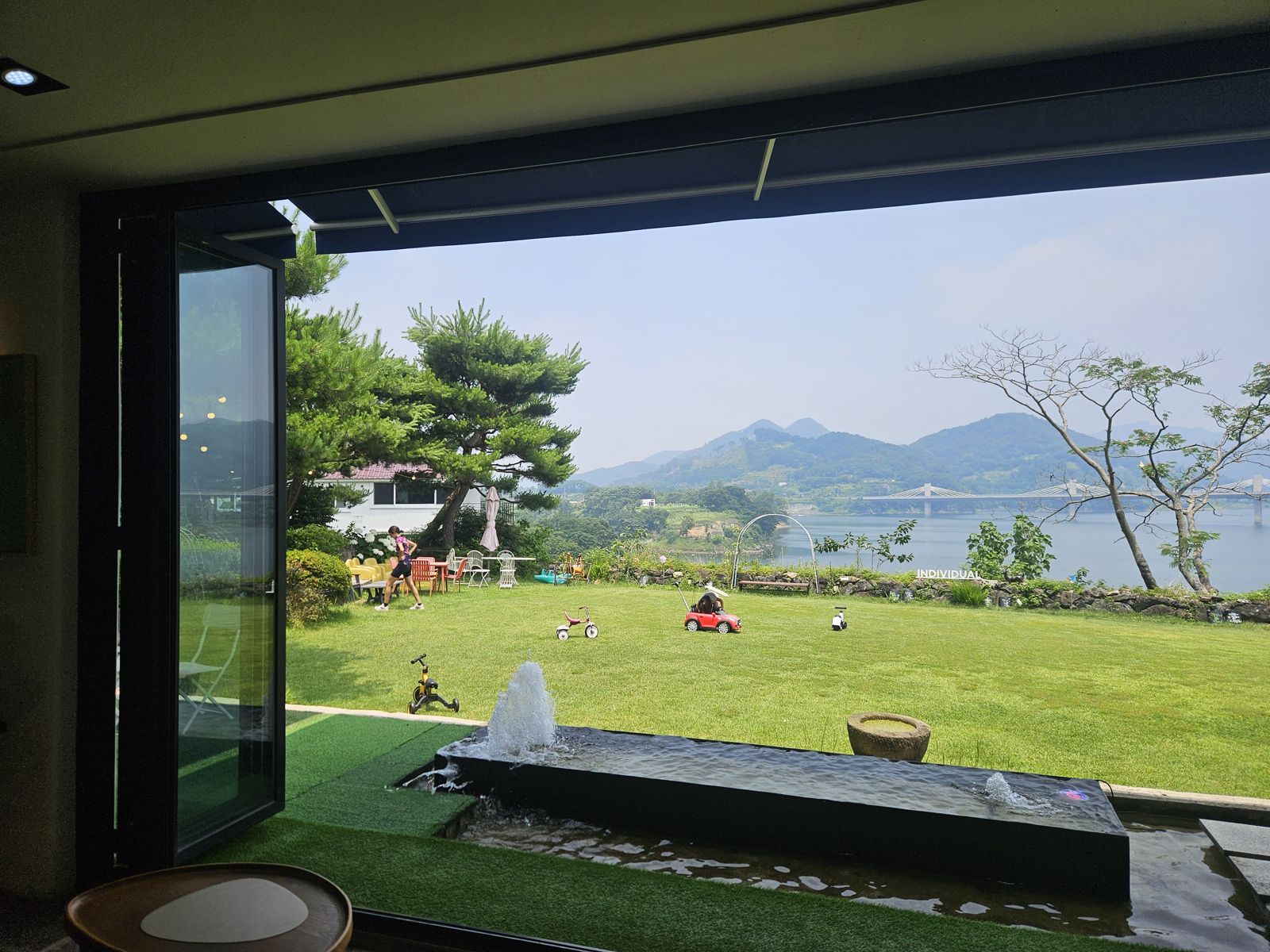
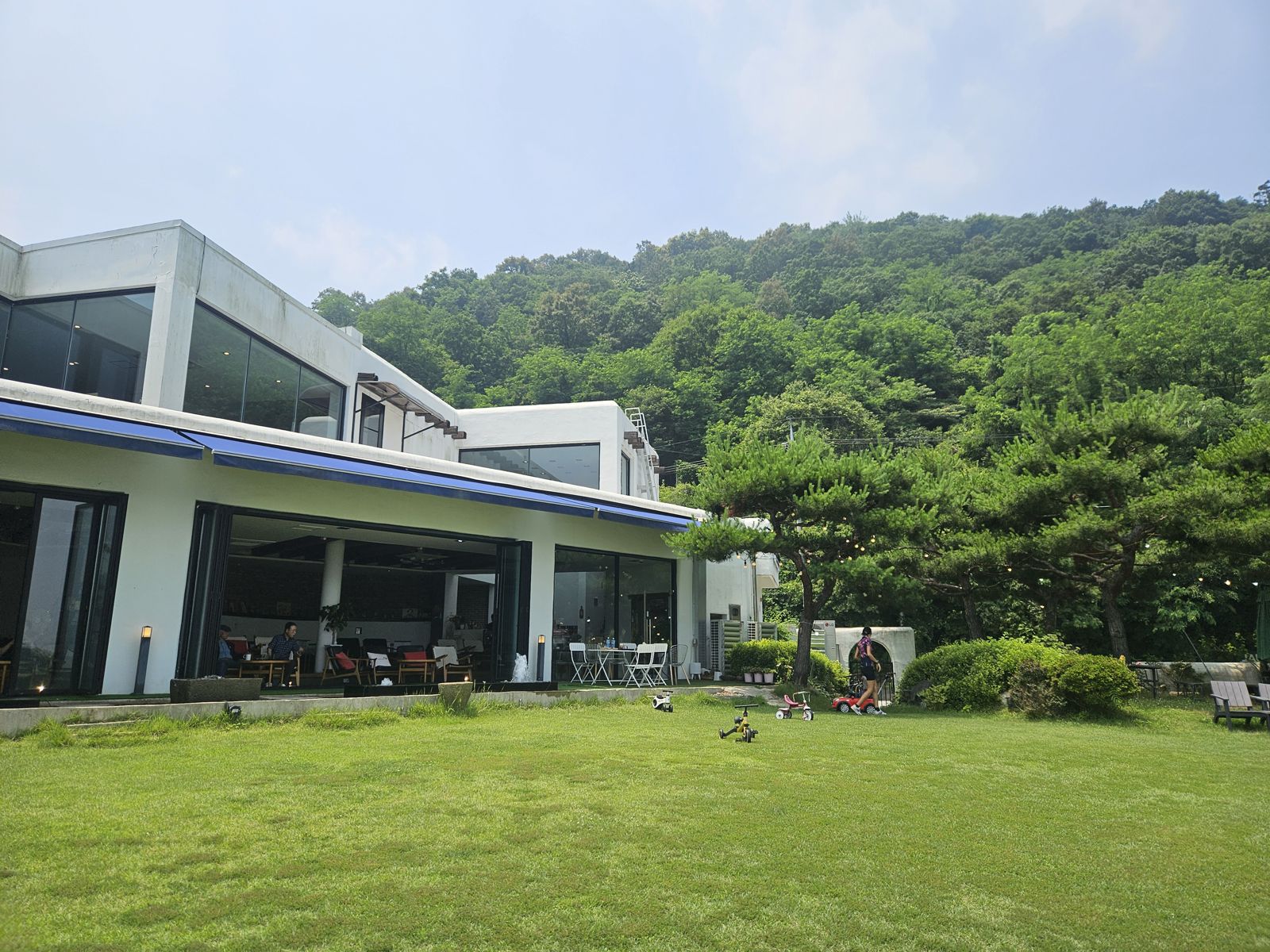
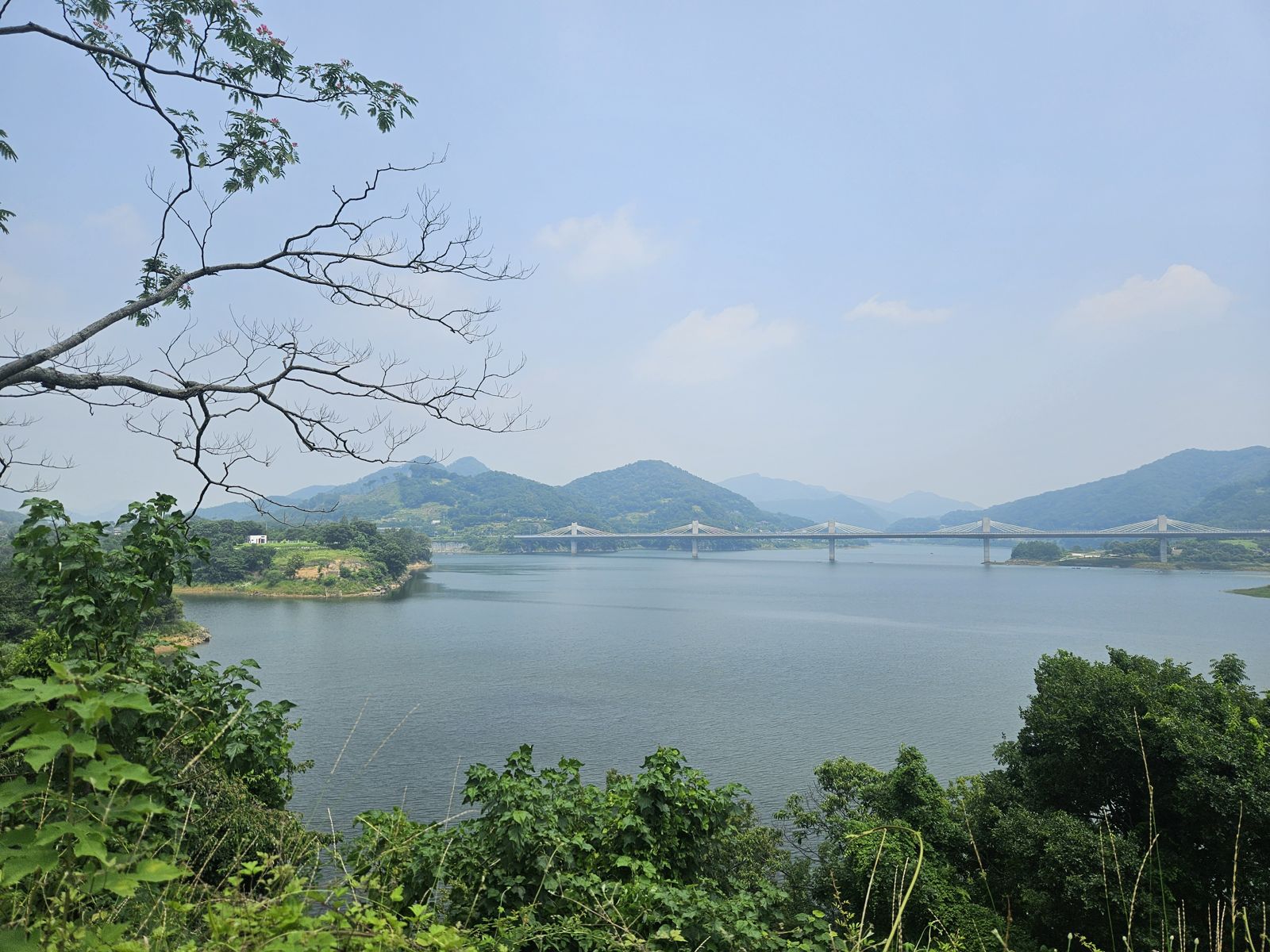
Their pumps never have a gauge to check the exact pressure, which isn't at all practical when you're riding heavily loaded. We don't want to insist, so we leave disappointed. To reach Korea's most beautiful cycle route from Jeonju, you have to ride about thirty kilometres on country roads. Crossing this hinterland, we can't help noticing that here, as at home, rural exodus isn't just a phrase but a reality. We hardly meet anyone, there are very few cars, and riding is very pleasant. We wind around the huge artificial Okjeongho lake and the views are sumptuous. After about thirty kilometres, we reach the start of the Seomjingang cycle route, which follows the Seomjin River (hence the name) through the very bucolic south-central region of Korea. We stop at a small convenience store to buy food for tonight and tomorrow morning, as there's nothing around the guesthouse where we're sleeping tonight. We've barely walked in when the cashier kindly gives us three ice creams.
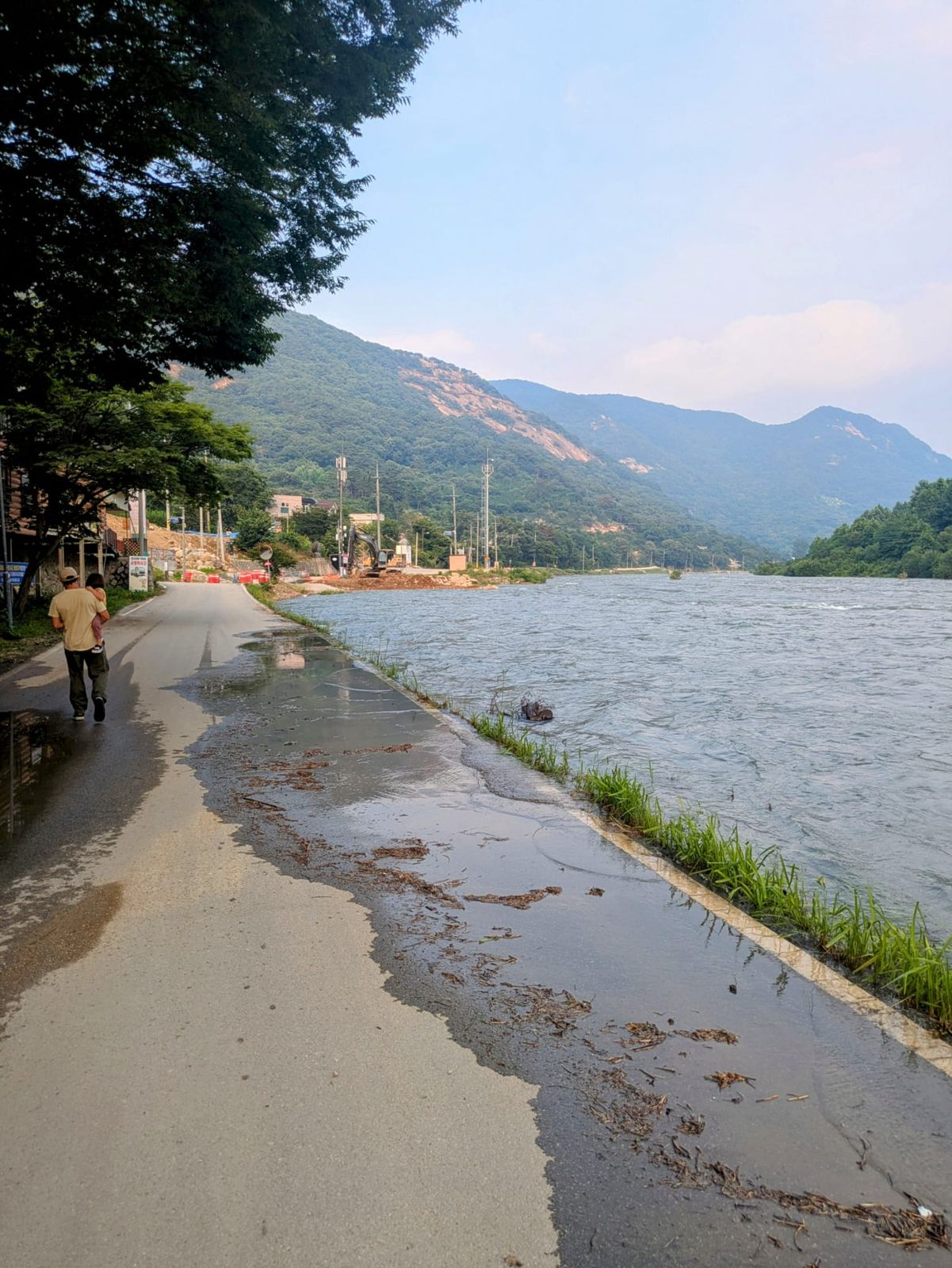
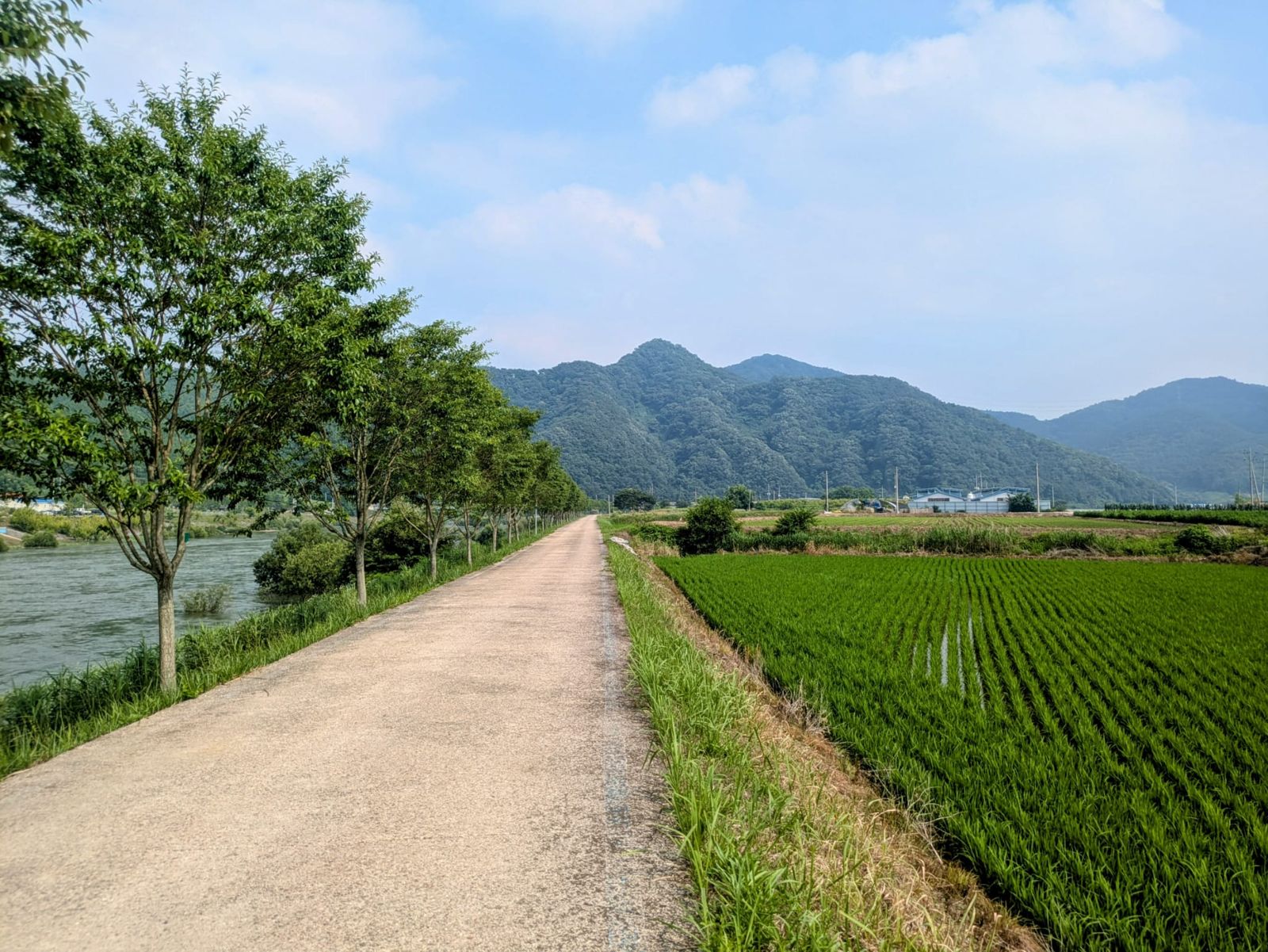
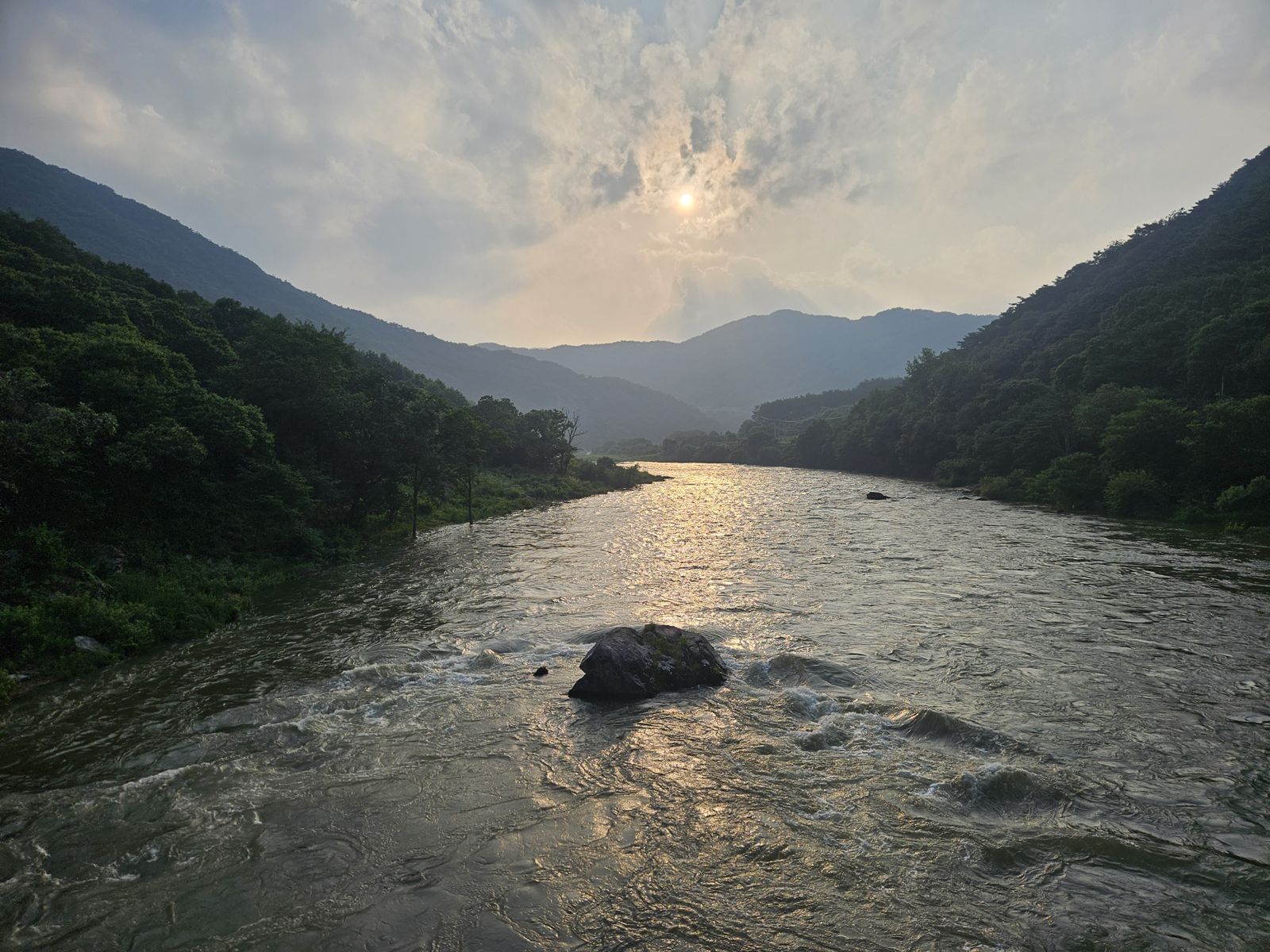
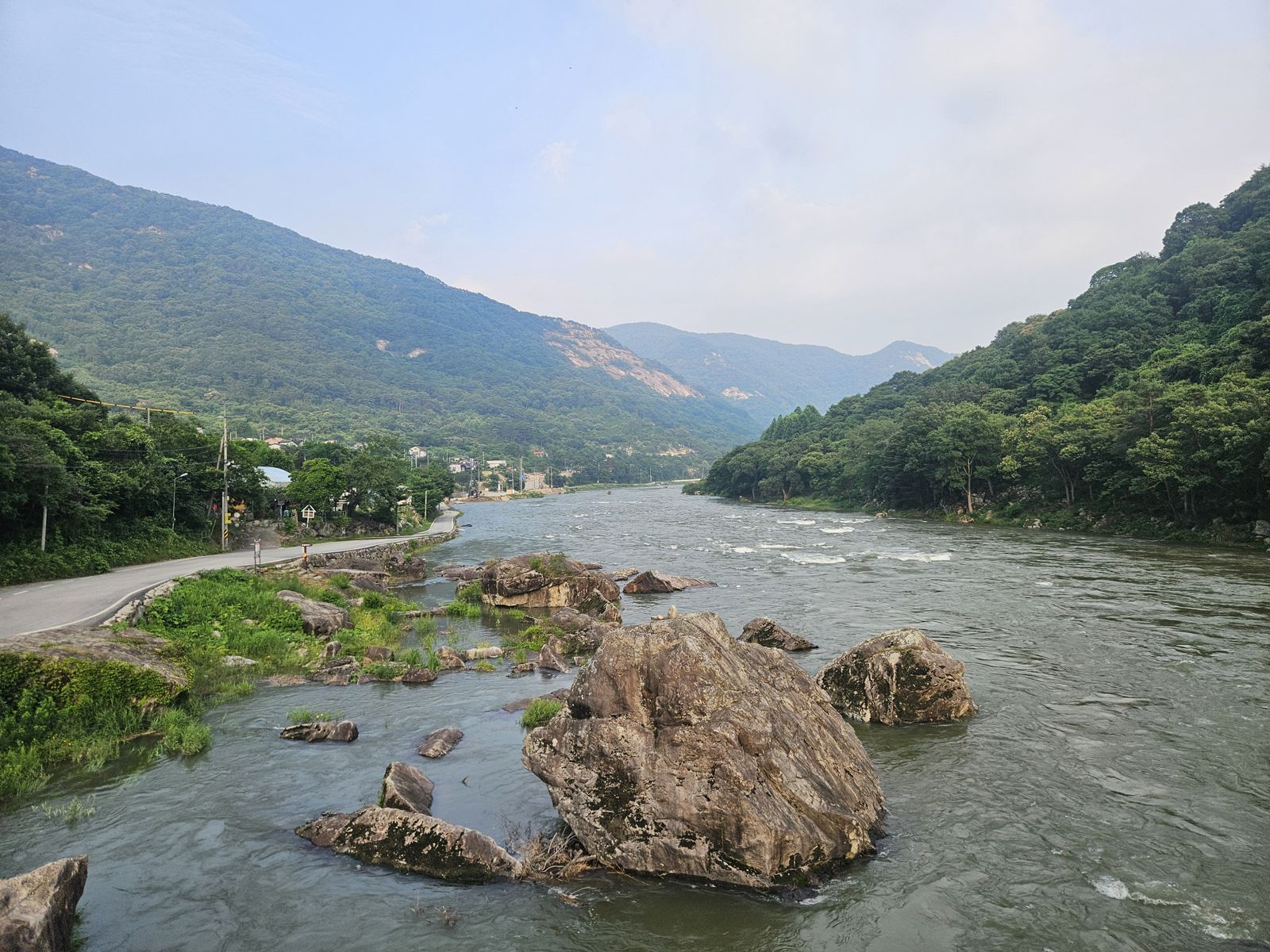
It's already 2 pm when we decide to stop for lunch in the shelter of a little square. A lorry driver passing by pulls up beside us, gets out of his truck and hands us drinks. He's very impressed to see us travelling by bike with Clémence. We really don't know how to express our gratitude to these people, each more adorable than the last (except bike mechanics, of course). We're at the start of the cycle route and glide along the river. Its level is dangerously high, as the sluices of the dam upstream have been opened to release water from the heavy rain the region has had in recent days. The cycle path sometimes skims the riverbed by ten centimetres and the fords are all flooded. Fortunately the detours don't add much distance and we reach the guesthouse in time for an afternoon snack.
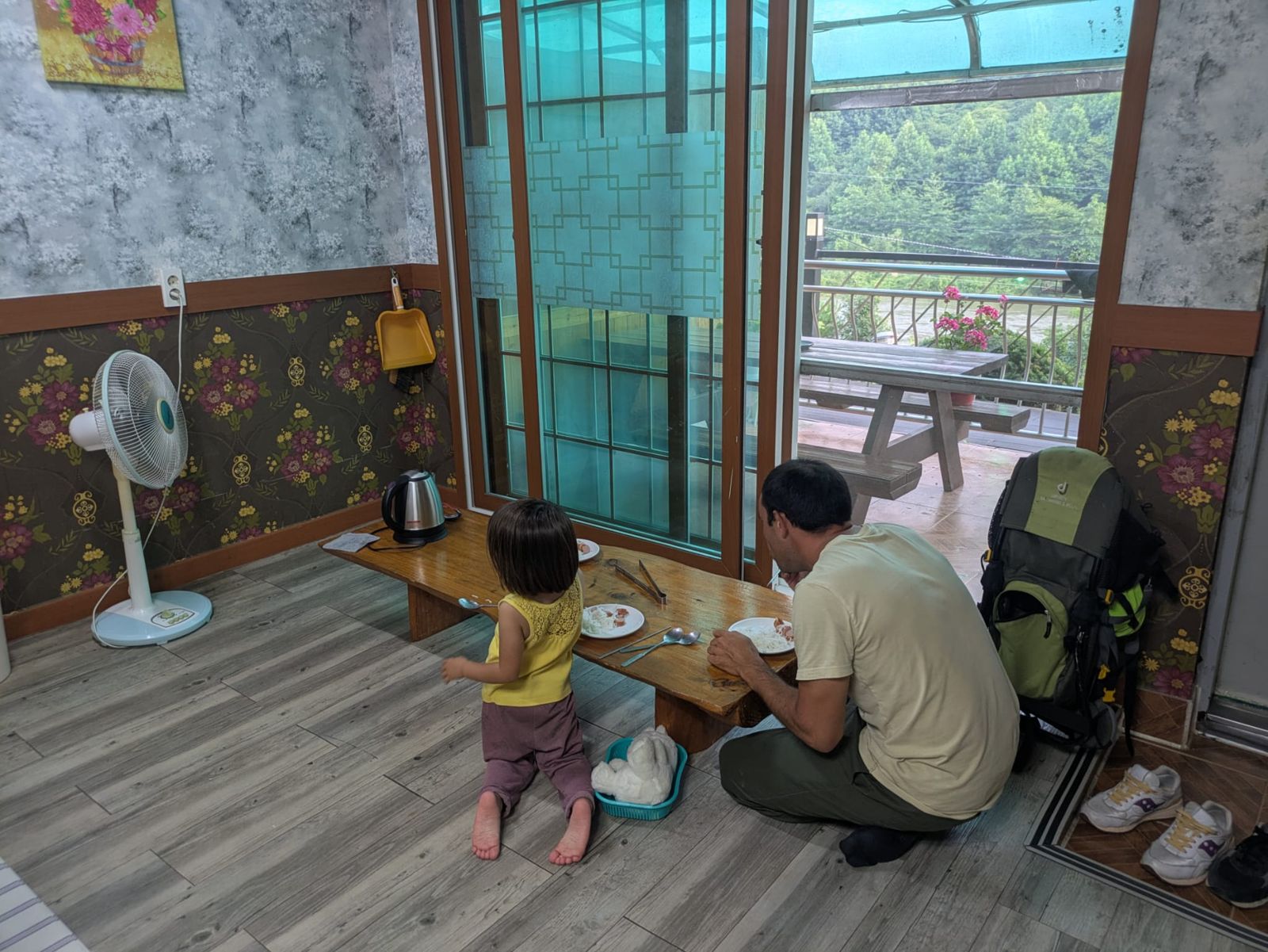
The owner is waiting for us and gives us a choice of two little houses. Here too we'll sleep on thin mattresses on the floor in true Korean style. We're also happy because we'll be able to cook for the first time in ages. Our meal is nothing exciting, noodles and sausages, but it's a pleasure all the same. The house has a little terrace overlooking the rushing river below and the surrounding mountains. All we can hear is the water and the crickets. It's sure to be a very good night.
On the road