 ← PreviousNagasaki, continued and concluded
Sunday 27 July
Miyazaki is a great filmmaker; that's a fact no one can deny. But we'd always thought he greatly exaggerated the local wildlife. After a few weeks travelling the roads of Kyushu, we now know he's only depicting reality. Butterflies are sometimes the size of big bats, huge dragonflies roam in swarms and birds of prey fill the sky.
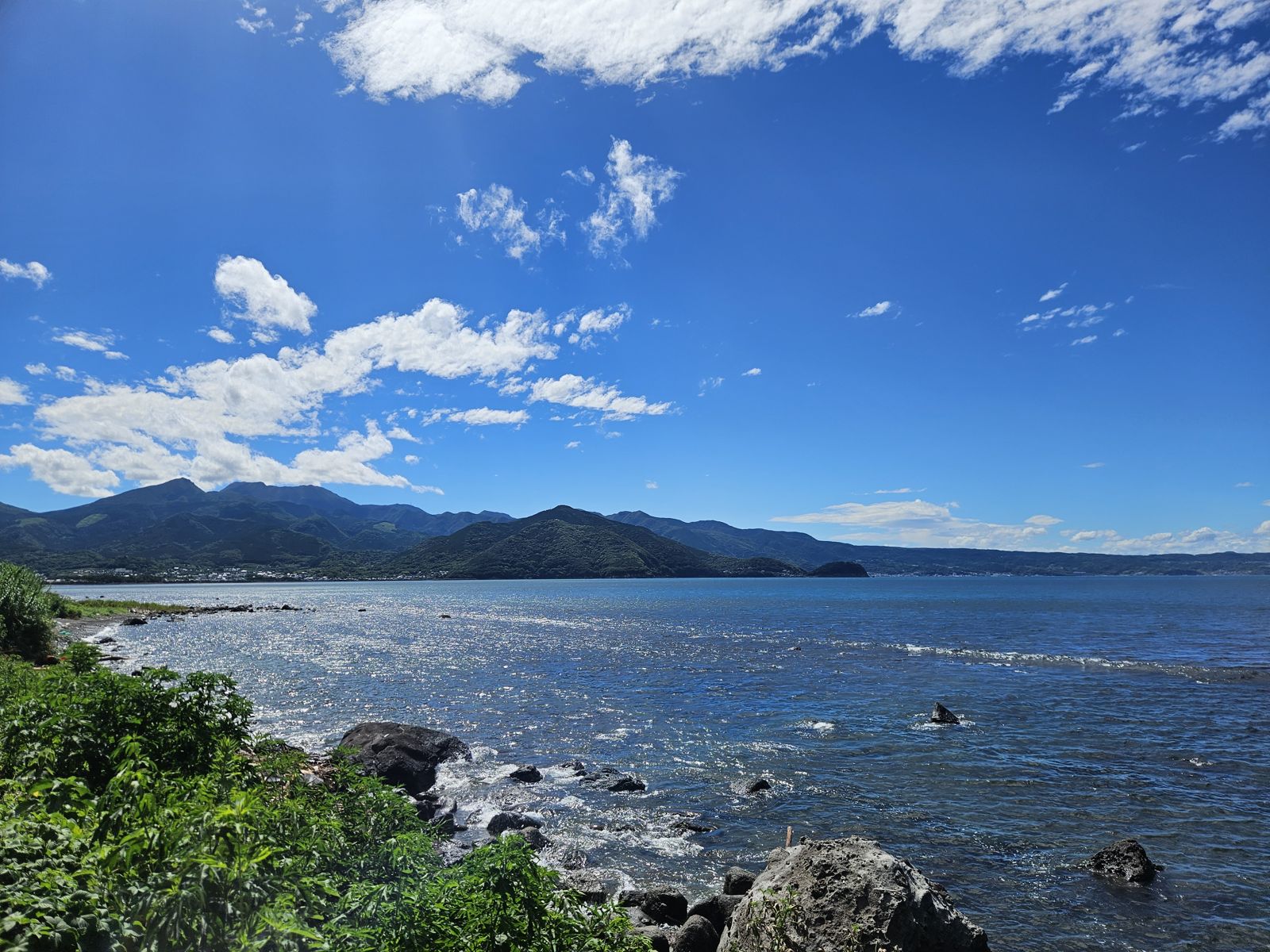
It's a source of daily wonder, like this morning as we ride towards the little coastal town of Obama (yes, like Barack). It's Sunday morning, so the road is a bit quieter than usual. That doesn't stop us having two or three unpleasant encounters, like the man who honks at us on a climb as if asking us to move over. But move where? There's forest on our left; we can't go anywhere. As usual, the green and blue landscape of hills plunging into the sea is splendid.
After less than twenty kilometres, we reach today's hotel at an unusual time: it's only 11 am. There's no one at reception, so we use an intercom and a toothless old man comes down to meet us. We just want to know whether we can leave our bikes and panniers here to travel lighter. He gladly agrees with the little English he knows. Japan has one of the lowest levels of English proficiency in the world, and you feel it every day. It's also one of the countries with the fewest passport holders. Since the 1990s and the collapse of the yen, the Japanese travel little. It's also one of the few countries where young people speak English less well than their elders.
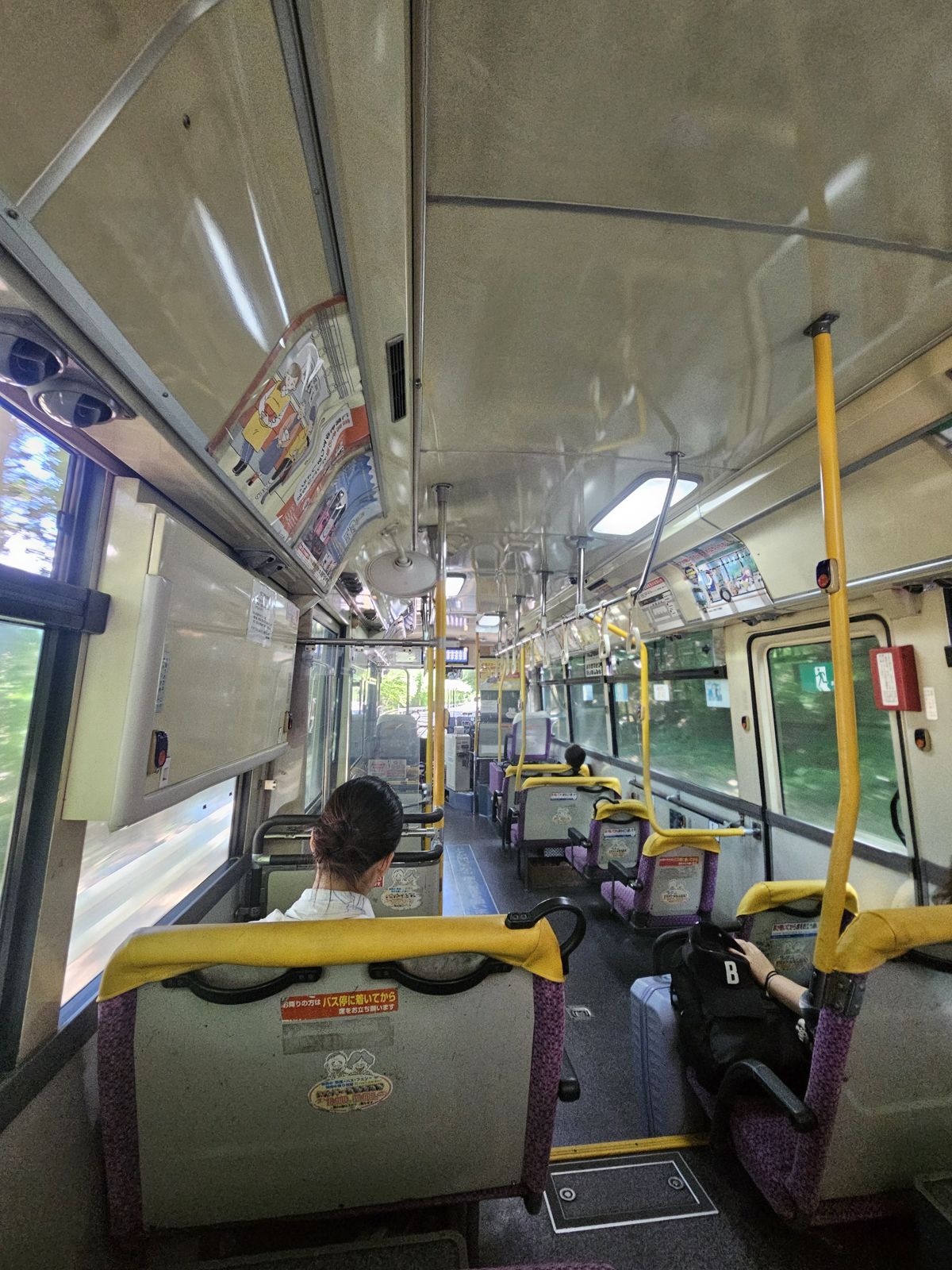
We take a bus to the spa town of Unzen, perched in the mountains at almost 1,000 m. We love cycling, but sometimes you have to know when to give up. The twenty-kilometre climb wasn't an option with our gear. Set in the heart of the national park of the same name, the village of Unzen is known for its volcano (also called Unzen) and its hot springs. Steam rises everywhere because boiling water flows all around and beneath the town. We eat on a public bench in the little town before starting a 4-kilometre hike to Nita Pass, where there's a cable car.
We've barely been walking 15 minutes when a threatening black cloud arrives overhead. Sure enough, it starts raining big drops. Luckily, at that very moment we're passing a chalet with toilets, which lets us shelter until the shower passes. After 20 minutes the cloud has gone and we can set off again. The climb is steep, it's hot and humid, and we take turns carrying the hiking backpack with Clémence in it, as we're sweating buckets. 1,000 metres of altitude isn't enough to cool the air, though it's much less hot than down below.
In June 1991, the French volcanologists Maurice and Katia Krafft tragically lost their lives on Mount Unzen in Japan while documenting a particularly violent eruption. Passionate about active volcanoes, they were near the crater filming pyroclastic flows when a glowing cloud engulfed them, also killing around forty other people, including several journalists.
Clem would like to walk, but the rocks are slippery and we want to reach the top as quickly as possible. After leaving a few litres of sweat on the trails, we finally reach the station. Clémence is wild with joy; she's developed an intense passion for anything remotely resembling a cable car. The machine doesn't exactly ooze modernity: the installation is covered in rust and the operator tries to explain something we don't understand. We get in anyway and are soon at the top. The start of the ride skims the treetops so closely that we wonder, given the state of the cabin, whether we're going to crash into them. From the top, the view is once again spectacular. Kyushu really is splendid, with unrivalled landscapes.
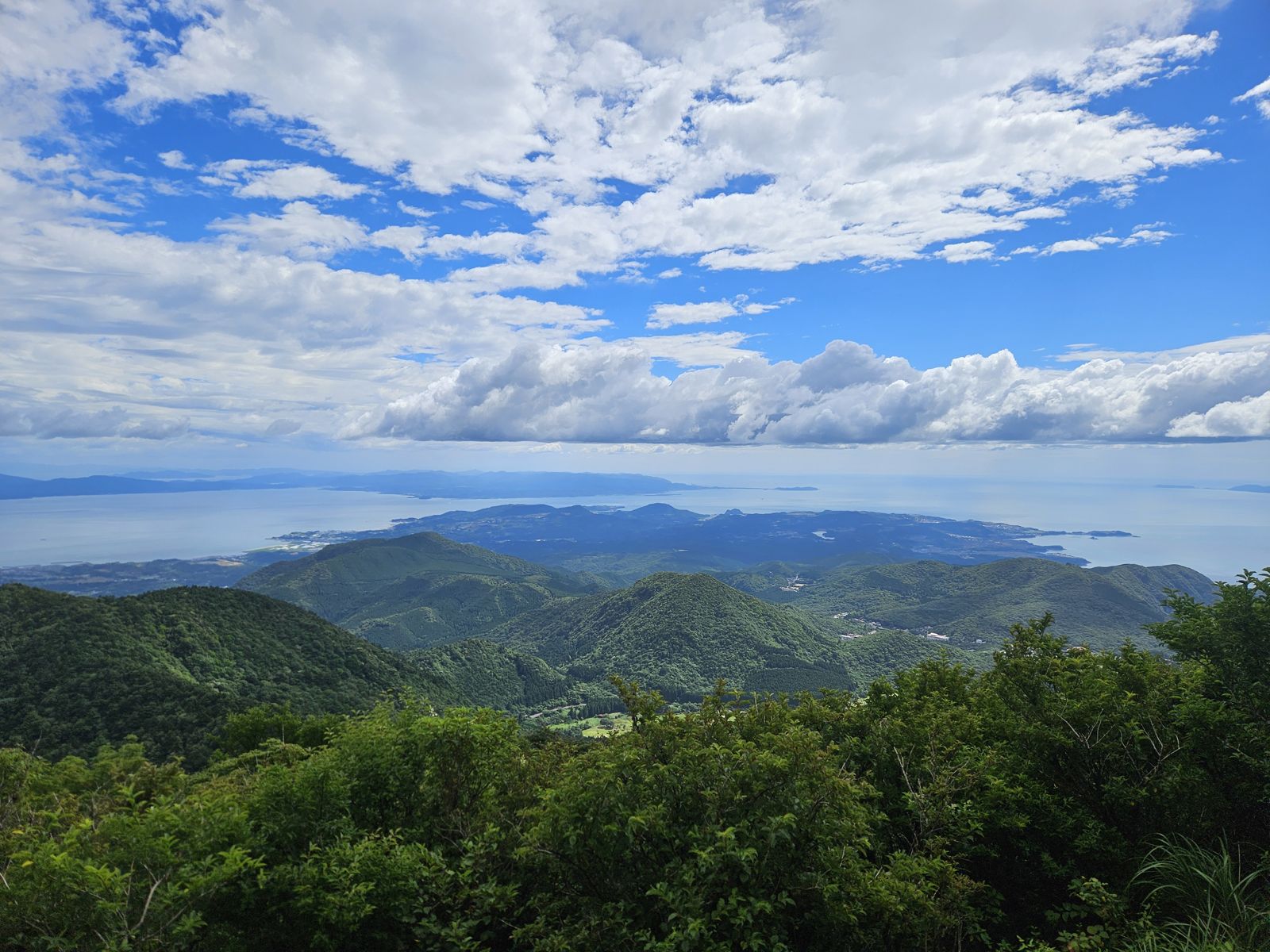
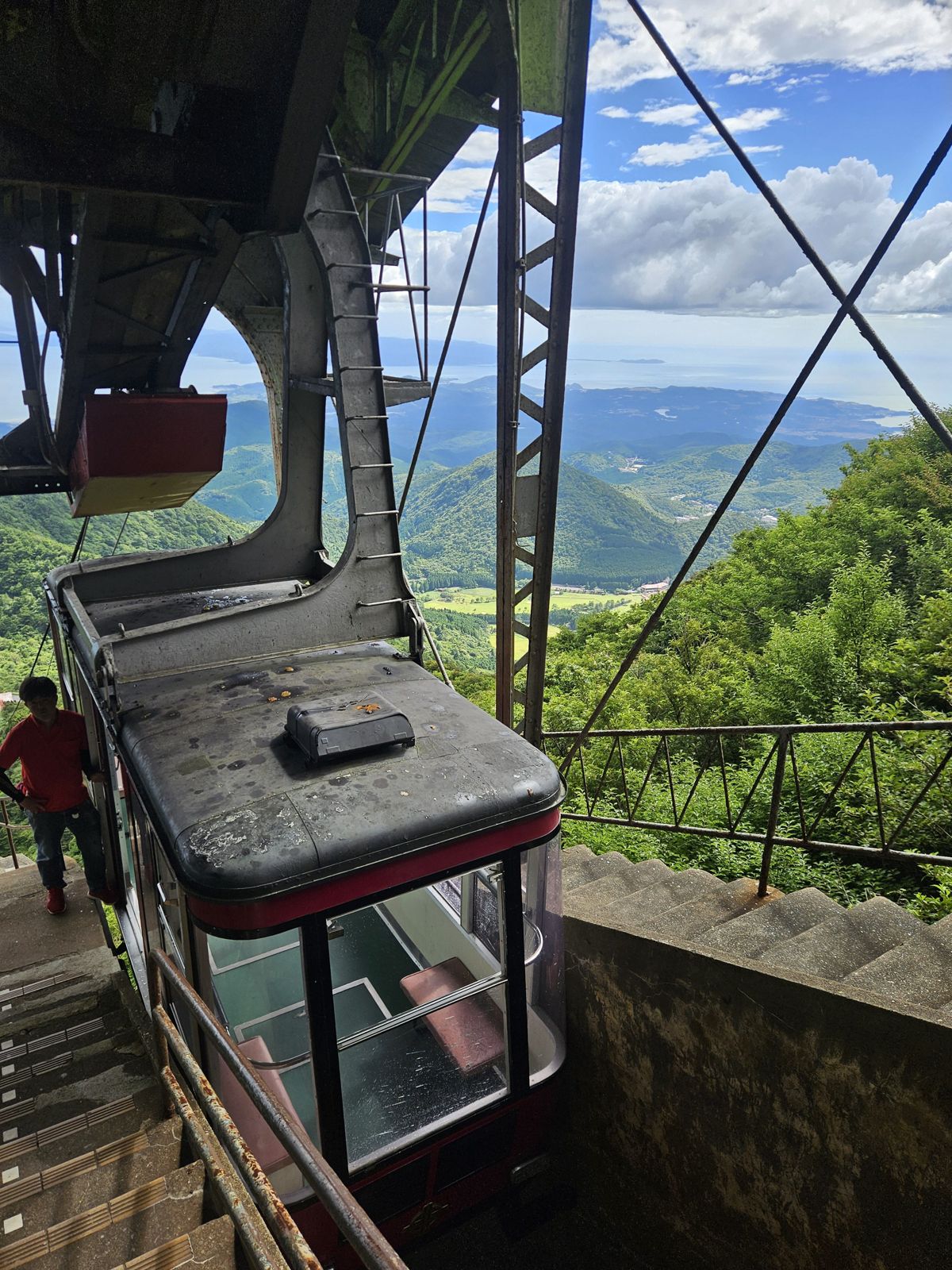
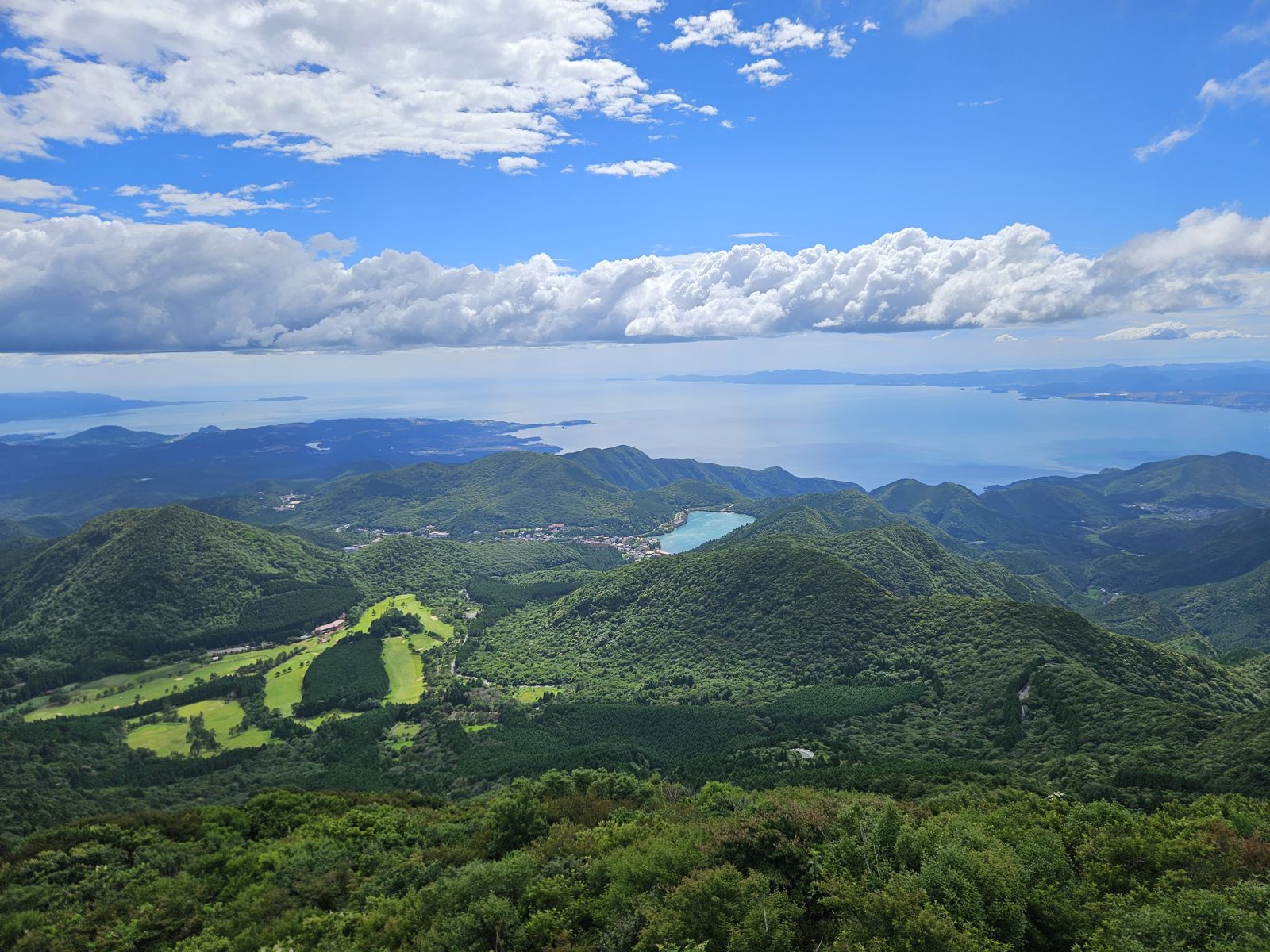
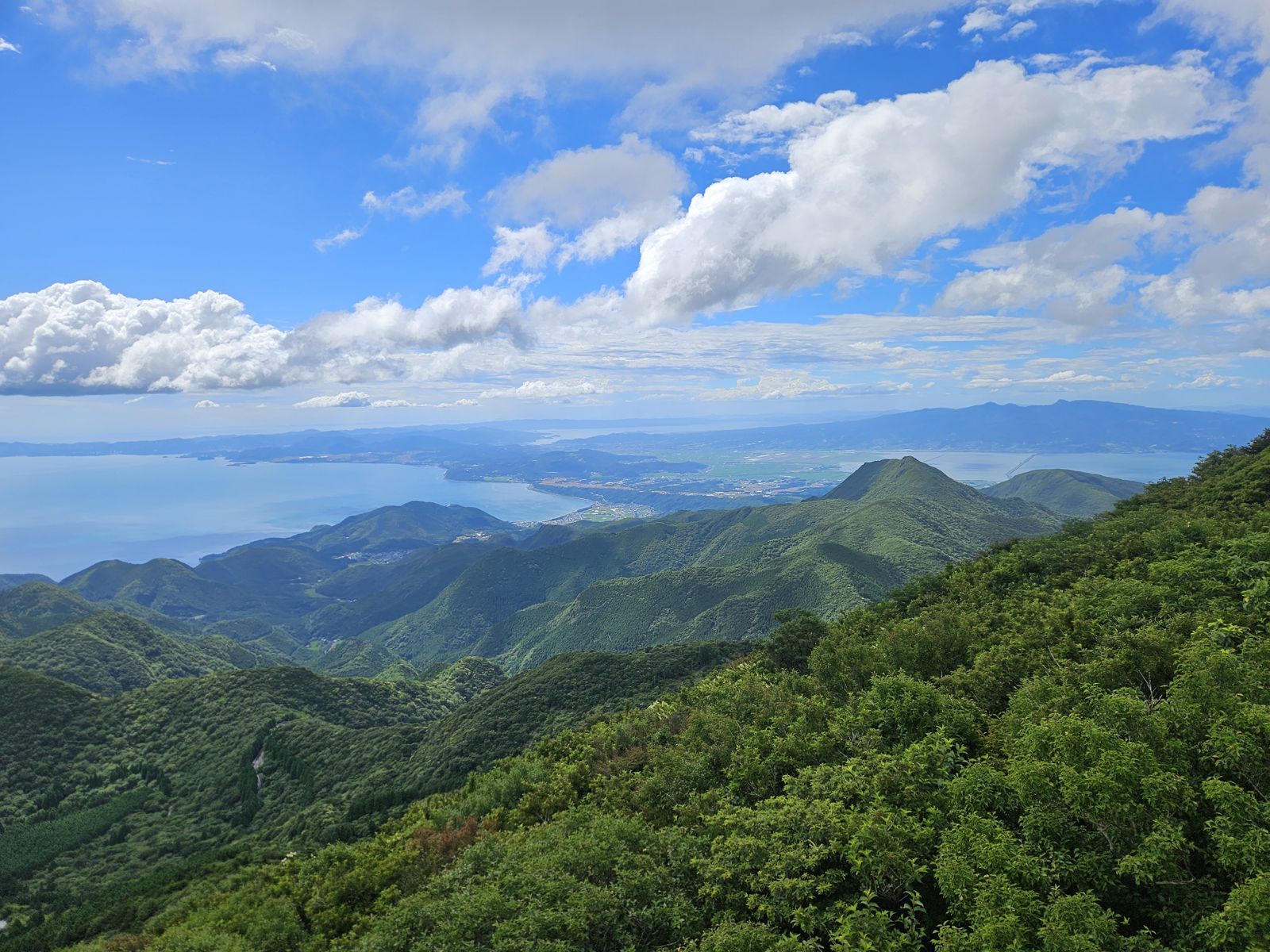
On the way down, Clémence wants to walk, and she does very well for the first two kilometres. She admits defeat after a few falls, climbs back into her backpack, and we soon reach the bus stop. We're a bit early, so we take the time to admire the hot springs and their white steam rising everywhere. It's a funny feeling: when the steam blows over us it's instantly very hot, then as soon as it passes it feels almost cool (even though it's over 30).
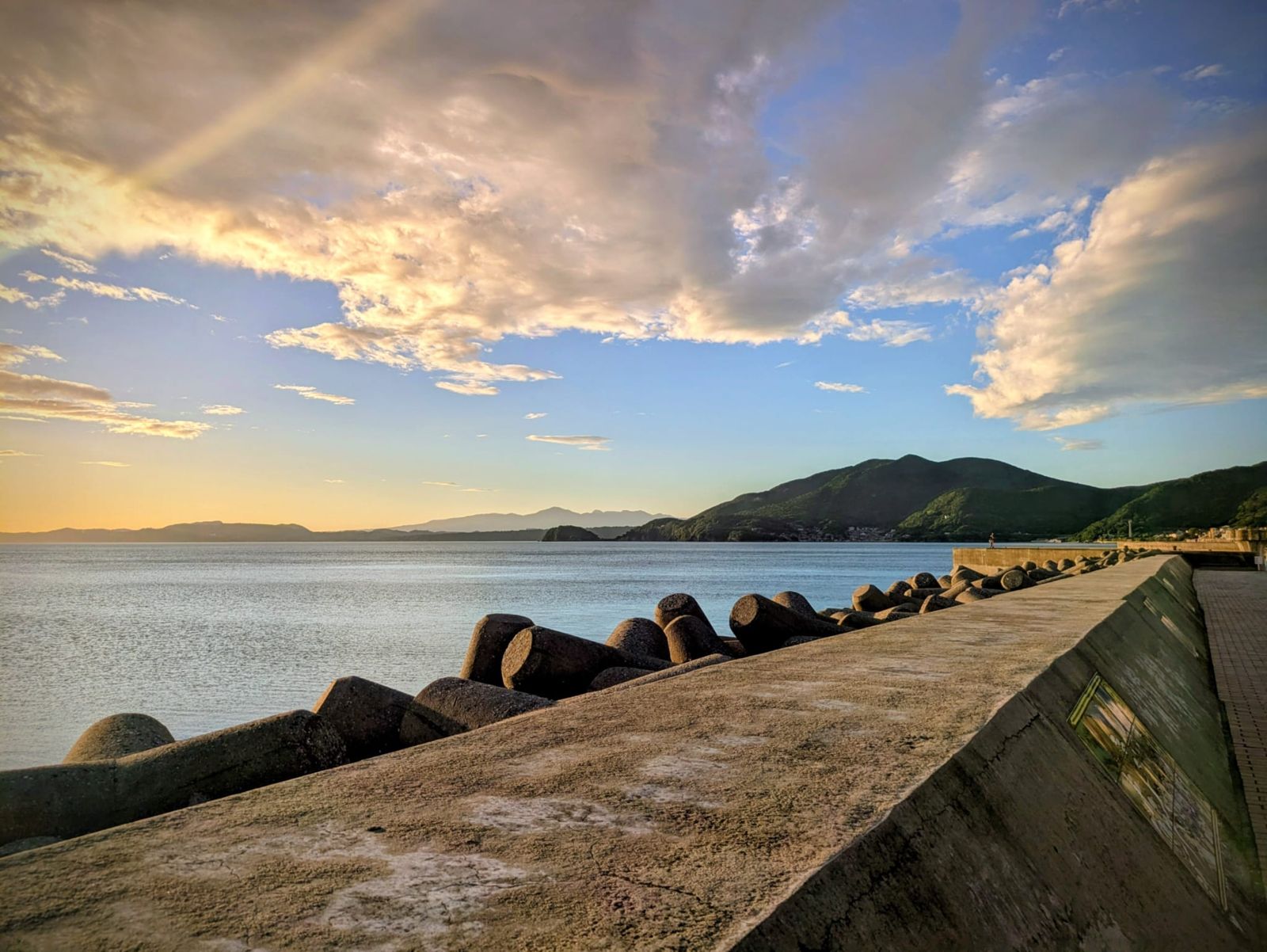
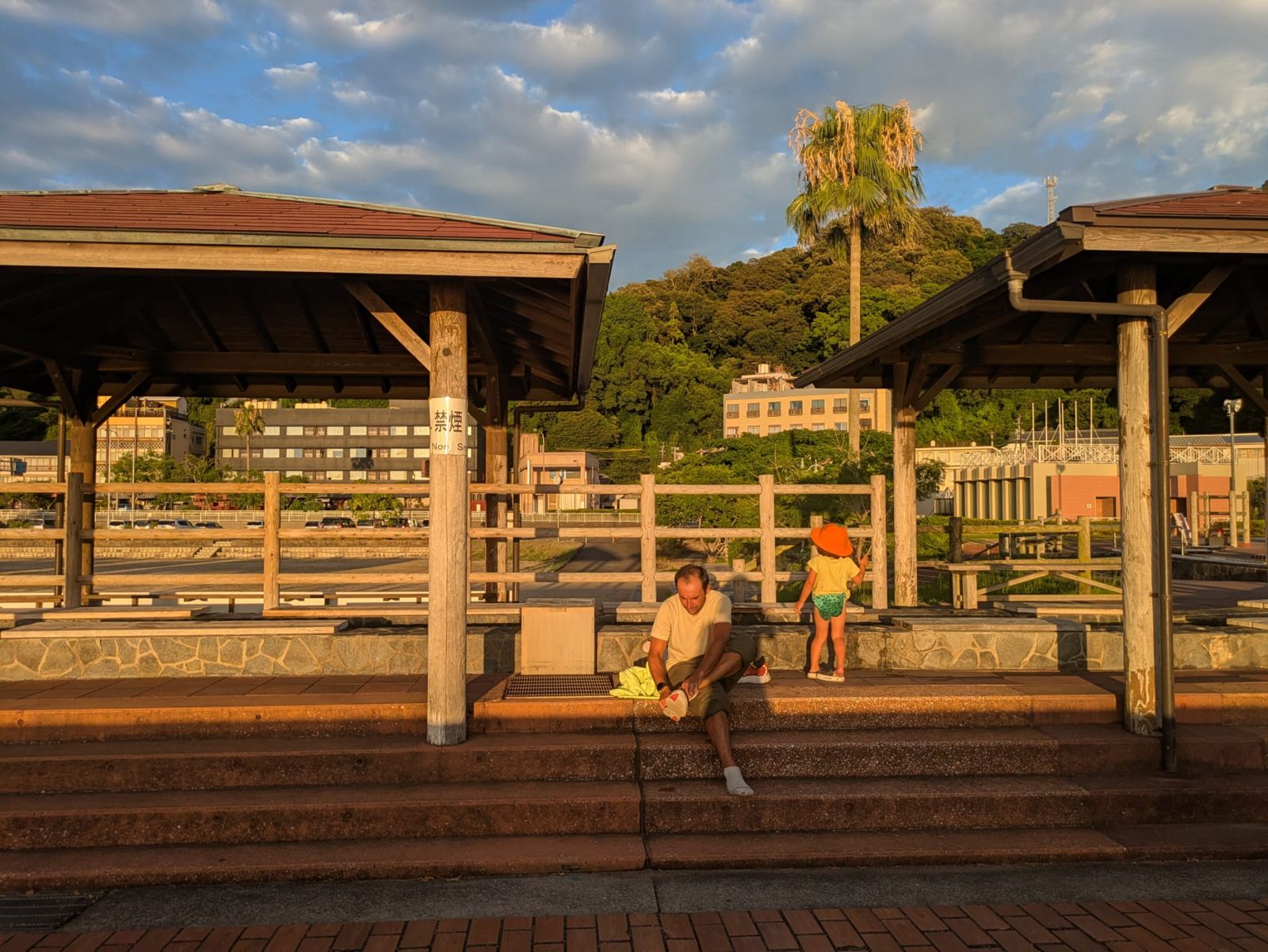
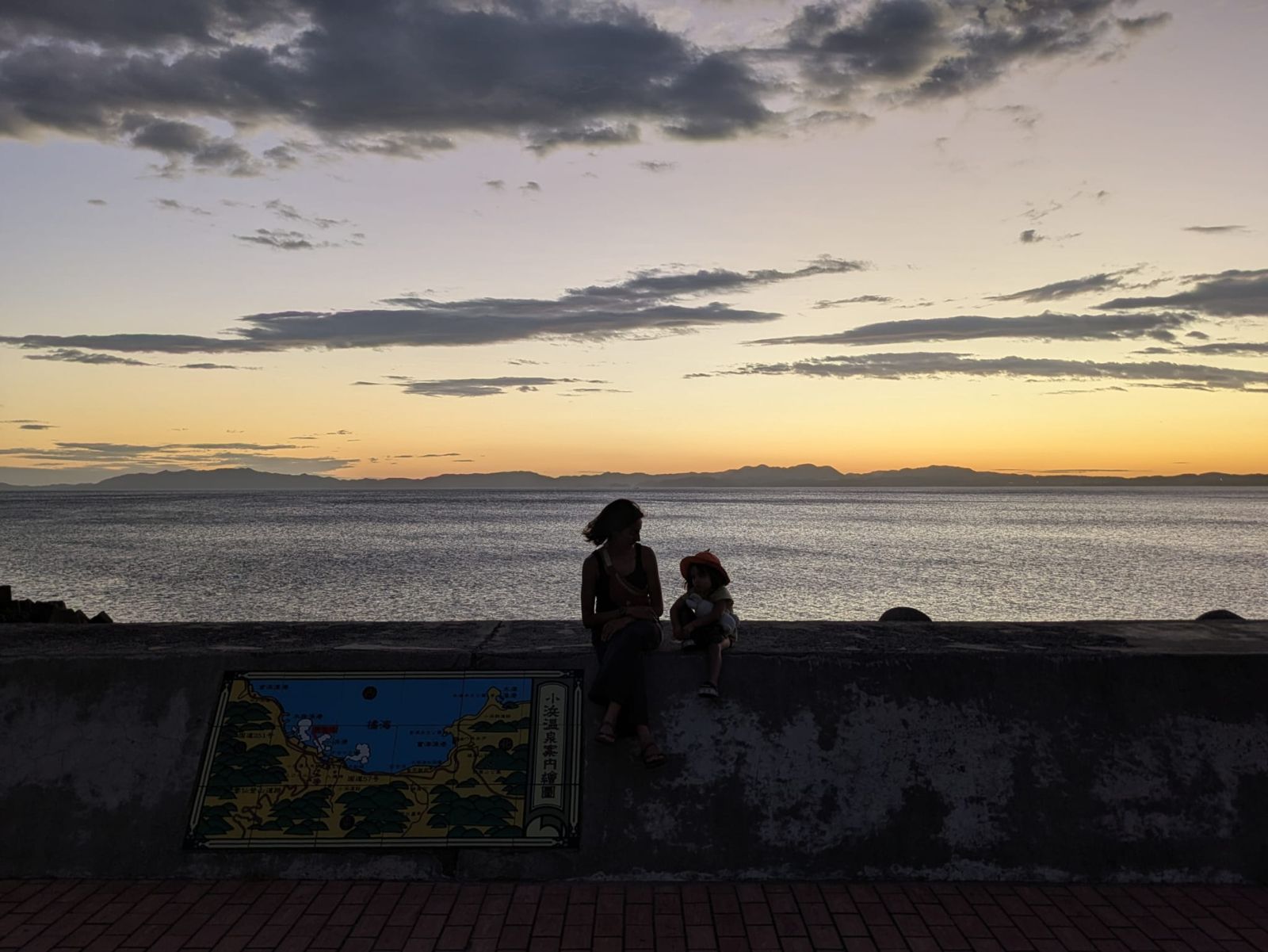
Down in Obama too, you can see white steam rising from the rooftops. The hot springs tumble down the volcanic mountain and pour into the little town. Every hotel has its own onsen, there are several public baths in town, and there's also a long foot bath, the longest in Japan (105 metres), right on the seafront. We dip ours in, which amuses us a lot. The setting sun adds a golden light to an already splendid landscape. To make the most of it, we eat while watching the sun slip behind the mountains, telling us it's time to go to sleep.
Monday 28 July
On long journeys there are always visits to the doctor or the hospital. Life doesn't stop, and what could happen to us at home can also happen at the other end of the world. This morning Cassandre ends up with a completely blocked ear after cleaning it with a cotton bud. She must have pushed in a plug of earwax. Either way, she can hardly hear anything on that side. That's the thread running through the day as we set off, anxious to know whether it will clear.
We're doing another short stage, because we'd rather minimise our time among the cars and because we have a rather special activity this afternoon. We thought we'd have a quiet ride leaving at 10 on a Monday, but apparently not. We're not on a major road, yet not ten seconds go by without someone overtaking us. The people in charge of Kyushu's cycle routes clearly never cycle. In France, to earn the cycle-route label, fewer than a thousand cars a day must use the sections concerned. Let's just say that's probably the hourly rate here. It's not a crush, but for a road at the end of a sparsely populated peninsula, it's still very busy!
We try to stop paying attention to it. We stop at a drugstore, a sort of gigantic pharmacy, but the staff can't find products suited to Cassandre's problem. They recommend a little bamboo tool to try to clean the ear, but it has no effect. We stop for a picnic on a pretty, clean and busy beach. We're always surprised to find riverbanks and beaches strewn with plastic in Japan. The country's geography must push a lot of waste onto its shores, but they consume so much plastic that they may also be responsible.
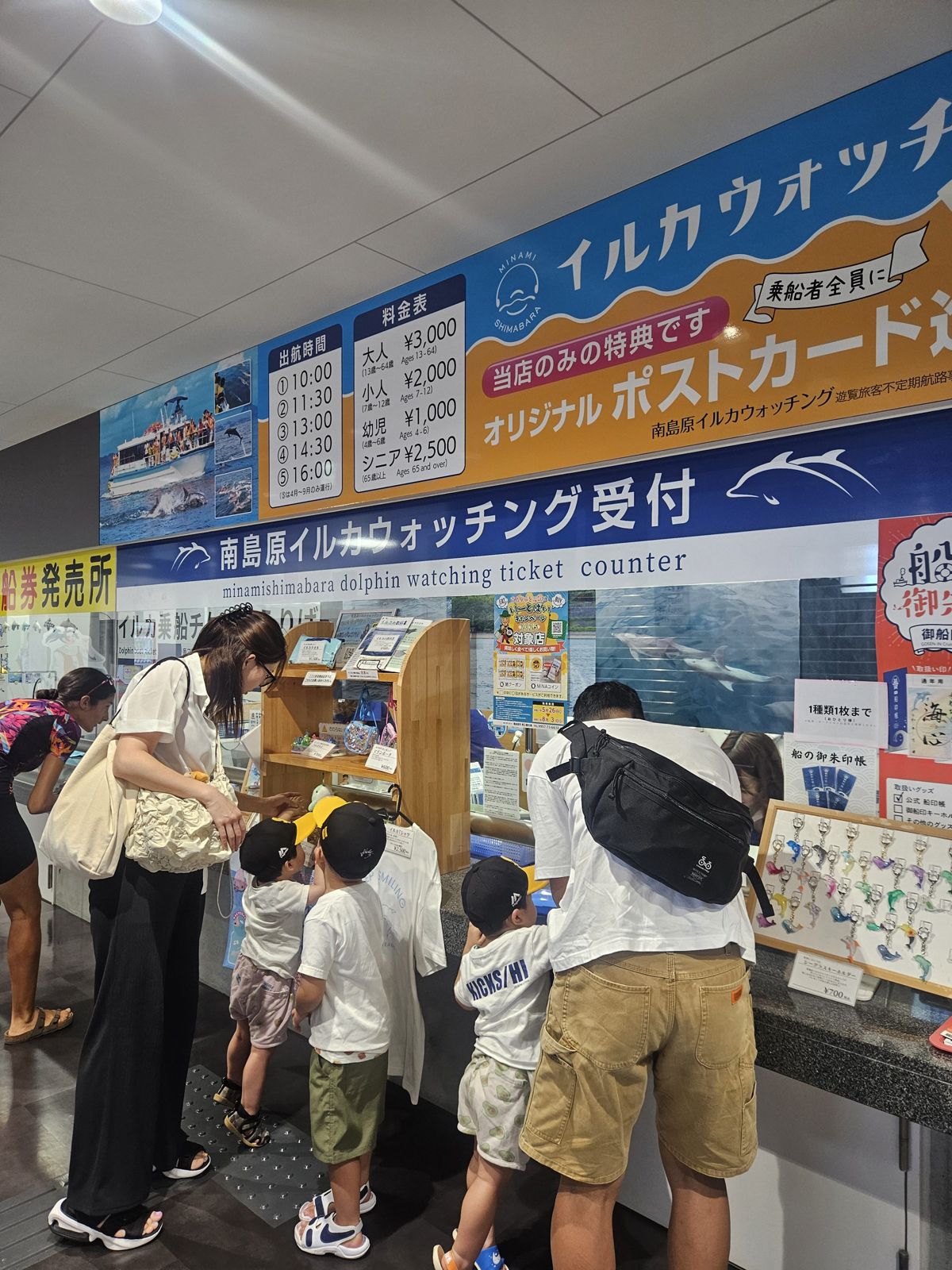
We get back on the bikes for a few kilometres to reach a small port. We board a pretty boat that heads out to sea, then stops after 15 minutes so we can enjoy… dolphins! There are dozens of them, playing at swimming under the boats and leaping out of the water. There are no adults on board any more, only little and big children amazed by this absolutely magnificent show. They pass so close to us that we can see their blowholes, the holes in the back of their heads that let them breathe. Some are more playful than others and keep swimming back and forth in front of us. They come so close we could almost touch them.
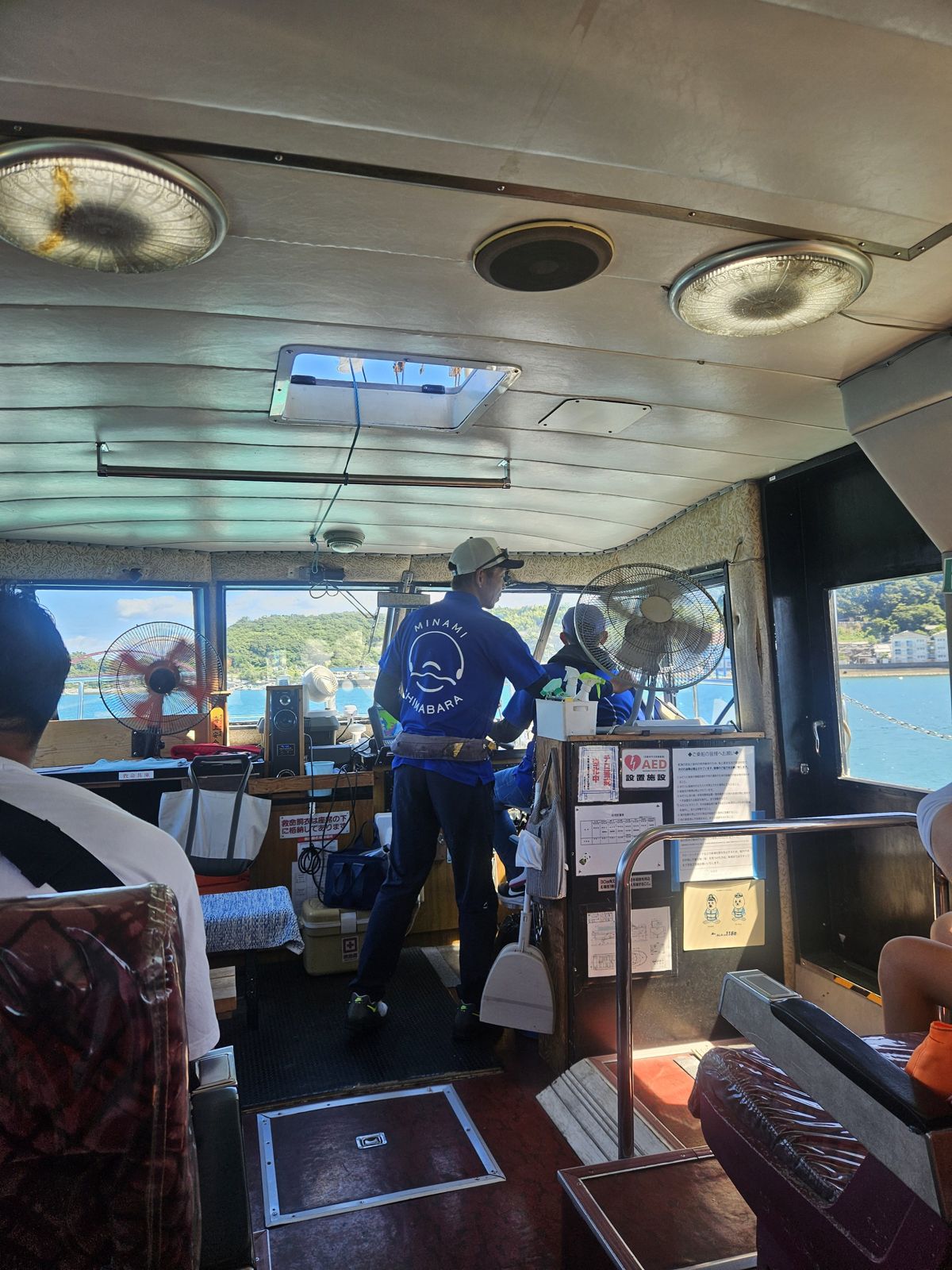
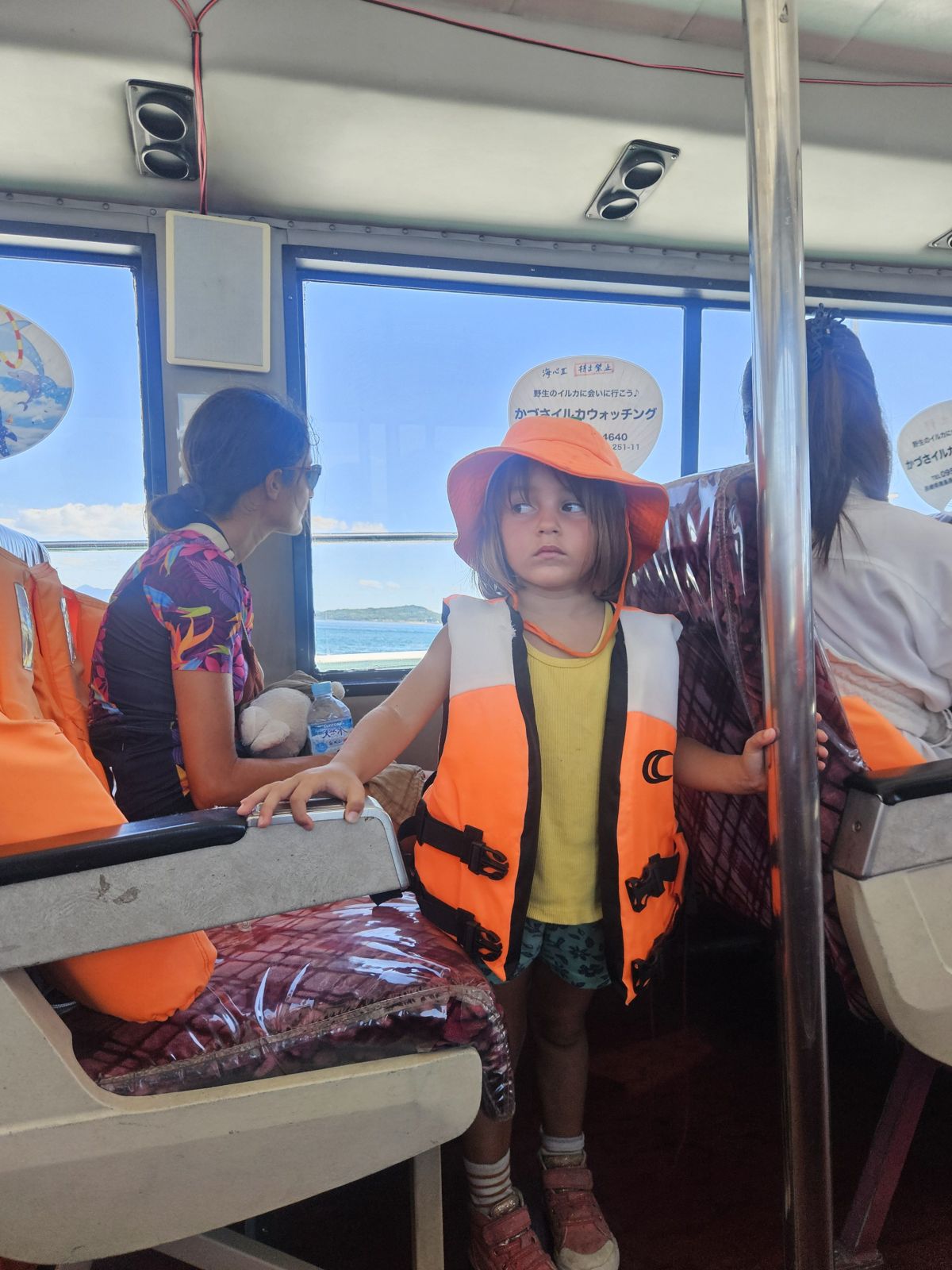
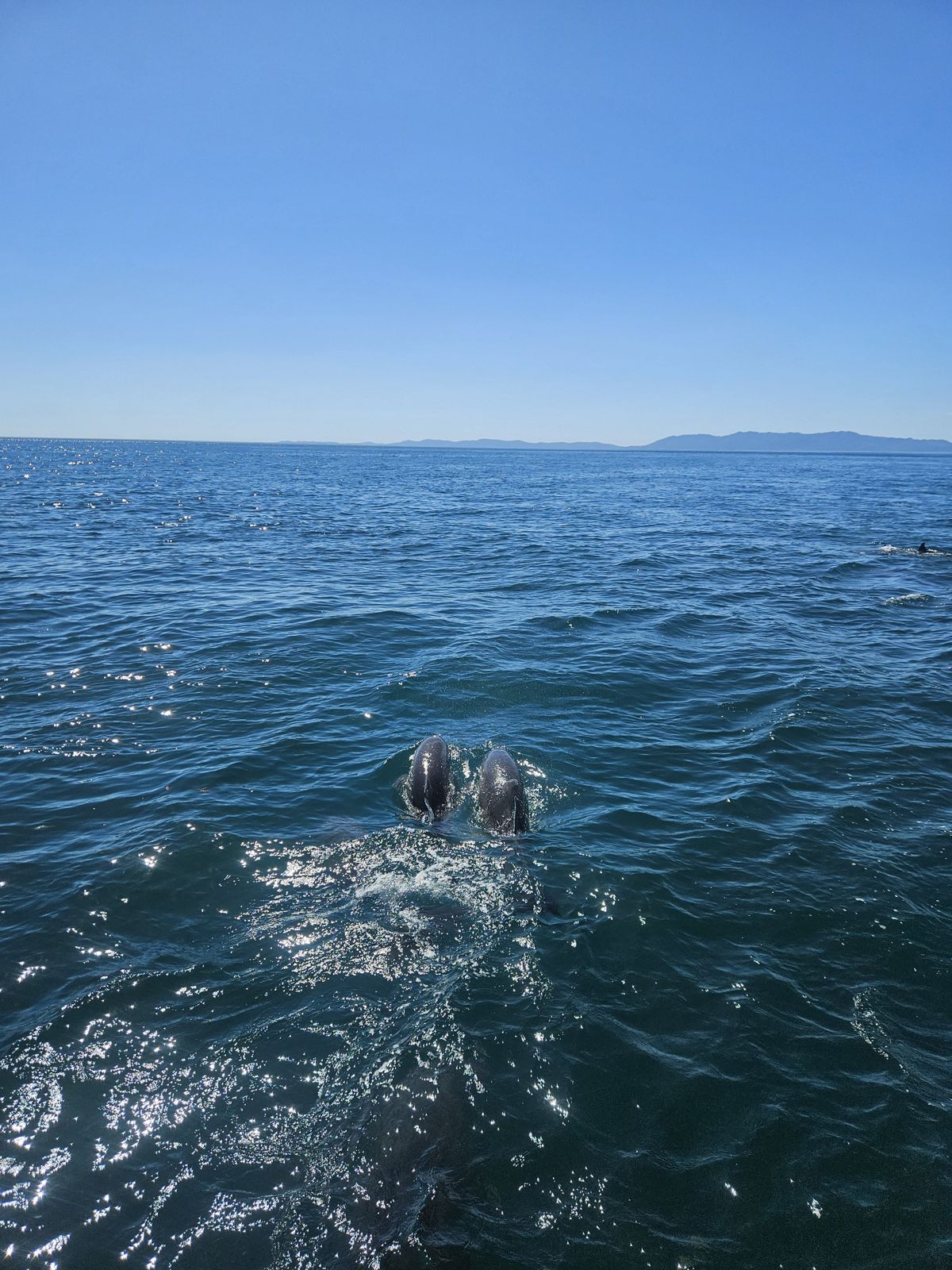
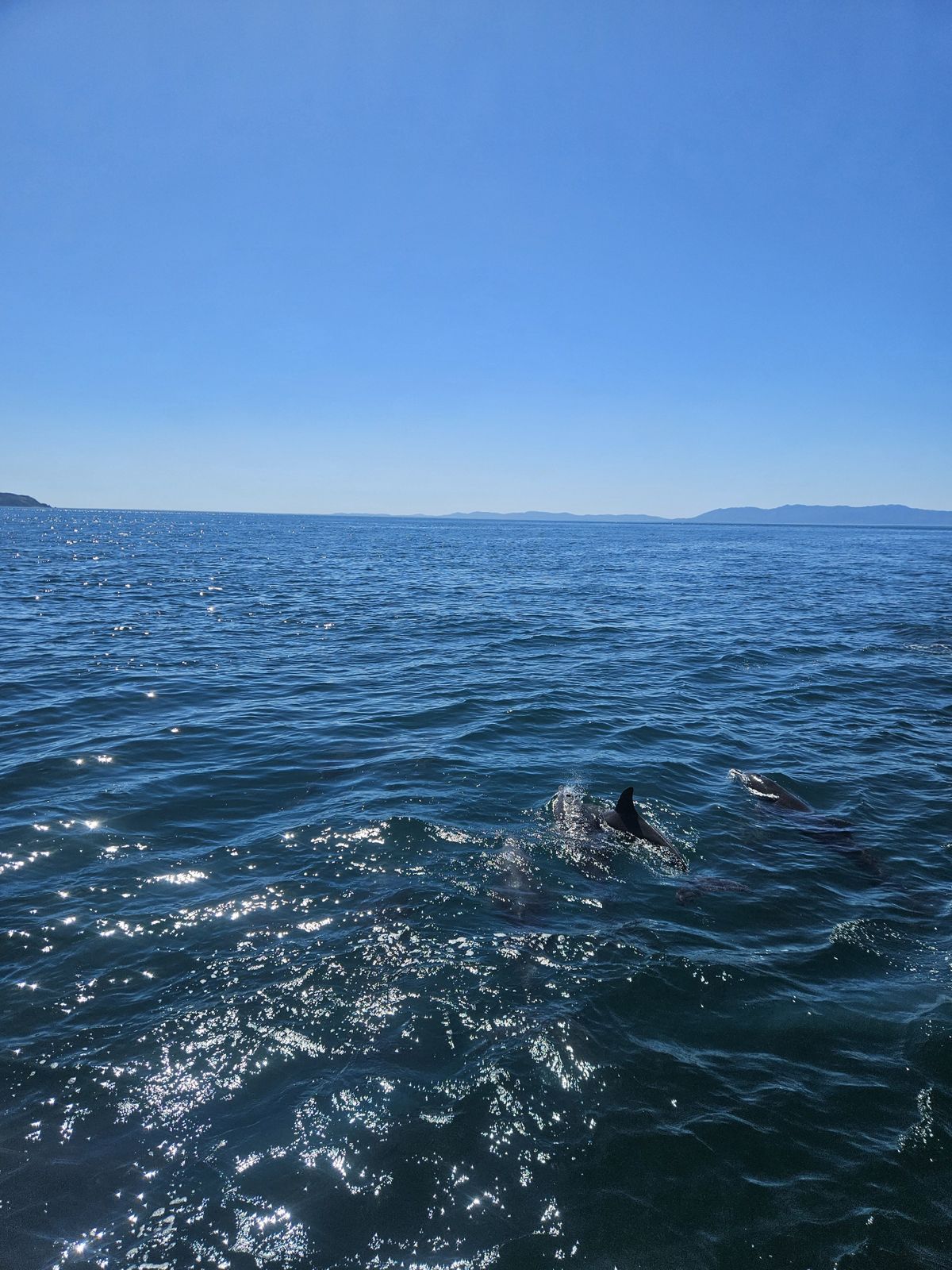
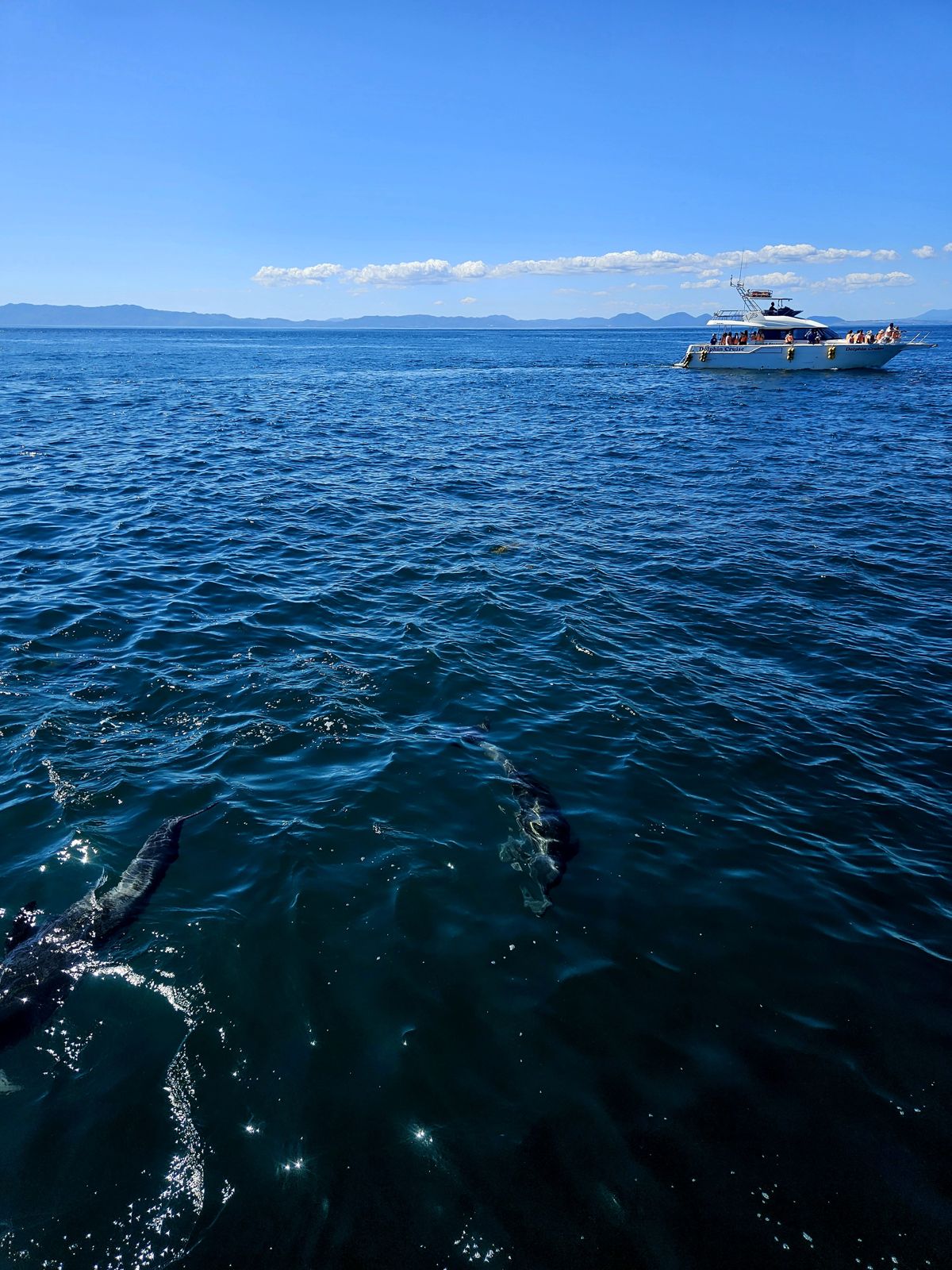
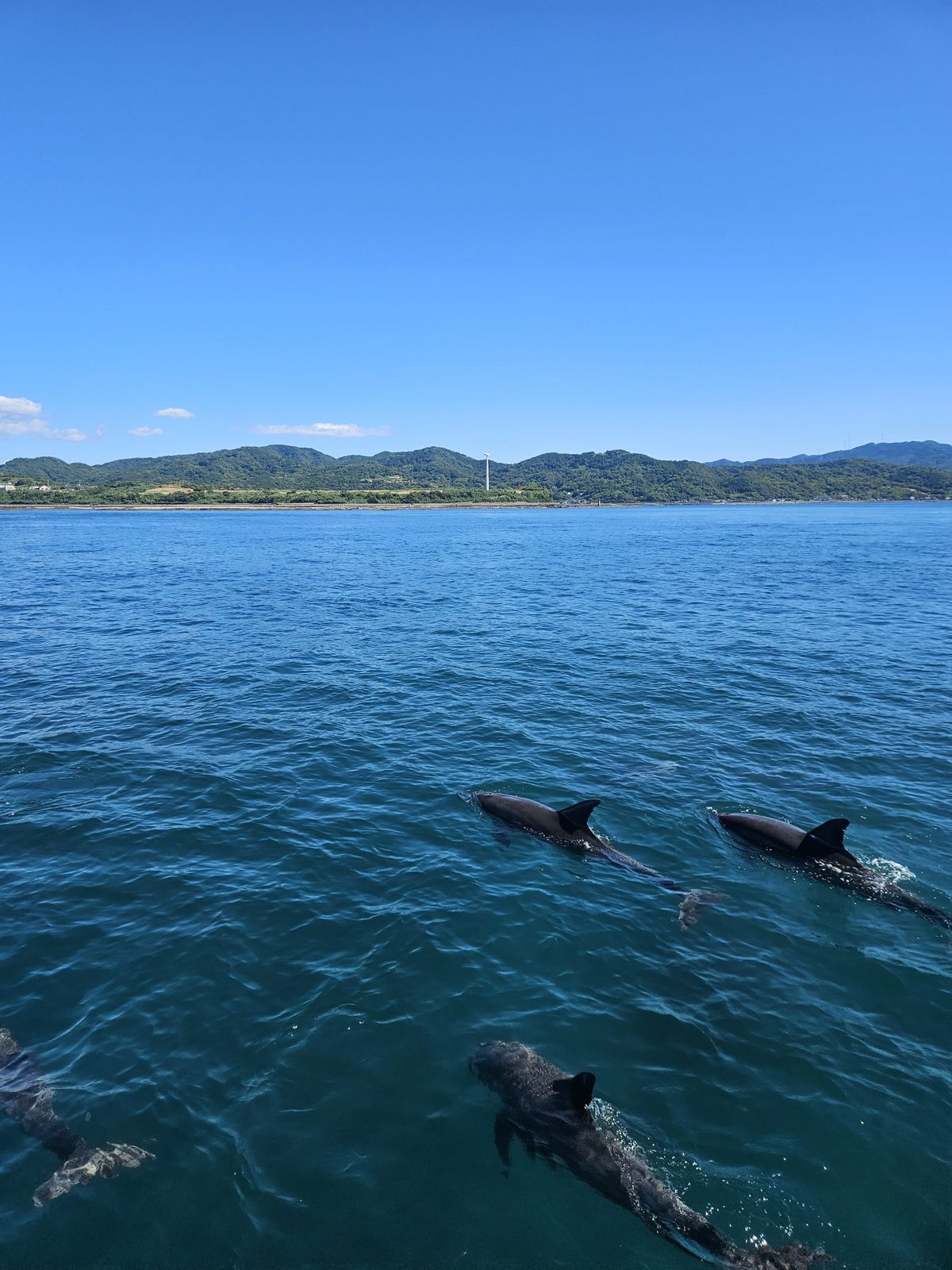
We have no idea how long it lasts, because time has stood still. The captain returns to his post, reverses the engines, and we go back into the cabin. The return trip is more monotonous, even if the surrounding landscape is as beautiful as ever. Getting off the boat, we come back down to earth with a bump, as we're heading to the hospital. We don't want to let Cassandre's ear drag on, so we face a new experience. The hospital is tiny and looks more like a small medical centre for the elderly (there are only old people). Nobody at reception speaks English, so we communicate using translation apps on our phones. After a few explanations, a doctor sees her while Clémence and Stéphane go shopping for dinner.
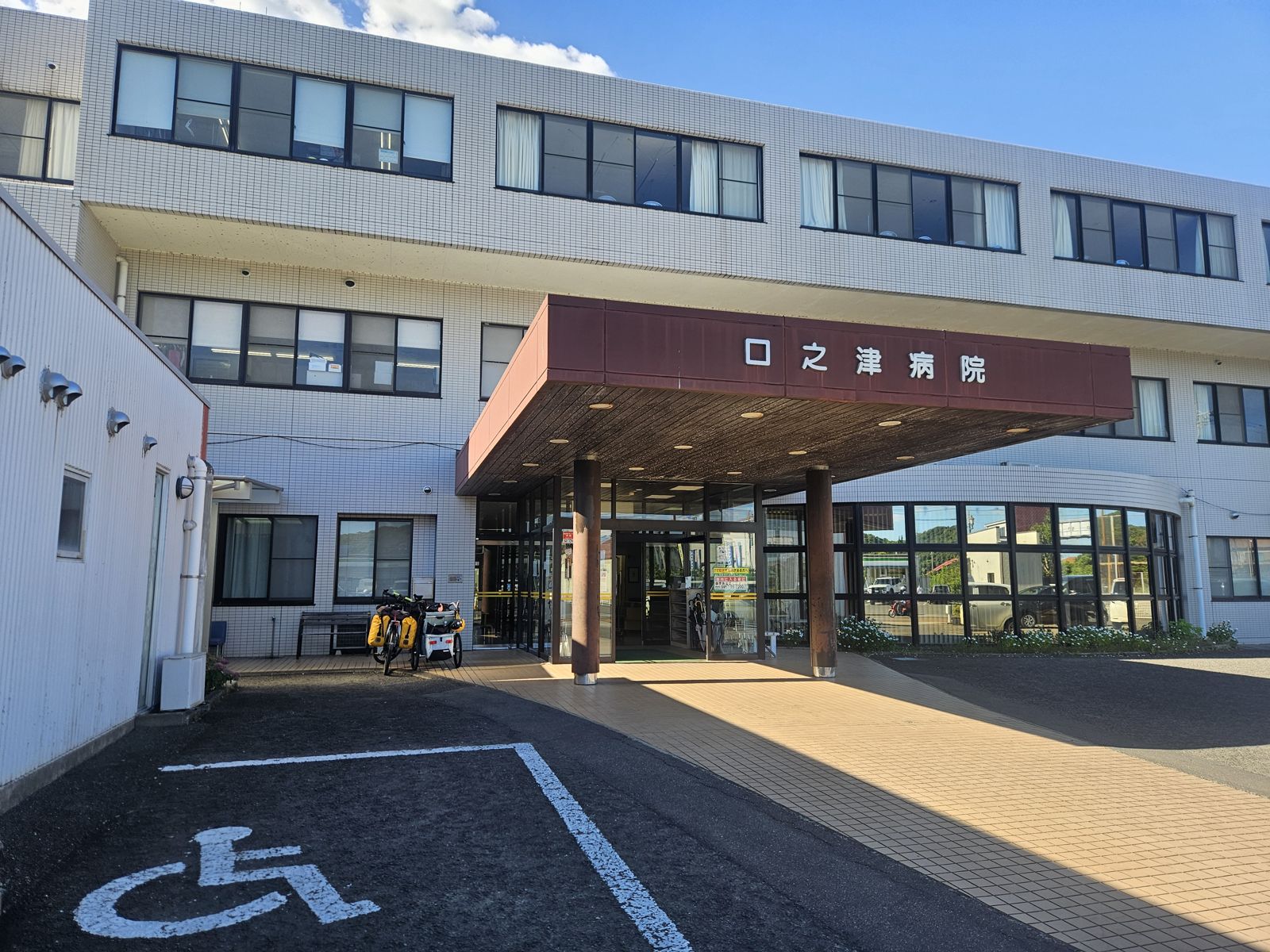
Country hospitals in Japan, though smaller than big urban centres, generally offer a good standard of care. Medical staff are usually competent and well trained, and basic equipment is available, especially for emergencies or routine consultations. However, for complex cases or specialist procedures, patients may be transferred to larger facilities.
Cassandre has a hearing test and a quick examination by the doctor. There's confirmed hearing loss in her left ear, and the doctor thinks it may be serious, as he believes he can see blood in the ear. He recommends going to a bigger hospital tomorrow to see an ENT specialist and won't commit further to a diagnosis, which doesn't reassure us. We get back on our wheels to return to the port and take a ferry. Unlike in Korea, where you only pay the foot-passenger fare on a ferry, in Japan you also have to pay for your bikes.
We already feel ripped off, but on top of that, at the ticket desk the clerk explains that we have to pay the bike fare for the trailer too. However much we explain and show him it's a buggy, he won't budge. So we pay our foot-passenger fares (Clémence goes free, thankfully) plus three bike fares. With our two bikes and the trailer, we end up paying almost the same as people with cars, which is incomprehensible. Of course there's no way to negotiate in a foreign language, so we resign ourselves.
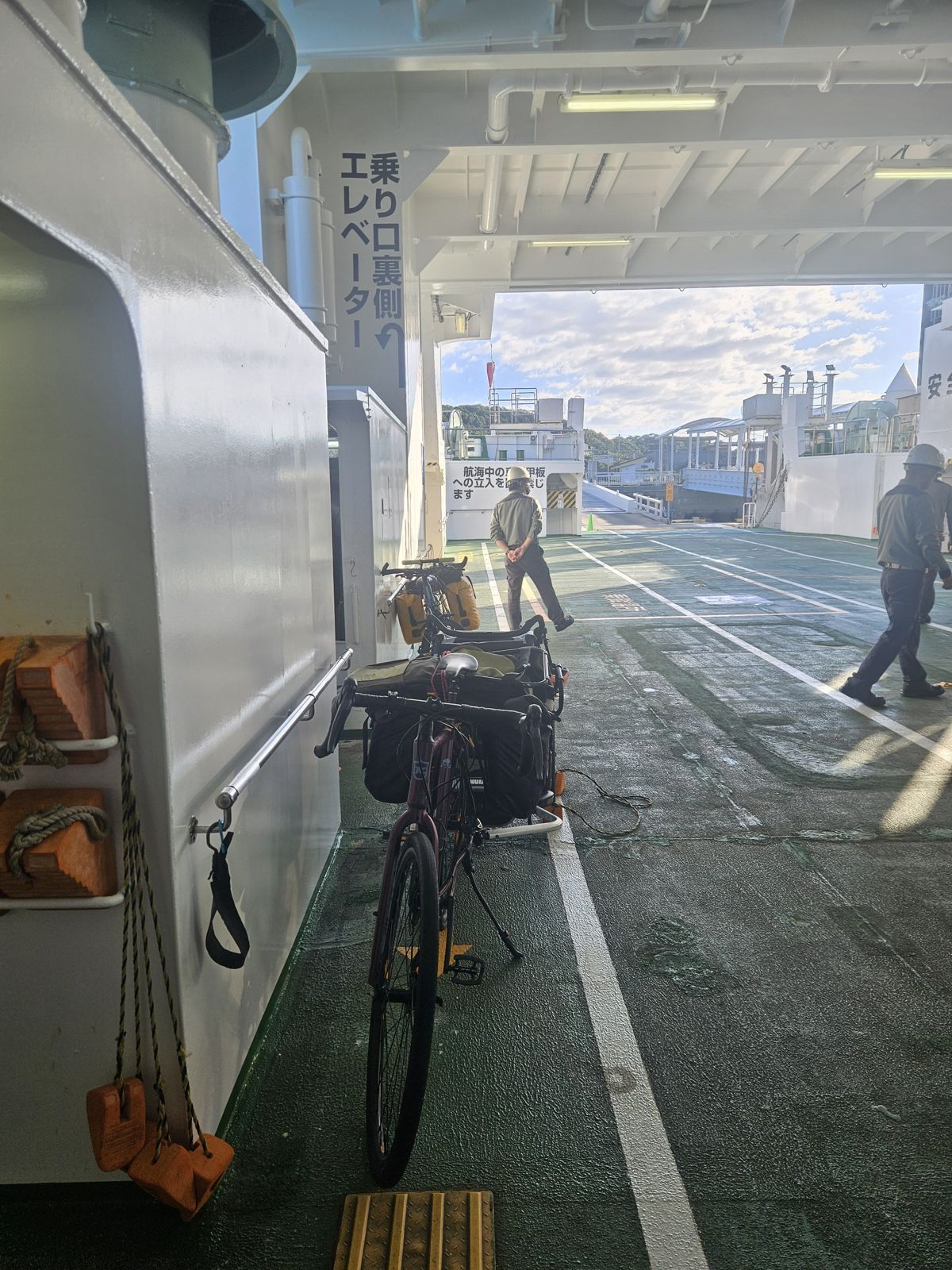
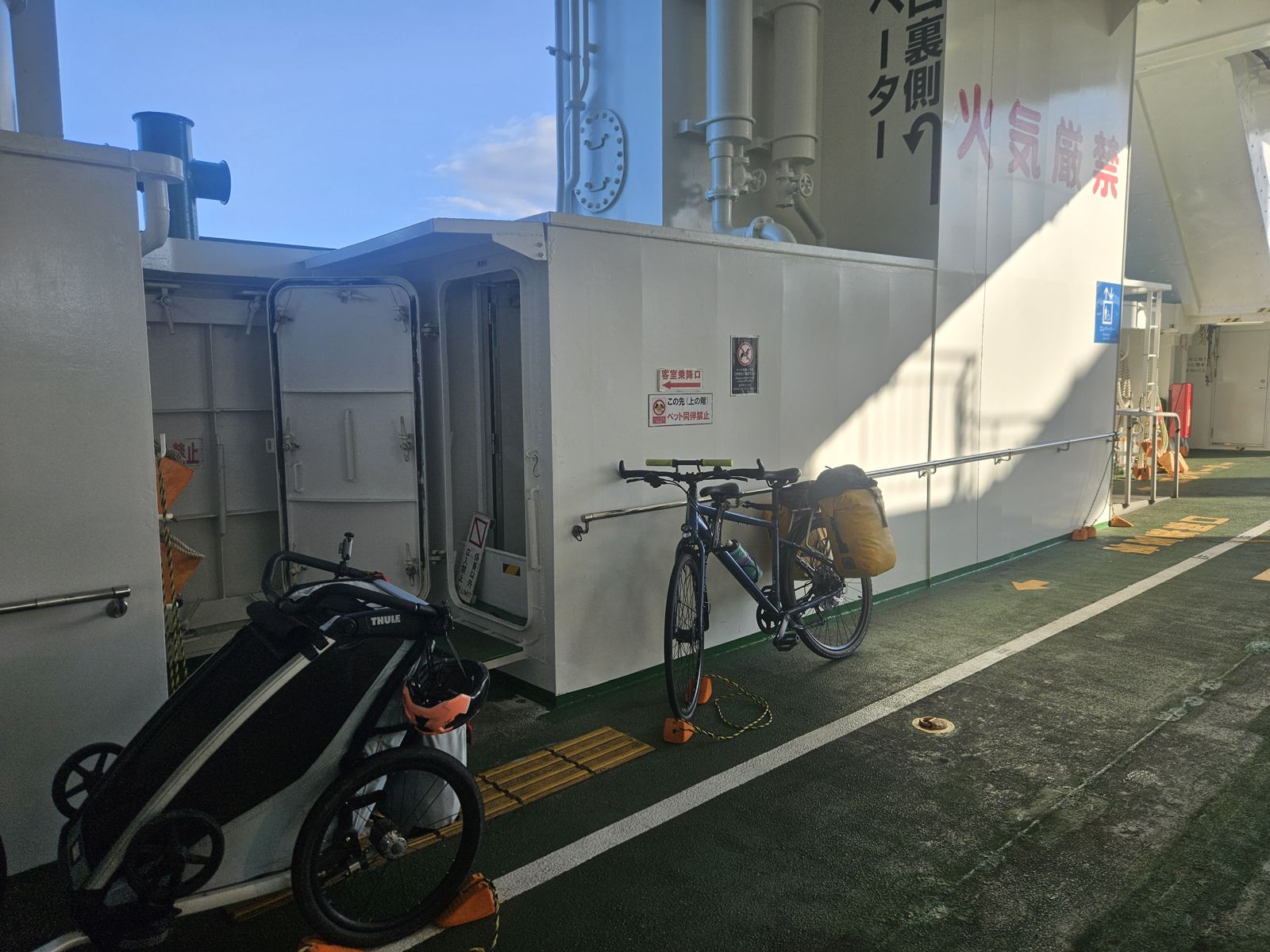
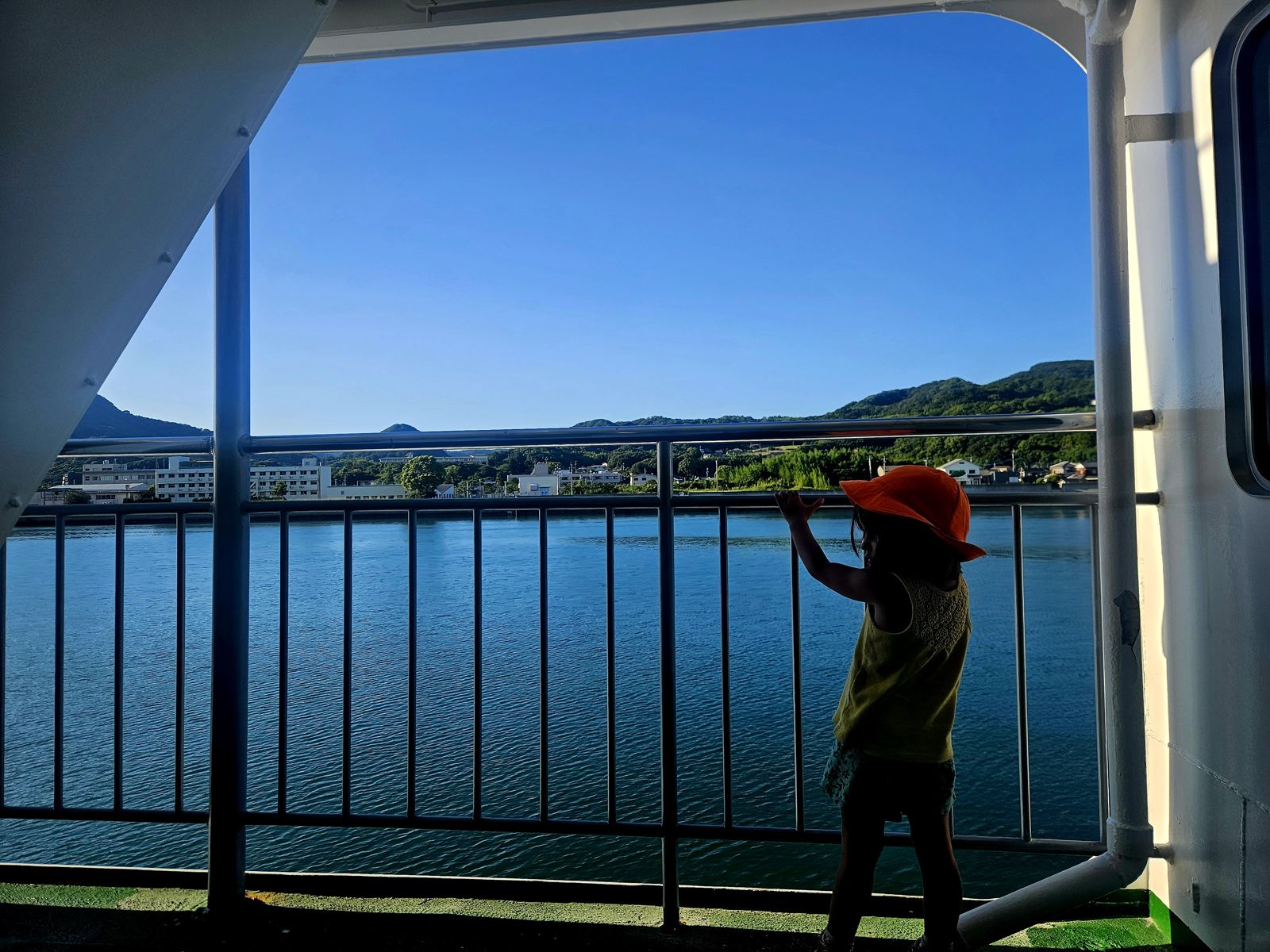
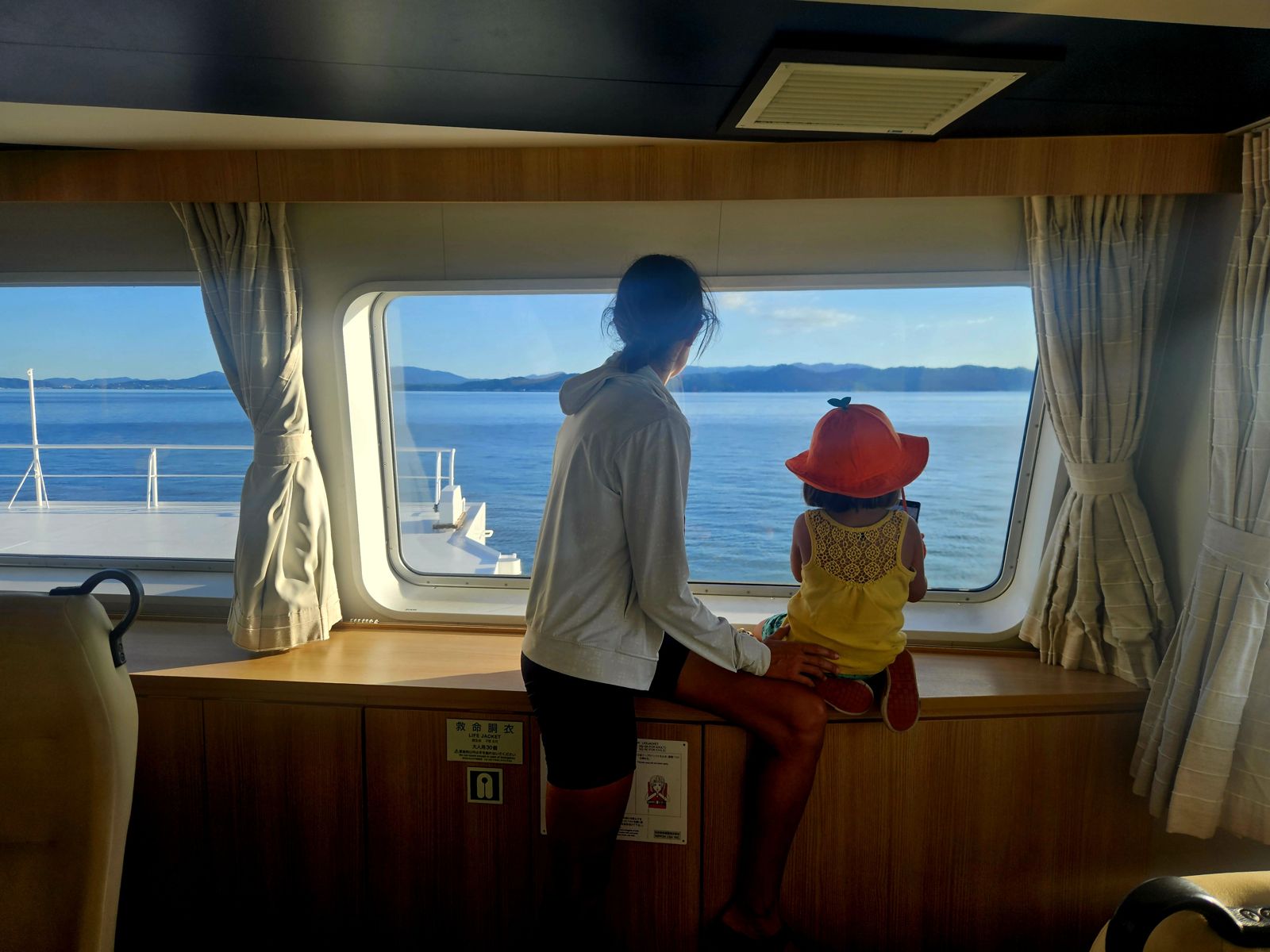
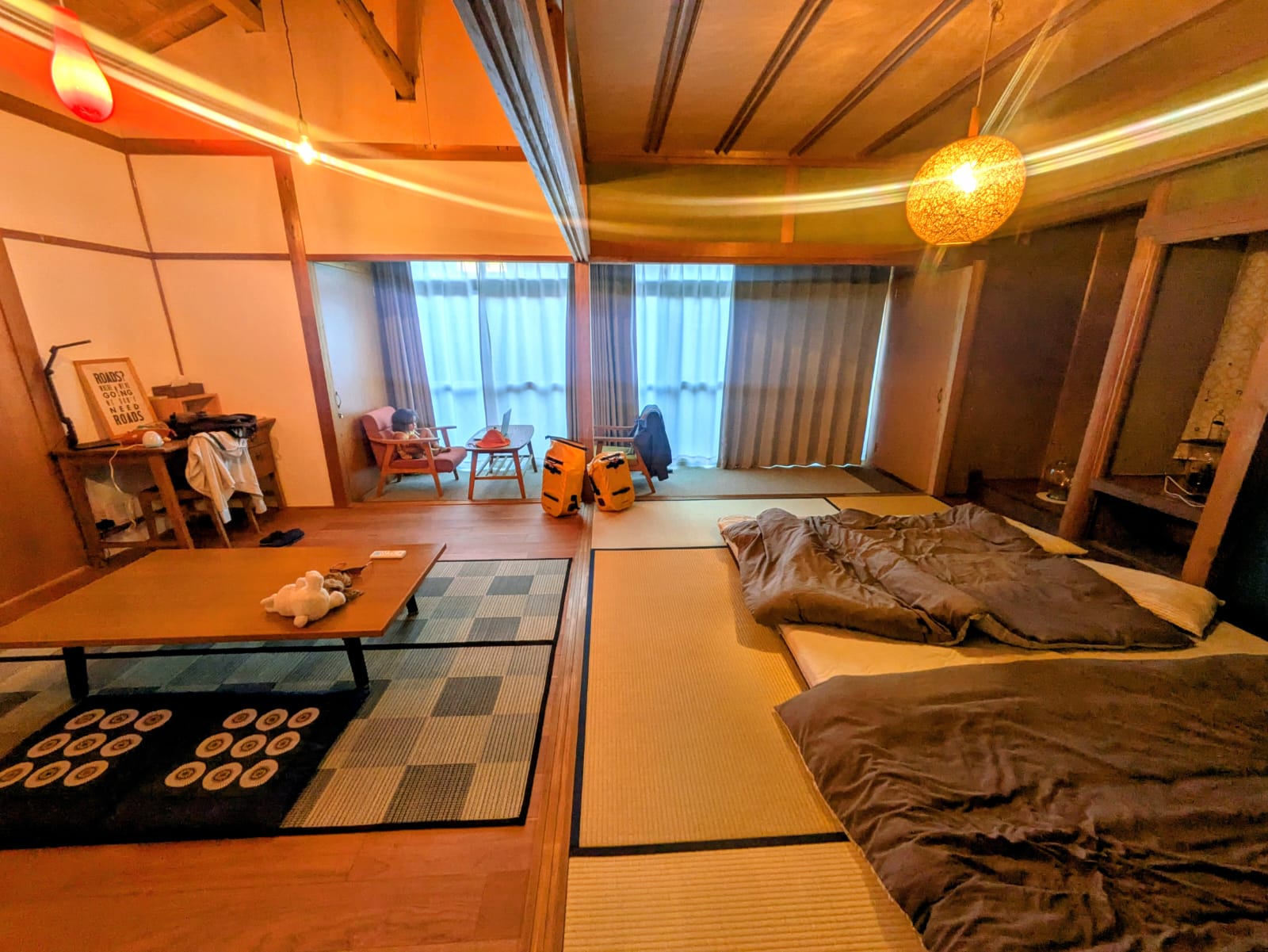
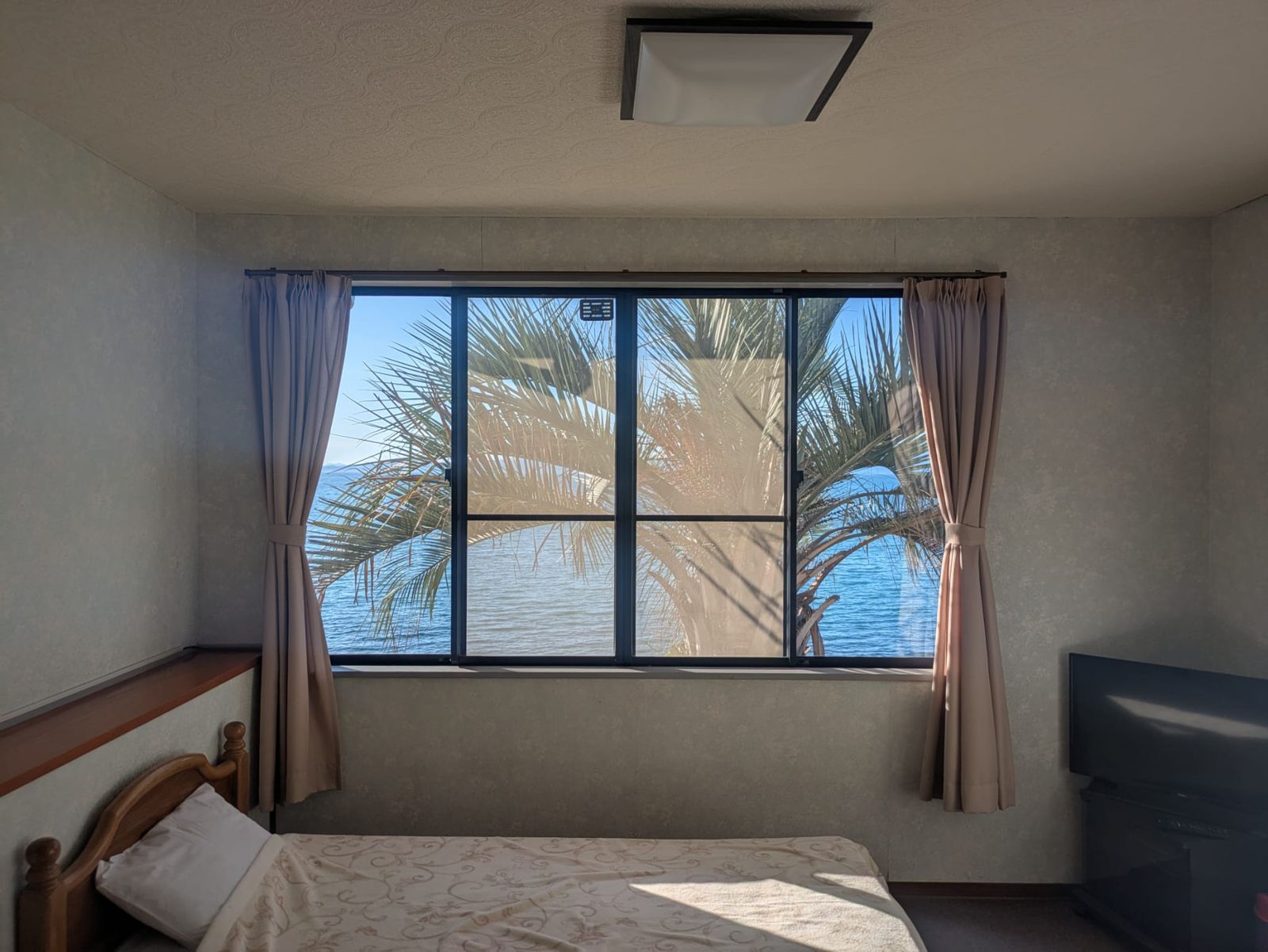
The crossing goes smoothly. The ferry is very comfortable and quiet; there are barely six people on board. Getting off, we have a little trouble finding tonight's ryokan, which is right next door. After a phone call to our host, the problem is quickly solved. We thought we'd booked a simple room with shared spaces, but it turns out we have a whole traditional house to ourselves. A luxury we make the most of to rest and make plans about Cassandre's ear.
Tuesday 29 July
Every morning, loudspeakers in small Japanese country villages play a melody (which varies from place to place), usually with a very vintage sound, to wake the inhabitants. You can hear it all over the village and we can't work out what it's for. Is it to tell the fishermen the time? Is it an agreement among residents to have a shared alarm clock?
These tunes blaring from the loudspeakers actually serve as alerts in case of tsunami, earthquake or any other imminent danger. The system isn't new: it was set up after the very serious 1964 Niigata earthquake. In towns, local councils test the loudspeakers once a day, usually at 5 pm ("goji no chaimu", the "five o'clock chime"). They play a little tune which, incidentally, officially serves to remind children it's time to stop playing and go home.
That's all very nice, but in the countryside it's another story! In rural areas, as well as the 5 pm tune, there's also a morning one. Seven days a week, weekends included. Clearly, country folk in Japan aren't late risers… Anyway, the little tune from the loudspeakers wakes us at 6 on the dot. Cassandre falls back asleep easily; that's the privilege of only hearing with one ear.
When we really wake up around 8, we make the most of this big ryokan to make ourselves the kind of breakfast we love, with eggs, bread and butter. The owner has given us free rein over when to leave, very impressed by our journey. However, we don't want to dawdle too much, as our first stop this morning is the ENT clinic in Amakusa. Used to long journeys, we know chance events can bring everything to a halt without warning, like that day in 2017 when Stéphane thought he'd broken both hands falling off his bike.
Rationally, we tell ourselves it's only a plug of earwax, but we still have to consider the possibility of something serious. After thirteen kilometres, we park in front of the clinic. As at the hospital yesterday, the staff take charge of us straight away, coming out to meet us. Thanks to the magic of instant translation apps, Cassandre explains her problem and answers their questions. Quite quickly she's taken into a room, and she comes out almost as fast with the problem sorted. It was indeed a plug, probably formed because of the humidity. We leave delighted, barely thirty euros lighter. The Japanese healthcare system is one of the most efficient in the world: no endless waits in A&E, no medical deserts, and highly qualified doctors. Japan has its advantages.
It's almost noon, so we cross the road to eat at the Family Mart opposite the clinic. After this little meal, we go to yet another playground. We adopted the Asian fashion when we arrived in Fukuoka and bought hooded UV-protection jackets. Living in this heat and humidity, a lot of Asian habits make sense. When we wear these breathable jackets, we're cooler than in T-shirts. We also sometimes go out with an umbrella to protect us from the sun, and we always wear something on our heads. Things we never did in Avignon, one of the hottest cities in France… The Japanese sun is much more aggressive than our European sun.
The road to today's hotel and beach is as busy as ever. We're astonished by the number of cars on roads that don't link big cities. Fortunately this one has a wide pavement we can ride on in peace. The constant noise doesn't spoil the incredible beauty of the landscape. Mount Unzen, which we were close to the day before yesterday, is now on the other side of the channel.
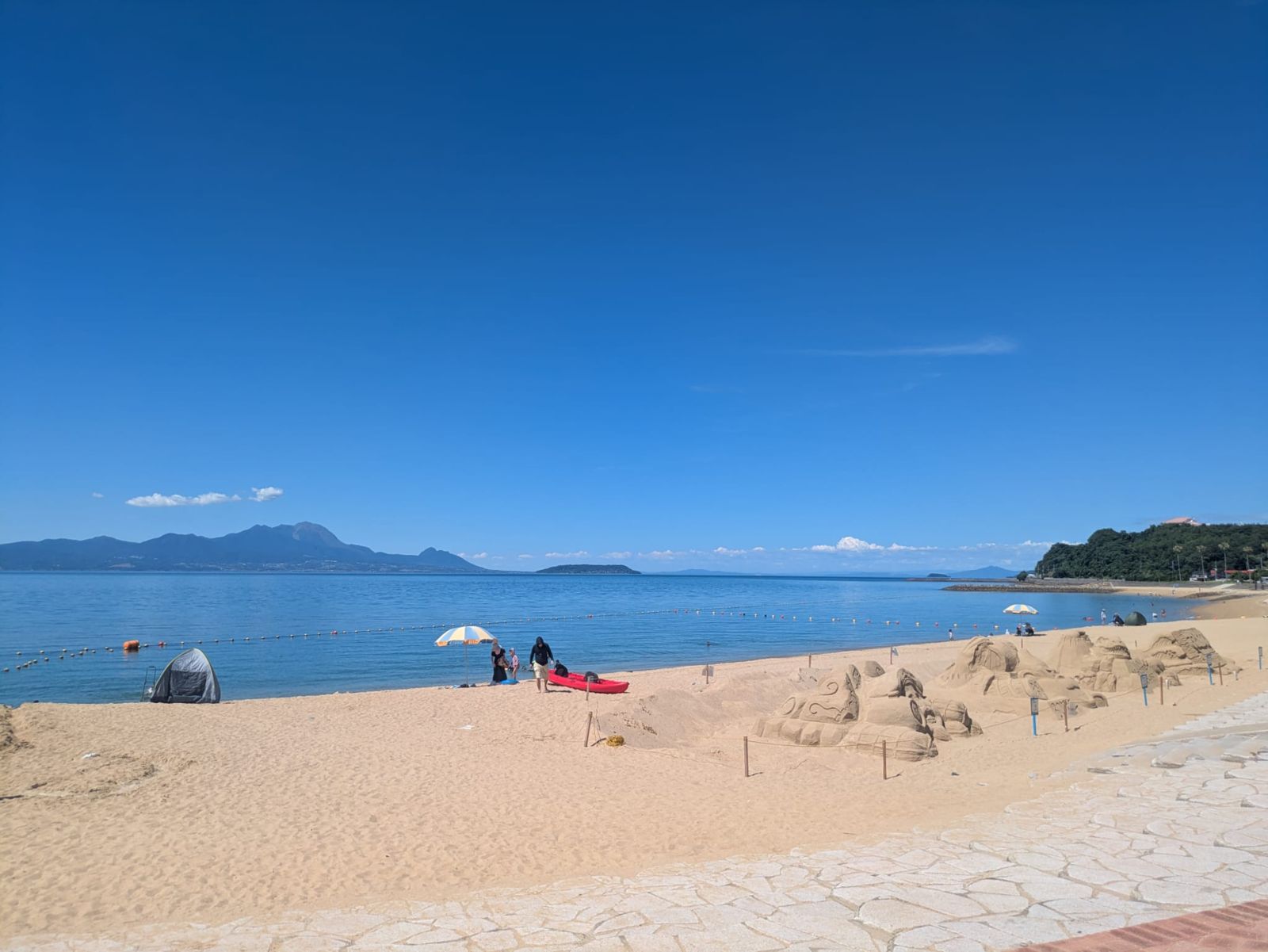
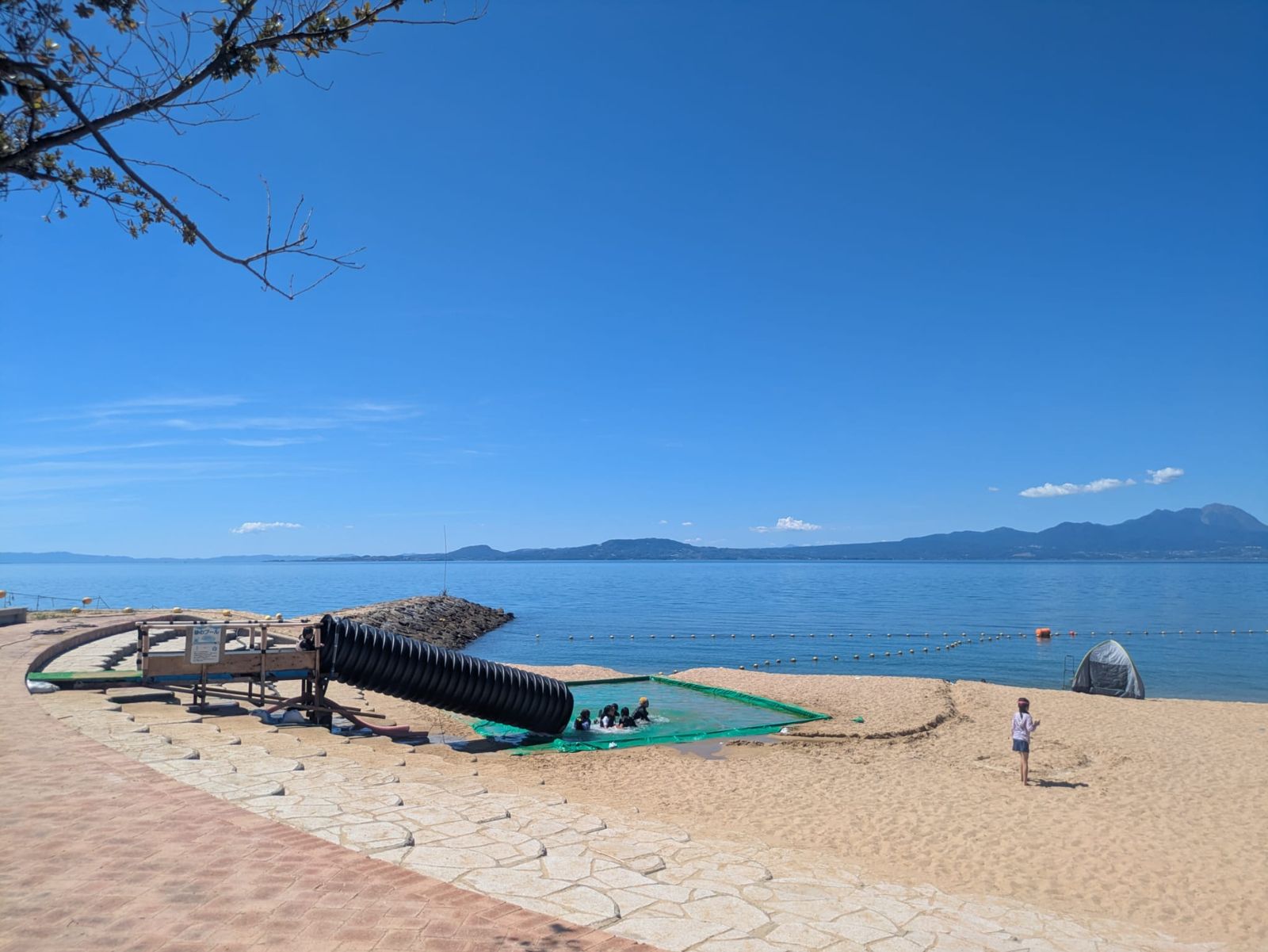
As we arrive at Shirogahama beach, a Japanese man comes up to us, surprised by our bikes. To our great surprise, he speaks excellent French, a legacy of seven years spent in France. He lives in Tokyo with his partner, and they're on holiday with his family in Kumamoto, one of Kyushu's big cities, 50 km from here. This little bay has the good taste to have a slide made from a big construction pipe that empties into a very shallow seawater pool. Clémence can't stop playing in it and sliding down.
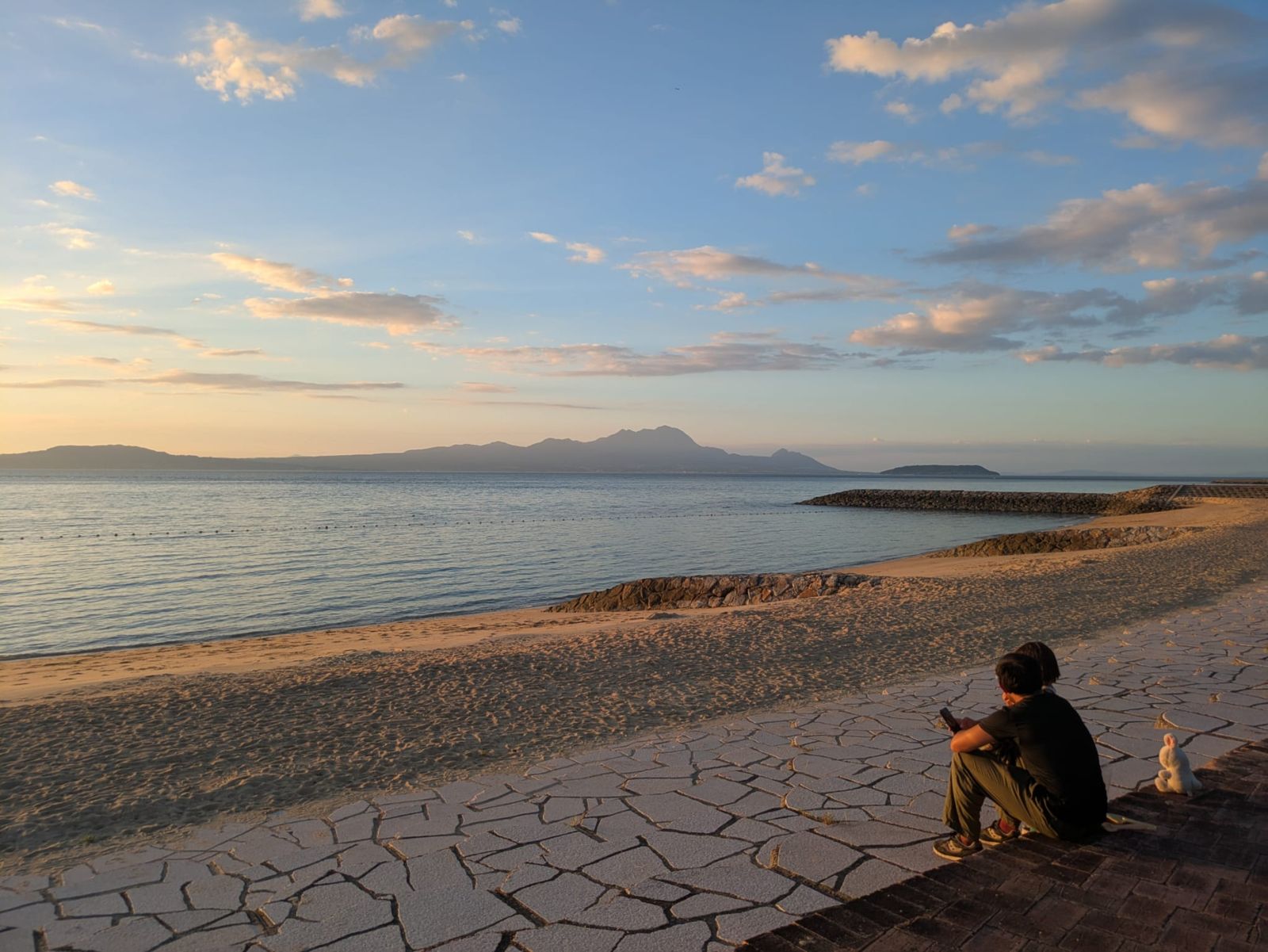
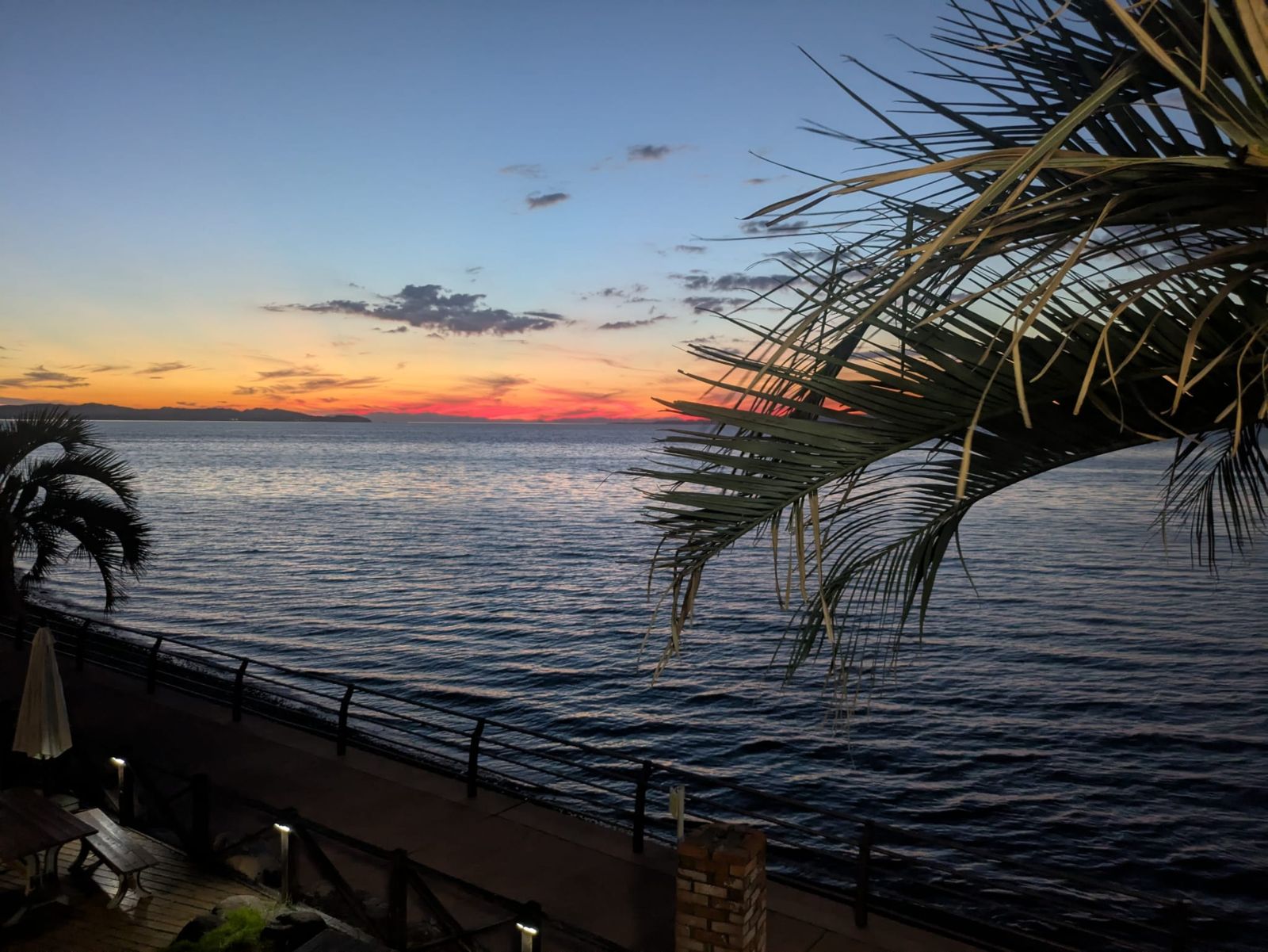
One mystery remains, though. We often find abandoned toys on beaches. Clémence usually spots them quickly, and it's hard to stop her playing with them. Today, a rake and a spade are washed up in the sand. Since our inn is right next door, we promise her we'll come back at sunset to check whether they're still there, which would mean they belong to no one. Sure enough, they're there, along with other toys. They can't belong to regulars who pick them up the next day, since they're clearly in the area where the rising tide will carry them out to sea overnight. Maybe little Japanese children have too many toys and forget some when they leave? Or maybe parents buy them just for the day and leave them in the sand? With these questions we end a day that began with worry and ends in joy, under a sublime red sky at sunset.
On the road