
 ← PreviousExploring Banff's hidden gems
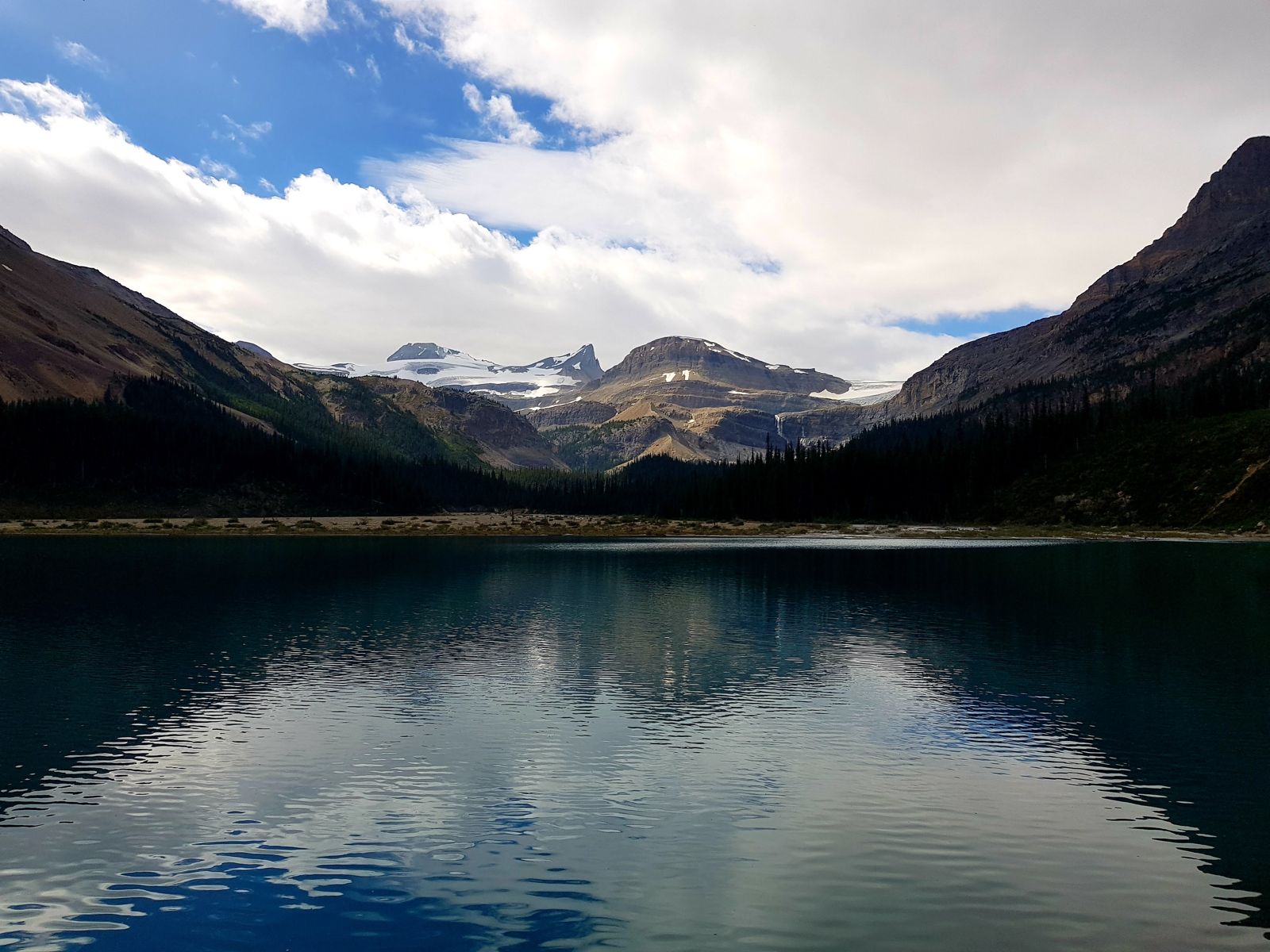
Our two new friends are already on their way when we open our eyes at 9:30. They're much less into hiking than us and want to cover the distance to Jasper straight away to find a spot at a campsite. We take our time, and after breakfast in the petrol station cafeteria we retrace our steps to tackle the hike up to the Bow Glacier hut. Unlike those of the previous days, it's a more athletic route, and at times you have to pick your way across gigantic piles of rocks. The weather is gloomy, a mystical mist has covered the mountain peaks, and we climb cheerfully. To scare off bears you need music, and we choose a playlist of French songs that suits the greyish setting perfectly. We walk at a good pace, singing and clapping, and quickly reach the foot of the glacier.
The Bow River, which flows through Calgary over 587 kilometres, rises here as a tiny stream of icy water running from the huge blocks of ice a little higher up. The hut isn't far away, but we can no longer see the trail, and the last part of the hike looks more like climbing than walking. Sleet starts to fall from the sky, so we make a wise decision and turn back. We don't want to be caught by a storm we're clearly not prepared for. No matter: what counts isn't the destination but the journey, and we enjoy the grand scenery on the way back. Back at our car, we return to the Icefields Parkway and head north to reach the village of Jasper. The mountains around us are each more sumptuous and imposing than the last, and as well as the magnificent viewpoints along the road, one of the major attractions is the Athabasca Glacier, part of the Columbia Icefield, which covers 325 square kilometres.
You have to take a small exit and follow a bumpy track to reach the foot of the immense block of ice. Along the sides, signs mark the years and show how far the glacier has retreated: in 100 years it has lost almost 500 metres and continues at a rate of 5 metres a year, a worrying sign of the global warming that some sceptics still choose to ignore. We see huge clouds approaching and the rain is already on us, carried by the strong wind blowing at this altitude. We finish the drive in torrential rain, and the low clouds completely hide the mountains. We reach Jasper late in the evening and grab a bite in a bar dedicated to Canadian military personnel before finding a spot on a discreet street and sleeping the sleep of the just.
We have to be discreet sleeping in the car here. Although we're in a fair-sized town, it's still part of the national park and spending the night anywhere other than a hotel or campsite is forbidden. The situation is particularly ironic: the campsites are full or closed, the affordable hostels are overrun by families, and the overpriced hotels all display neon signs saying they have vacancies. But who's prepared to pay 400 dollars for a night in a place barely better than a motel? In the name of environmental protection, the tourism industry has locked down Canada's parks. It's barely disguised hypocrisy. You're advised not to cook outdoors so as not to disturb the animals' sense of smell, but no one sees any problem with fast-food outlets you can smell for miles. You're constantly reminded, rightly, to leave no trace on the trails, but they're quick to build highways and chairlifts that tear through the animals' natural habitat.
The weather is dreary today, so we take the opportunity to see places that don't require walking for hours. The gigantic glaciers pour into the valley and shape the landscape with the force of their flow, so there are several canyons and waterfalls along the river. Some places are barely developed, like Sunwapta Falls, where we have a pleasant time following the forest paths. Others, like Athabasca Falls, look like Disneyland and are swamped with tourists in flip-flops taking photos in front of every rock. An information board points out that the stream of visitors on the paths is irreversibly damaging the surrounding nature. So why not close these places? Because tourists might stop coming to Jasper? We're afraid that question answers itself.
Arriving at the Mount Edith Cavell glacier, we really wonder whether it's still August, because the thermometer reads one degree. It's not so surprising after all, as this part of Alberta is classed as subarctic. We even hurried to get here because we'd read that snow could fall from early September and temperatures drop dangerously. Checking the forecast, we find the mercury is set to fall to around zero overnight, so we hurry to book a room in a motel outside the park, as we're not equipped to sleep in temperatures like that. After a day of walking, we're not sorry to have the comfort of a shower and a bed, and we hope for a restorative night.