
 ← PreviousA journey into Québec's autumn colours
14 October 2019
All good things come to an end, and our road trip was over after 1,300 kilometres on the road. A new adventure was now beginning: taking on the city of Montréal. As when we arrived in Sydney, it was time to get all the paperwork going: getting a social insurance number, opening a bank account, deciphering phone and internet plans, looking for a job and an apartment, and so on. We were well aware that this part could paralyse a lot of people, but it was the one we liked best, like a fresh start.
After a good lie-in, we drove to the airport to return the rental car. To get from the airport to the apartment where we'd spend the week, we took the Montréal metro for the first time. We actually had to take a bus to reach the metro, because contrary to what we'd thought, there was no direct rail link to the airport. After an hour's journey we met our host David, an Argentinian in his thirties who had lived in Canada since he was ten. He spoke pretty good French and very kindly offered to spend the evening with him and his Mexican friends, who'd arrived a month earlier. A bit tired from the day before, we reluctantly declined, but suggested organising a dinner later in the week.
15 October 2019
Up at 8:30 this morning to start our paperwork. First we went to a Service Canada centre, the equivalent of a French prefecture, but much more efficient. Launched in 2005, this Canadian government initiative aimed to improve federal services for citizens. Unlike our good old French prefectures, there were government offices in every district, which made waiting times almost negligible. When we arrived and explained we were there to get our social insurance numbers, the young man at the counter kindly told us the wait would be about twenty minutes and asked if that was OK. A mere fifteen minutes later, a lady called us to handle our application. It was very quick, and we came out barely thirty minutes after going in. Coming out of an administrative office that fast was beyond our wildest hopes compared with France!
Our next mission of the morning was to open a bank account. The day before, we'd studied the various offers from Canadian banks, and it had been a real headache. Online banks weren't very widespread yet, and bank fees were exorbitant. On average you had to reckon on about €10 a month for a basic service. Fortunately, being a newcomer to Canada came with perks, including specific offers depending on the bank, often six months to two years without fees. We finally opted for TD Bank. The service was minimal, but it was free. In thirty minutes our account was open and we left with our new Canadian bank cards.
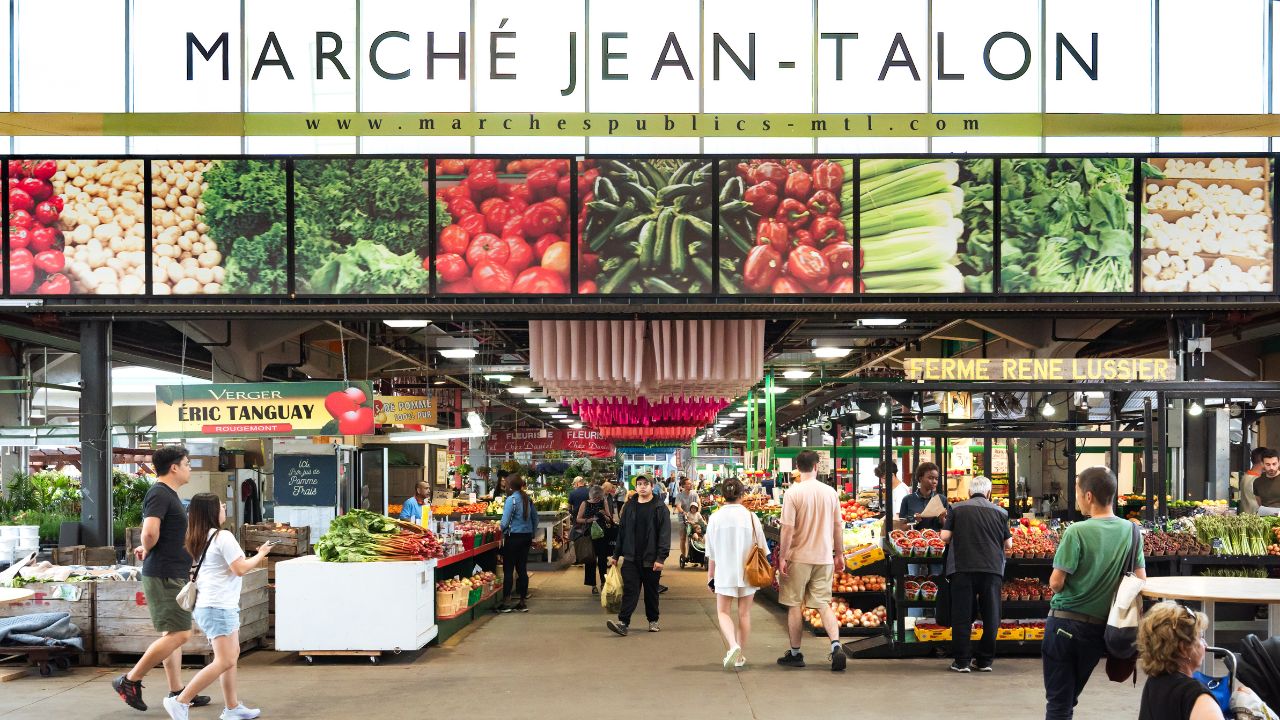
Two good things done! We then headed to the Jean-Talon Market, a huge market in a working-class part of Montréal, under a big open shed. Prices were so good that we left with our backpacks full of vegetables! After a quick bite at a little stall in the market, we went back to the apartment to start our job search, which took up most of the afternoon.
We ended the day by going to the cinema to see Joker, a film we'd wanted to see for a long time. On Tuesdays, in most multiplexes, tickets were 7 dollars, about 5 euros. As usual, we chose to see it in the original version. We thought the film would be subtitled in French, as is often the case in France for foreign films. But no. In Québec, films are either dubbed in Québécois French or shown in the original version without subtitles (for English-language films, of course). That didn't bother us, since we'd been used to watching films in the original version without subtitles ever since Australia, but we'd assumed they'd be subtitled in French given that Québec is French-speaking. It made us realise how multicultural the city was.
16 October 2019
We were starting to get the hang of the Montréal metro. It wasn't really complicated, with its three main lines and its little yellow line. When you come from Paris, almost every city in the world is a letdown in terms of transport, and Montréal was no exception. The layout of the lines seemed to come from another era. The network covered 71 kilometres with 68 stations, mainly along the river. By comparison, the French capital had a 220-kilometre network with 302 stations. So a twenty-minute car journey took us an hour on public transport, with two metros and a bus. All for… nothing. We wanted to go to a winter-clothing clearance sale to kit ourselves out cheaply, but to our great surprise the event had been mobbed. The queue went round the block and we reckoned we'd have to wait at least an hour. Not at all keen to wait in the wind, we turned round to go "magasiner" — the Québécois word for shopping — elsewhere.
On a long, rather shabby and run-down street, we found all of Montréal's discount stores. Rather vulgar promotional signs adorned every shopfront, and although the graphic standard of signage had pleasantly surprised us until then, these ones made do with the bare minimum. We spotted a few bargains and looked for shoes that Cassandre needed for an interview the next day. After a little sandwich at a Vietnamese stall and finding the shoes, we went back to the apartment to keep browsing job and housing classifieds.
Property listings in Québec had something peculiar about them: the number of rooms always ended in ½, which stood for the bathroom. Another difference from France: the kitchen counted as a room. Looking for a two-bedroom apartment to host friends and family, we therefore had to target 4½s. As in many big cities, property was suffering unreasonable inflation. Whereas Montréal was still very affordable two years earlier, it was starting to catch up with its big sister, Toronto. We set our budget at about $1,400 a month (about €900) and replied to every listing that interested us in the areas we favoured. Work was a bit more complicated, as you had to balance the dream job against the one that was available. Stéphane was ideally looking for a writing job, while applying for more manual jobs like snow clearer or traffic controller. Cassandre, with her degree, had a broader range in administration and finance. Our hope was to find a job quickly and then keep looking to move into work that suited us better.
At the apartment, David regularly had his Mexican friends over, which let us practise our Spanish. They were a bit surprised to hear us speak their language, but not as surprised as we were to learn that they spoke neither French nor English. When we asked how they managed, they simply replied that they worked in a warehouse where everyone was Mexican or Hispanic. All their friends spoke Spanish too, so they didn't need another language. That stunned us a little, but in the end there was nothing shocking about it. Everyone looks for something different when they emigrate to a new country. For some it's financial security and a stable job. For others, like us, it's discovering a new culture.