
 ← PreviousA sister at the door
What a week! All over the world, governments are responding to the spread of Covid-19 with announcement after announcement. France has just locked down its population, a week after Italy; the United States has closed its borders to non-citizens and banned flights from Europe, pulling Canadian Prime Minister Justin Trudeau in its wake. One by one, countries are adopting similar measures to try to contain this epidemic that started in Wuhan in December 2019 and has now crossed every border. Val and Nico picked the worst possible moment to travel. Especially as the Canadian government also announced this week the closure of schools, bars, restaurants and non-essential shops. Shops are pulling down their shutters one after another, cities are emptying, people are wary and afraid of catching it.
Here, Quebecers avoid the French like the plague. In Montreal there are luckily enough of us not to be treated as pariahs, but that's already less true in smaller towns and the countryside. All week we follow Val and Nico's adventures, and some behaviour appals us: an Airbnb host tells them overnight that they can come, but must stay shut in their room with no access to the kitchen or shared spaces, for the same price of course; Quebecers ask them point-blank when they arrived and whether they have the virus; a ski-rental man flatly refuses to serve them because they're French and “in these conditions you don't go sightseeing, you go home”. A little advice for that gentleman: people don't necessarily want to postpone a holiday they've saved for, and at first the airlines refused to refund anyone who didn't take their flight. You left, or you said goodbye to your ticket. And how could anyone anticipate such U-turns when, a week earlier, governments were still repeating that the virus was just a “little flu” and that closing borders or wearing masks was pointless?
Either way, Cass's sister and her partner now have no choice but to bring their return forward: their airline, Corsair, is stopping commercial flights to Paris from Monday. They can't be reached, and the French embassy is unable to tell us how to get them repatriated without buying a full-price ticket from another airline. So we decide to go to the airport the next morning to ask Corsair directly which flight they could take before the service stops.
21 March
Stéphane has rented a car for the weekend again, because although everything in town is closed, the national parks are still open, and free, since the staff have been laid off. We don't really expect Val and Nico to fly today, but we drive to the airport with their luggage in the boot in case tomorrow's last Corsair flight is already full. At the terminal it's like a film: the airport is almost empty, the counters closed, silence everywhere.
No luck: today's Corsair flight is cancelled. However many times we go round the check-in counters, there isn't a single agent from the airline, as if it had never operated here. Yet a few flights to Paris are still leaving with other airlines: one with Air Canada, two with Air France, one with Air Transat. The Air France counters are closed but Air Canada's are open, so Cassandre goes to ask whether the flights are continuing and how much two one-way tickets to Paris would cost. The ground agent tells us Air Canada will keep flying at least until mid-April and that a one-way ticket costs €400. Paying for another ticket is never pleasant, but we're reassured: they won't be stuck far from France and their two teenagers, aged 16 and 18.
As we head for the exit, we come across an Air Transat agent and ask her, on the off chance, whether Corsair is still operating. Since today's flight is cancelled, she advises us to come back tomorrow for the 7 pm one, and to show up at check-in two hours before take-off to ask to be put on it if there's room. Making the best of a bad job, we decide to enjoy ourselves as much as we can. To round off their Quebec experience, we go and eat at the little poutine place near our home, which has become a must for our guests. The food is delicious, the staff as lovely as ever, and we have a great time. The owner, whom we're getting to know well, tells us he's thinking of closing altogether because customers are getting scarce. We wish him luck, hoping to come back soon for his delicious poutines, and head off to Parc Jean-Drapeau.
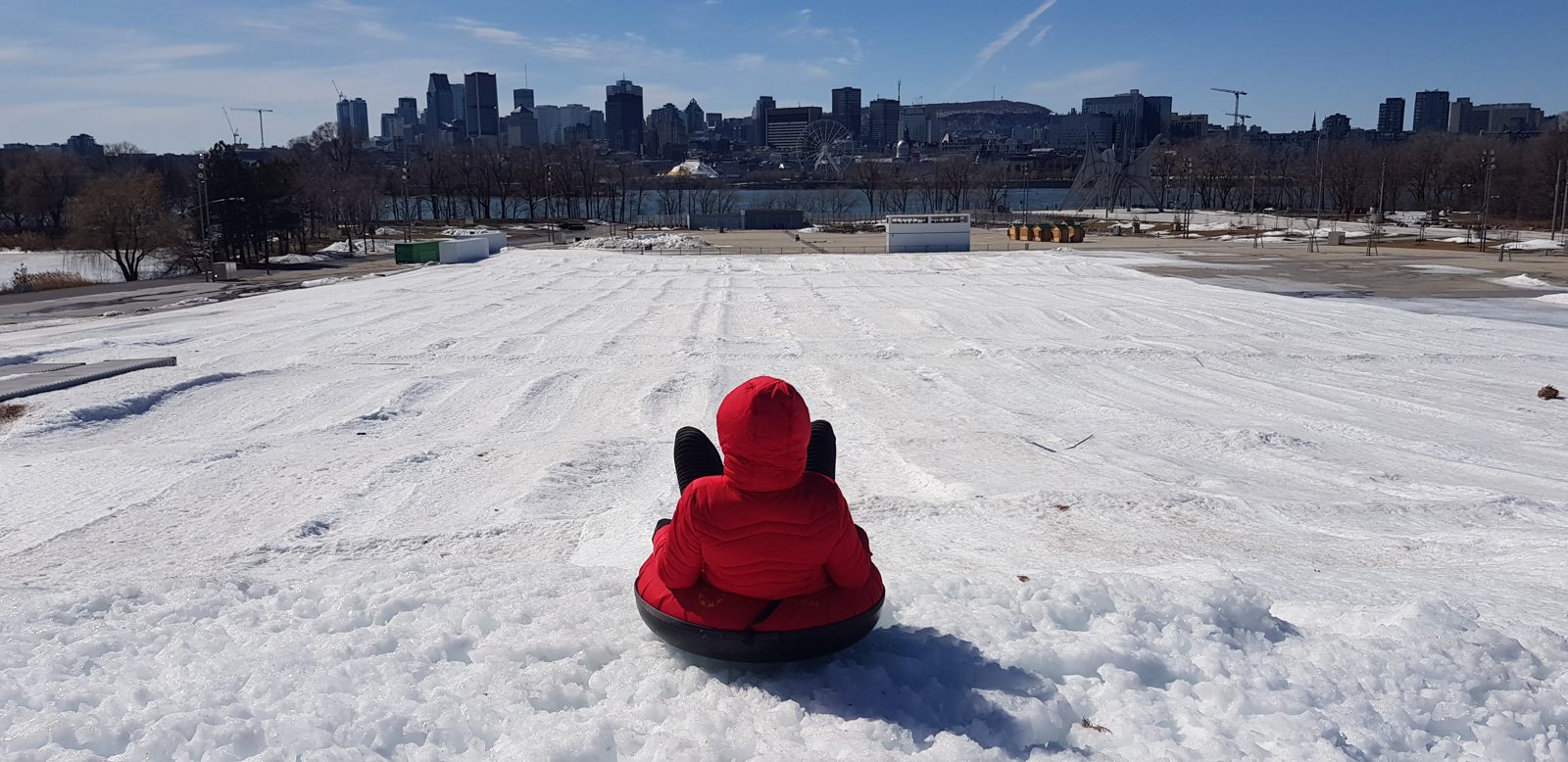
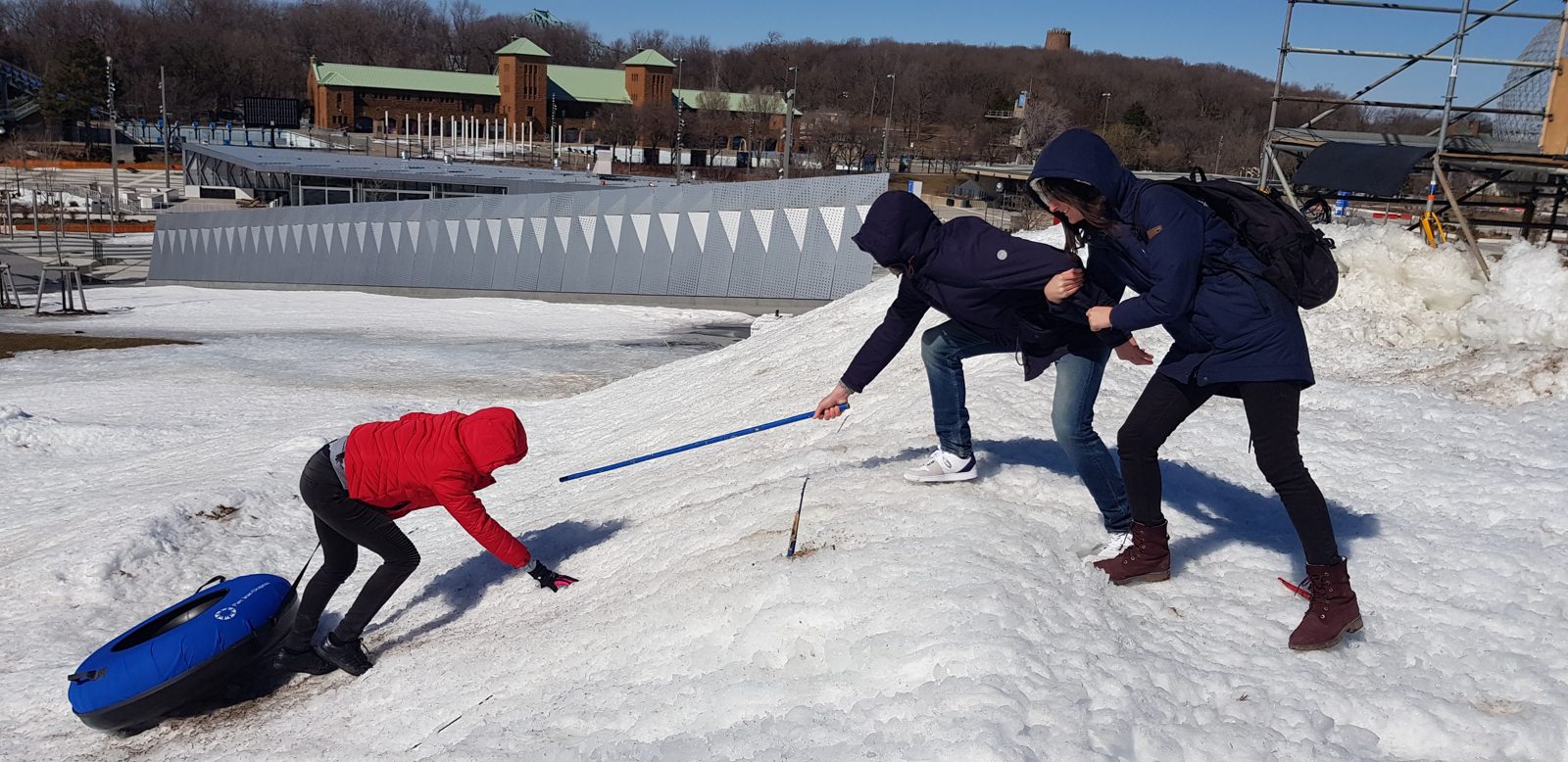
We'd already visited it with Cassandre's parents and wanted to show it to Val and Nico. Same path, but the snow is getting thin. The tubing area set up for the Fête des Neiges has survived, though, and the slopes are still slippery. Three rings are lying in a corner: off we go, fooling around on the runs, Val having a whale of a time on these slopes in their last days. After that good laugh we head to the other island in the middle of the St Lawrence with a question in mind: can you drive on the Gilles-Villeneuve Formula 1 circuit? Well, yes! Any driver can come with their car and pretend to be Michael Schumacher. And if that doesn't appeal, you can also do it by bike, on foot or on rollerblades. A tiny bridge, a minuscule roundabout, a right turn, and there we are, without a single sign, on the circuit's only straight, the “Casino straight”.
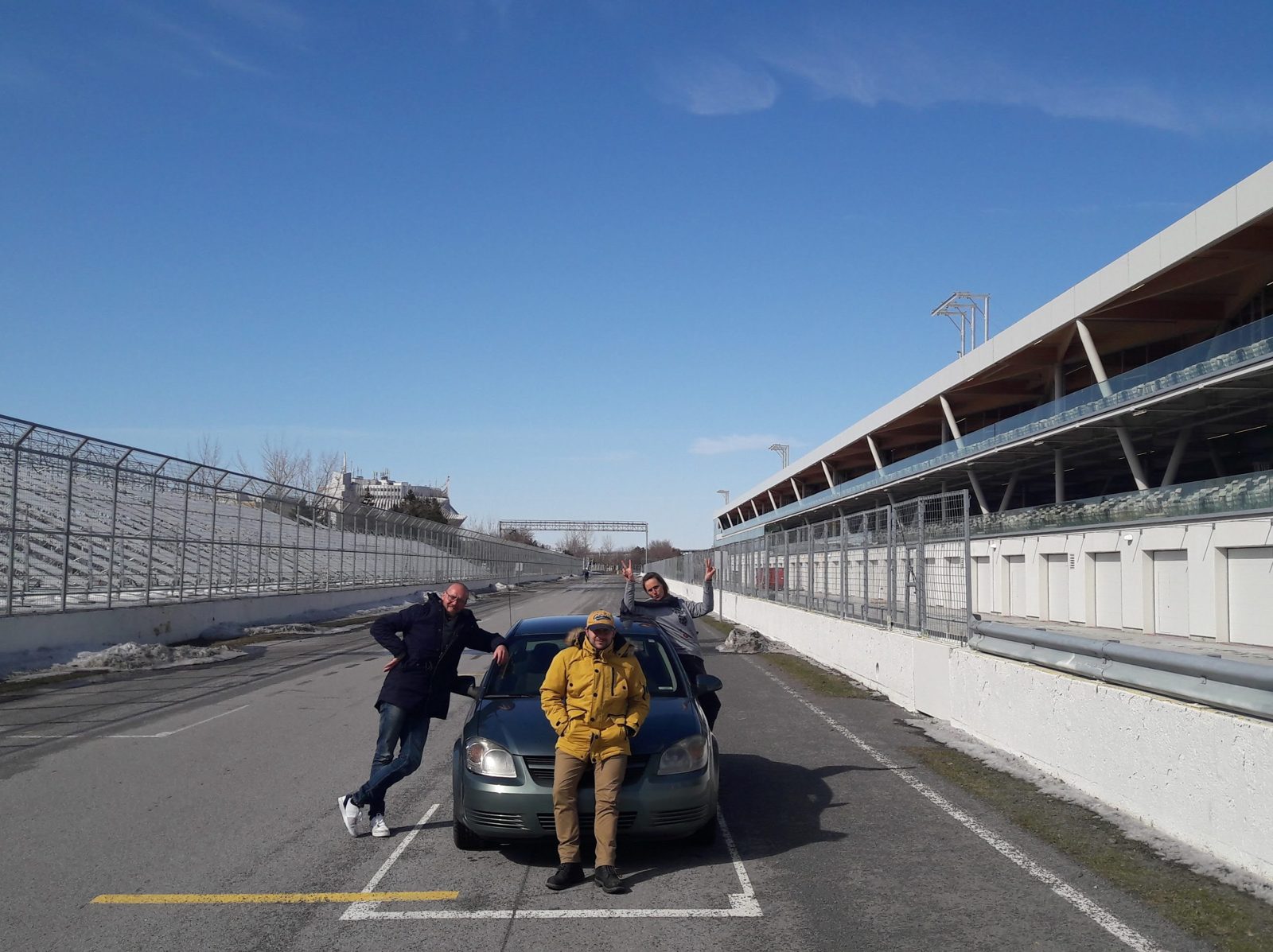
Sunday drivers are asked not to exceed thirty kilometres an hour, and of course we respect the limit, marvelling at driving on such a prestigious track. The first, very tight bend leads to the Wall of Champions, so called because in 1999, during the same race, three great champions, Schumacher, Damon Hill and Jacques Villeneuve, missed the bend there and ended up against the wall and its ironic “Bienvenue au Québec”. A little further on is the finish line, where we take photos on pole position for our collection of souvenirs, then the “Senna hairpin”, a double chicane shaped like an S. The circuit is pleasant, lined on one side by the majestic St Lawrence and on the other by green forest. We do two laps to make the most of it, then head to the Jean-Talon market, which needs no introduction, to stock up for dinner.
The measures against the epidemic have already changed noticeably: you have to queue at the entrance so as not to exceed the maximum number of people, wash your hands before shopping, keep your distance from everyone. We have to face facts: the epidemic has well and truly reached us too.
22 March
Yesterday the SÉPAQ, which runs Quebec's national parks, decided to close them all. We fall back on a privately run park in Sutton. We hadn't planned to visit it so early in the year, but it's a chance to take our guests as close as possible to the now-closed American border. A winding road drops us at eight hundred metres, and we tackle the Round Top trail: five hundred metres of climbing on a path snowy from start to finish, when it isn't completely iced over. Halfway up, Spruce Lake offers a welcome break and lovely photos of the frozen water. We're not sure how solid the ice is and don't venture onto it.
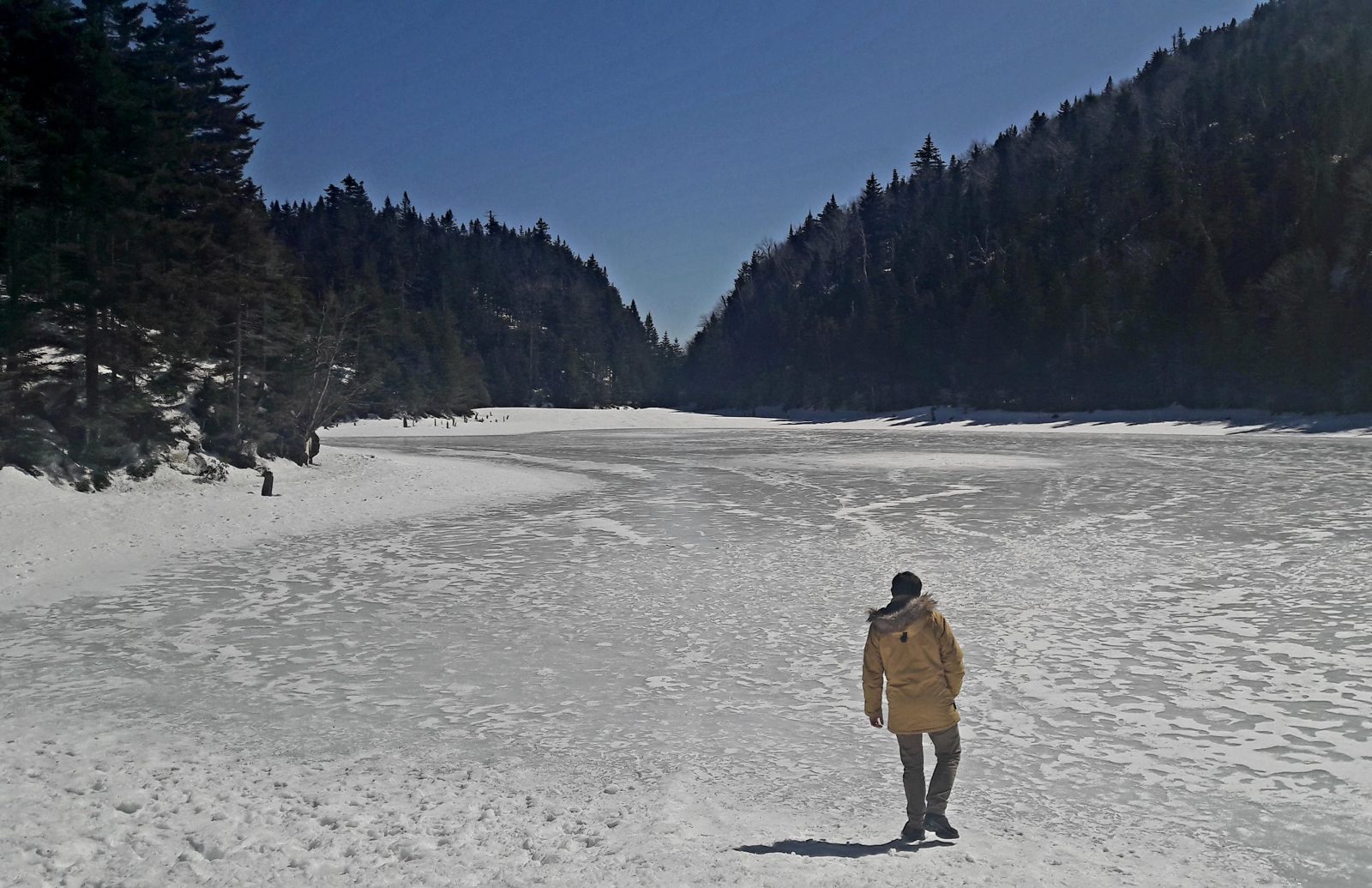
The last stretch is almost vertical, and where there were steps there's now a wall of ice. A rope is there to help hikers in difficulty, or badly equipped ones, which is our case, but without crampons it's still a perilous passage, and we get across this slippery section amid great bursts of laughter. At the top the view reaches the mountains of Vermont, so close and yet out of reach for who knows how long. We run back down, sometimes on our bottoms like a sledge, and are soon back at the car. We still have a little time: we grab a bite outdoors in the village of Sutton, in the sun, before driving to the airport hoping that this time Nico and Val will be able to board.
After an hour and a half on the road, Stéphane pulls into the drop-off zone and the three passengers go to find out. Less than ten minutes later they're back: they have seats! Corsair is running its last flight to Orly tonight and agrees to check them in free of charge, simply on presentation of their ticket dated 31 March. They take their bags from the boot and we part in a hurry, torn between disappointment and relief. Disappointed not to have shared more special moments; relieved to know they'll soon be with their children rather than stuck here indefinitely. Back home we realise, a little sheepishly, that we're on our own now, and that it will be a very long time before we see our loved ones again.
Coronavirus
Since early January the coronavirus has intrigued Stéphane. A keen reader of the news, he has followed its progress almost from day one, and by February he was telling Cassandre about each stage. When the situation turns chaotic just about everywhere, we're glued to the news as soon as we get home from work. It's all so unprecedented, so unpredictable! Looking back, we were probably lucky to be in Canada when the crisis began. Quebec, like all the other provinces, very quickly took drastic measures, out of proportion to the virus's actual impact on its territory. Anticipating is easier when overwhelming images arrive every day from France, Italy and Spain. We could have trusted what China was showing sooner, but it seems urgency feels more pressing when the victims look like us.
As long as the virus stayed in China, the threat seemed unreal. Europe's catastrophic example made everyone revise their plans, and here we are in quarantine too, with a negligible proportion of cases across the whole of La Belle Province. The Trudeau government very quickly puts the country under a bell jar and showers workers with financial aid to encourage them to stay at home. There's no strict lockdown here, but in practice it's more serious than in France. Only essential shops open, with reduced hours, and they close on Sundays, heresy in such a free-market country. No permission form is needed to go out: there's nowhere left to go anyway.
Luckily we chose to live in Hochelaga, a working-class neighbourhood. When we travel we like to avoid the obvious and prefer neighbourhoods that gentrification hasn't yet reached, because the people there are more like us: simple people living simple lives. The Plateau is the haunt of the French and of expats in general, an excellent reason to avoid it like the plague. It's also one of the densest parts of the city, so the mayor, Valérie Plante, quickly decides to close its big parks, too crowded for distancing to be respected.
Our neighbourhood has a poor reputation; it's sometimes even looked down on with the disdain Parisians reserve for anything beyond the ring road. So our park isn't overrun, and it's one of the few to stay open. It's so big you feel completely out of the city. There are people on sunny days, of course, but the police patrol to remind everyone of the rules and there's room for all. No more shopping as a couple, and a long queue stretches outside every shop. Canadians have a culture of queuing, so nothing very new for them; it's just unusual to wait outside the bakery or the supermarket. Each shop admits a number of customers in proportion to its size, and you're handed hand sanitiser at the door. Phlegmatic as ever, Quebecers adapt without a murmur.
Stéphane receives the government's support, the Canada Emergency Response Benefit. Anyone whose hours have been cut and who now earns less than a thousand dollars a month is entitled to it: two thousand dollars a month. It's meant to help people through this troubled time and, above all, to avoid the American situation, where many have no choice but to brave the virus and go to work, at the risk of catching it or passing it on.
During these two months of lockdown, our radius barely exceeds a kilometre. For people used to being constantly on the move, it's a strange change. We're obviously not to be pitied and our situation is in no way hard: it simply forces us to wait, in unison with the whole world, and to learn to make the most of this enforced rest.