
 ← PreviousFrom Brooklyn to Harlem, then New Year's Eve dinner at 6:50 pm
9 January
Influenza. Behind this rather harmonious little name hides the virus so dreaded by us little humans as soon as winter shows its face: the flu. And Cassandre won't escape it this year. She came home from work yesterday with a 39-degree fever, shivering and aching all over. So on this Thursday 9 January we stay snug at home. “We”, because Stéphane isn't working today either. He has taken a few days off to go to France and his plane takes off tonight.
No, we're not going to give you a lecture on the flu, but rather a little overview of the Quebec health system. We won't talk about the Canadian system as a whole because, the country being divided into provinces, each one works more or less in its own way. Like France, Quebec has a public health system, which means its citizens and permanent residents are covered by health insurance. So they have nothing to pay when they see a doctor or go to hospital. Most care and medicines are covered by the public insurance (RAMQ), and if they aren't, it's their top-up insurance (more or less expensive) that covers them. So far the system is quite similar to ours in France. Unlike France, however, there's no patient contribution in Quebec: if the care is provided by professionals taking part in the public scheme, you don't even have to pay for the consultation or the procedure. You never pay anything up front. On the other hand, if you're treated by professionals outside the public scheme, you'll have to pay. So the system is rather well designed if you're a citizen.
Where it falls down is access to care. In theory everyone in Quebec should have a regular doctor, here called a family doctor. In practice, getting one isn't easy. Most family doctors are overwhelmed and no longer take new patients unless they're referred by existing ones. Another cause of this shortage is the doctors' “cartel” at work in Quebec. More doctors means more competition and therefore less money for each one, so everything is done to make it very hard to become a family doctor. There's no recognition of foreign degrees, so immigrant doctors have to spend years back at school, and the admission criteria are very demanding. The result: nearly 25% of Quebecers have no regular doctor, and even with one it becomes complicated, or impossible, to get an appointment quickly (within two days). As a result, people very often turn up at A&E with minor problems that shouldn't be treated there (sore throats, colds, stomach bugs…). The Quebec health system is indeed criticised for waiting times in its hospital emergency rooms: 4.5 hours on average. And since that's an average, it means a large number of people wait much longer (often 6 to 12 hours)…
If you don't have a family doctor, there are fortunately so-called “walk-in” clinics (“walk-in” meaning they give you an appointment within 48 hours…) that see everyone within their opening hours. They're open seven days a week, even on public holidays. Unfortunately the walk-in slots are often stormed. You have to call the evening before from 5 pm for the next day's slots and, often, all the appointments are gone within twenty minutes. Seeing a doctor is therefore a real obstacle course not only when you don't have a family doctor, but even more so when you're on a temporary work visa like us.
Cassandre learned this the hard way. After three days of flu with a fever that won't come down, and unable to find an appointment within 48 hours (in other words, when the symptoms are at their worst and you most need care), she has no choice but to treat herself with whatever is at hand: herbal teas, essential oils and paracetamol for the fever. Even if it isn't necessarily recommended to see a doctor for the flu, it's never good to wait if the symptoms persist, especially with a 39-degree fever. Luckily they finally fade after a week. So to sum up: the Quebec system looks after you very well (even better than at home) if you're a permanent resident. Access to care, however, is much harder, unless you go through private clinics that are far more expensive and not reimbursed by the public insurance. If you're not a permanent resident, better hope you don't fall ill, and if you do, arm yourself with patience and good private insurance (compulsory for working holiday visa holders like us), because the bills can add up fast.
19 January
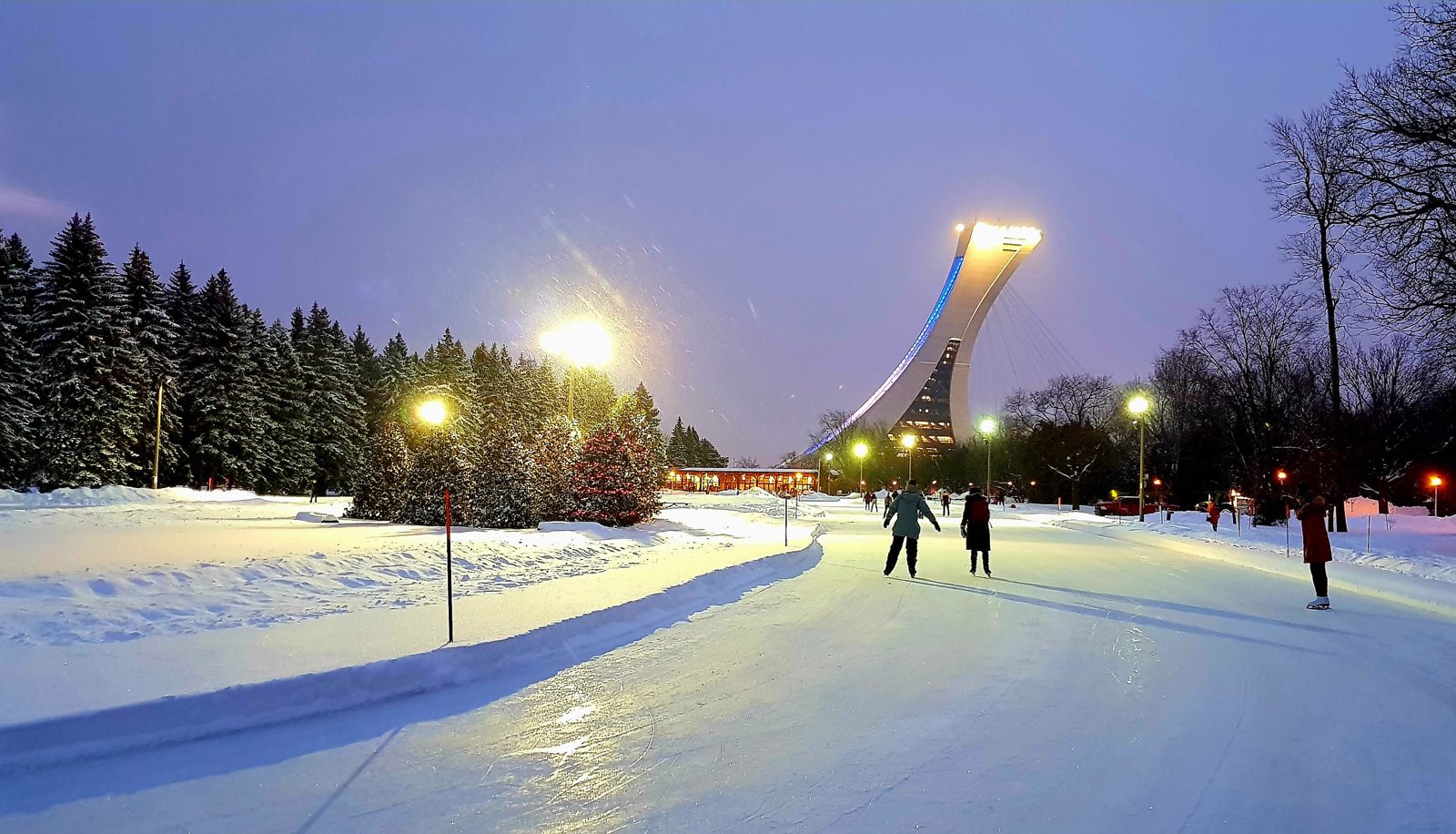
We've been wanting to try the big rink in the park next to our place for a while, and this Sunday we're determined to give it a go. Stéphane already has his skates, which he bought for next to nothing from a friend who was going back to France for good. So we go to the downtown Decathlon to buy Cassandre's. For the equivalent of thirty euros, we come out twenty minutes later with a perfectly decent pair for the recreational use we'll make of them. It's close to 3 pm when we set off for the Maisonneuve park rink, one of the most beautiful and biggest rinks in Montreal. With its magnificent view of the Olympic Stadium, the ring-shaped track, 300 metres long, is open from morning until 10 pm and entry is completely free. All you need is your skates. A chalet is open all year round, where visitors can warm up, change and leave their things before skating, snowshoeing or cross-country skiing.
Stéphane having skated only once in his life, we take it very gently. Cassandre tries as best she can to explain the technique and lead by example, but it's easier said than done for Stéphane, who struggles to master the skater's stride. After an hour of slow skating and several laps, the cold finally gets the better of our hands and feet and Stéphane is getting tired. So we go back to the chalet to collect our things, which stayed, and this is worth pointing out, in lockers completely open for all to see. For us French people, it's unthinkable to leave your belongings unattended like that without locking them away, but here in Quebec (as in Australia, by the way), theft is extremely rare. So it's naturally with confidence that we return to our locker to change before heading back to the apartment, very pleased with this first session on the ice.
20 January
The cold isn't the monster it's often made out to be. It's a layer that calls you back to life, a felt that wraps around you and won't let go. And cold is relative, in every sense. When we were in Australia, anything below fifteen degrees seemed dismal, the sign of a bad day. The human body is incredible; it adapts to every situation. And yet we've put it through the wringer these last few years: from the fifty degrees of the Australian bush to the minus thirty of Canada. Here we're learning to weigh our impressions. When we get up and the thermometer shows the balance point, zero, we're heading for a pleasant day. When it announces minus fifteen, we no longer complain; we face it. In fact, the words “it's cold” hardly ever leave our mouths any more.
Because the cold isn't an enemy, it's a companion that catches you by the cheeks when they're the only uncovered part of the iceberg you've become. These are new sensations you learn to love as the weeks go by, that wake you up in the early morning. It's the mucus in your nose crystallising as you breathe. It's the fingers that redden and stiffen when you forget your gloves. The cold takes you hostage, but it's no longer Stockholm syndrome, it's Montreal syndrome. Because you end up loving this permanent dry cold, this constant envelope. Deep inside us, the skin engraves unconscious memories and builds its own database. It remembers the slightest shiver, the heat of a burning sun, the rain running over it, and it learns from this snow that never stops falling. And then we're no longer just tourists in search of culture but climate travellers, beings in search of sensations. Because at a time when we travel at breakneck speed, when the goal is to photograph ourselves everywhere possible, when we can see the most beautiful places on the globe in three clicks, there is still a world left to visit that is impossible to capture, that belongs only to us: the world of sensations. That one needs no algorithm to exist; it's deep within each of us. All you have to do is listen to it and cherish it.
24 January
Canadians really do face up to the cold; they don't let it get them down. While in our part of the world everyone retreats indoors as soon as it drops below five degrees, in Montreal they use the cold as a marketing argument. After all, who would think of organising an outdoor electronic music festival in the middle of January? That was the slightly crazy bet of the creators of Igloofest, which takes place every year over five weekends in January and February and grows more successful every year.
Set up in Montreal's Old Port, an iconic spot at the foot of the big wheel, the event has two stages and hosts big names in electronic music. This Friday evening our friend Guewen joins us at home for a well-lubricated aperitif before we take the metro downtown. The festival has been designed not to disturb life around it too much, as it ends thirty minutes before the last trains, plenty of time for revellers to make their way home calmly. Apart from Vladimir Cauchemar, a French DJ, we don't know any of the artists lined up for the night, but that matters little since we've come for the atmosphere. It's minus two tonight and it's the warmest weekend of the month; it was almost minus twenty the week before. Around us the atmosphere is friendly, people are dressed in multicoloured ski gear or wacky costumes. We're warmly dressed too, but it still takes a few drinks to warm us up, and after two or three dance steps we no longer even think about the temperature. We move between the two stages, where all the artists are excellent and the crowd is electric.
The site is well laid out, with plenty of space to move around, bars set up in little caravans scattered everywhere to keep service flowing, and a long row of toilets. While we wait for Cassandre, who is queuing for the loo, a young man comes up to Guewen and me. He's trying to buy some weed but, to his dismay, nobody is selling. It's one of the downsides of legalisation: the black market is considerably reduced, and he tells us so himself: “Back home it's illegal but you find it everywhere.” We keep chatting and learn that he's from Connecticut, a state near New York, and that at 21 he's leaving the USA for the first time in his life. He came to Montreal with his girlfriend and a friend, who are also at the toilets and in fact join us at the same time as Cassandre. We carry on talking and discover three very endearing, really funny young people, and we invite them to come and eat at our place the next evening. Guewen takes Zach's number and our two groups split up in the ever-thickening crowd. We're starting to know Americans and their boundless enthusiasm well, so we don't really expect to hear from them the next day.
On the Vidéotron stage, Vladimir Cauchemar takes his place at the decks and is soon blasting out hits laced with French rap in a really talented mix without a single false note. The hours fly by and at midnight Guewen pays for his mistake of not wanting to wear his biggest coat and proper shoes: he's frozen stiff. Still dancing, we make our way to the exit and walk through the deserted, snowy streets of Montreal, once again happy to be exactly where we are.
25 January
Surprise this morning: it's eight o'clock and the Americans have already written to Guewen to say they'd be very happy to see us again today. We're of course up for it, and I take over to invite Zach and his two friends, whose names we don't even know yet, to come and eat with us around 8 pm. They agree and we set the date. We'd planned to go hiking in one of the parks around Montreal, but Cassandre isn't feeling very well, so we change plans for a rest day at home. We barely go out, just to discover a bulk shop ten minutes' walk from our place. As we mentioned before, the zero-waste movement is big in Montreal, and it doesn't have the same connotation as in France, where you'll quickly be labelled a hipster if you don't want to buy cucumbers wrapped in plastic or a box of biscuits wrapped in little bags. This afternoon we're simply stocking up on sugar and washing powder, and the process is as simple as ever: you weigh your empty container and write its weight on it in marker, then the cashier weighs it again once it's full.
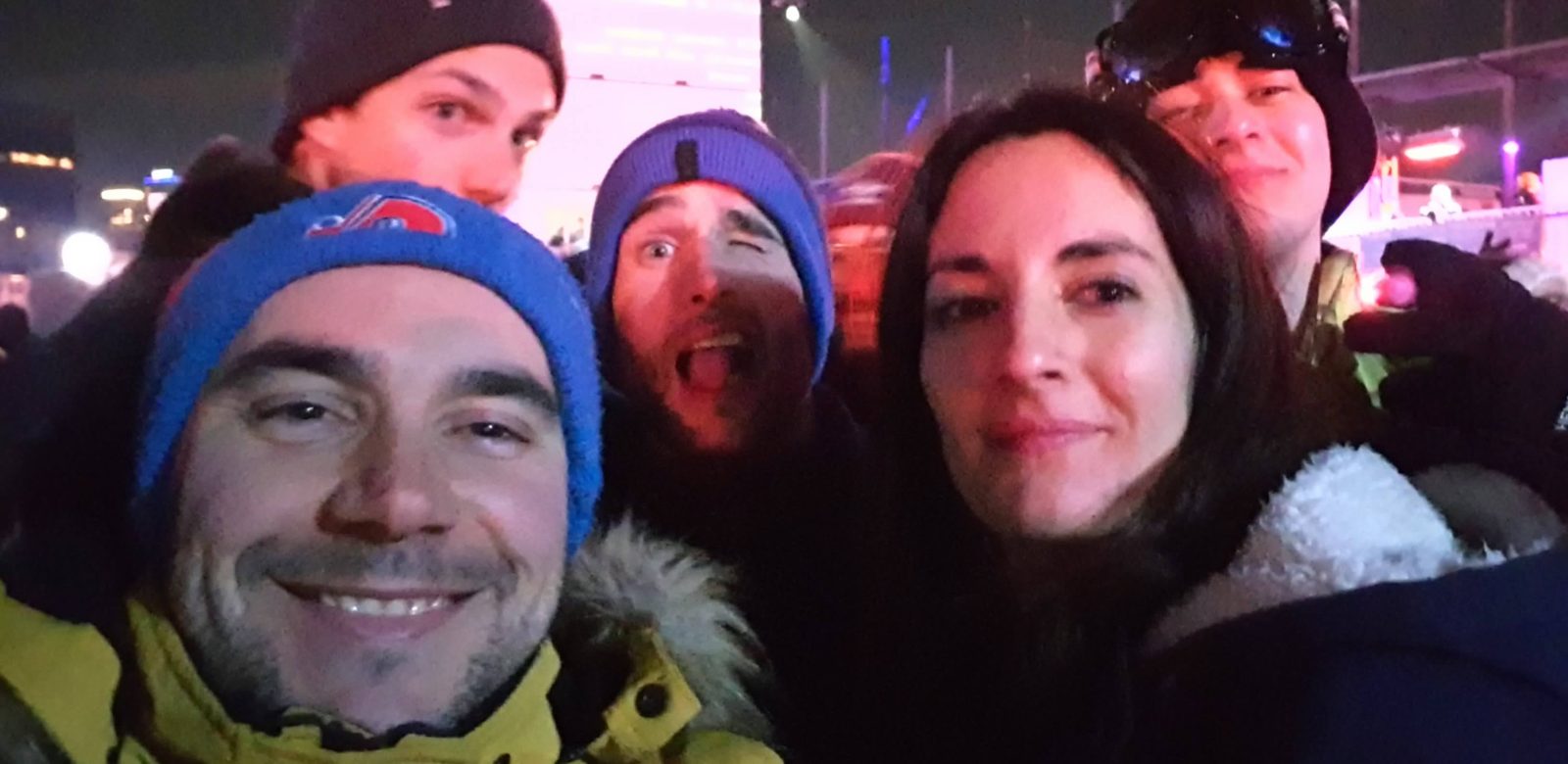
It's snowing hard today, huge flakes that look like the fake ones you see in films, and we walk without hurrying. Guewen is joining us tonight too and arrives around 6:30 pm to eat with us, since the Americans had dinner at 4:30 pm, another cultural difference we find hard to really get our heads around. We share pizzas while looking at travel photos and memories we have in common. At 8:15 pm our new friends arrive and we exchange first names after this completely unlikely and spontaneous encounter! He's Zach, 20, a student at a “community college”, the equivalent of public school. His girlfriend Katie, 21, of Filipino origin, is also a student but at a different school. Their friend, who goes by the funny name of Ash, is a few years older and dropped out of school to devote herself to her passion: photography. A world made all the harder for her by social media, which she doesn't really care for. So we spend hours talking about their country, ours, our cultural differences, the American political situation, which saddens them so much that they've turned away from it completely, and travel… The hours fly by and at almost 1 am it's already time for our new friends to go back to their Airbnb before the metro stops. So we say goodbye but stay in touch for future reunions on one side of the border or the other.
30 January
Today's the big day: Cassandre's parents are coming to visit us for a month! We're very excited at the idea of welcoming our first guests to our home in Montreal, and in the middle of winter to boot. There's no shortage of activities: downhill skiing, cross-country skiing, skating, snow tubing, dog sledding, snowshoeing… We have several in mind to entertain our guests properly. At 5 pm sharp we leave work and set off for the airport in a car we rented the day before from a private owner (a very common and very cheap practice here). The drive is quicker than expected, when we'd feared the monster traffic jams usually found on the motorway to the airport.
Their plane is due to land at 4:45 pm and we reckon it'll take them at least a good hour to collect their luggage and get through Canadian customs. To our great surprise, the whole process is faster than expected, because we've barely arrived at the drop-off area when we spot them on the pavement, outside for five minutes already and already frozen. Yes, the Canadian climate has nothing in common with the French one. Here the cold is dry and bracing, and when you come from the south of France, arriving in minus five can be a shock. Once the joy of the reunion has passed, we quickly get back in the car. Less than 30 minutes later we're home and the parents take over our bedroom, since it's bigger and more comfortable. We know how to host here! We show them around, then have the eternal, unmissable aperitif of wine and saucisson (yes, Quebecers make it too, and some are even excellent). We're delighted to have company and to share our new life with family. February promises to be packed with discoveries and activities!