 ← PreviousBogotá's fascinating history: from gold to street art
17 March
Bogotá is a sporty city, and on Sundays most of the main roads are closed to traffic so cyclists can ride. It's a breather for the most congested city in the world, which gets to breathe a little. Bogotanos make full use of it, as we can see when we go down to walk with them. Street markets have set up their stalls on every available bit of pavement. We visit a little market that isn't so different from those in France: unscrupulous sellers here too try to palm off shoddy goods at prices too high for the quality.
Local young people put on a dance show dressed in traditional clothes. The show is a mix of contemporary dance and hip-hop. It's not very polished, but they seem to be having fun, and that's what matters on a beautiful sunny day like today. Heading back up towards our place, we come across a teqball competition, a sort of table tennis played with the feet and a football. The tournament is nothing official, more of a winner-stays-on system across the tables open to anyone. We don't try it, but we make use of a bench to admire the skill of some of the players. Another dance show, more professional this time, holds us captivated, and it's with regret that we head back up to our apartment, where our host is supposed to be waiting to take us for a drive. Supposed to, because she isn't there when we arrive, and the few days we've spent with her have made it clear she lives on her own time.
We grab a bite while waiting, and when she arrives we get into her little car for an almost improvised outing. When we told her we wanted to visit the Salt Cathedral of Zipaquirá, she kindly offered to take us. She's a bus driver and even makes a detour to show us the school her bus serves.
The Salt Cathedral is a church built inside the salt mines of Zipaquirá, on the Bogotá savanna in the department of Cundinamarca. It's also a place of worship and one of the best-known Catholic shrines dedicated to the Stations of the Cross of Jesus Christ. All very nice, but nothing that justifies paying almost a hundred US dollars for the two of us to visit. That's obviously the tourist price, and most tourists are probably willing to spend that much, but not us, travelling on a very precise budget. We call Xinthia back, and when we tell her the price, she exclaims "¡qué ladrones!", which makes us laugh a lot, because it means "what thieves!" and she says it with real indignation.
To console ourselves, we buy churros to share between the three of us, then take a rather scenic road before heading back to Bogotá. Halfway, she stops at a little shop to let us try a speciality: hot chocolate with cheese, an unusual combination that's surprisingly good. We then realise the scale of Bogotá's traffic jams when we find ourselves at a standstill 25 kilometres from the city limits. Most of these slowdowns are caused by toll booths, very frequent and very expensive in Colombia. Once past that obstacle, Xinthia drives flat out through the pitch-black night, and her car shows several huge signs of weakness that make us laugh a lot. Home in one piece, we all go straight to bed without further ado.
18 March
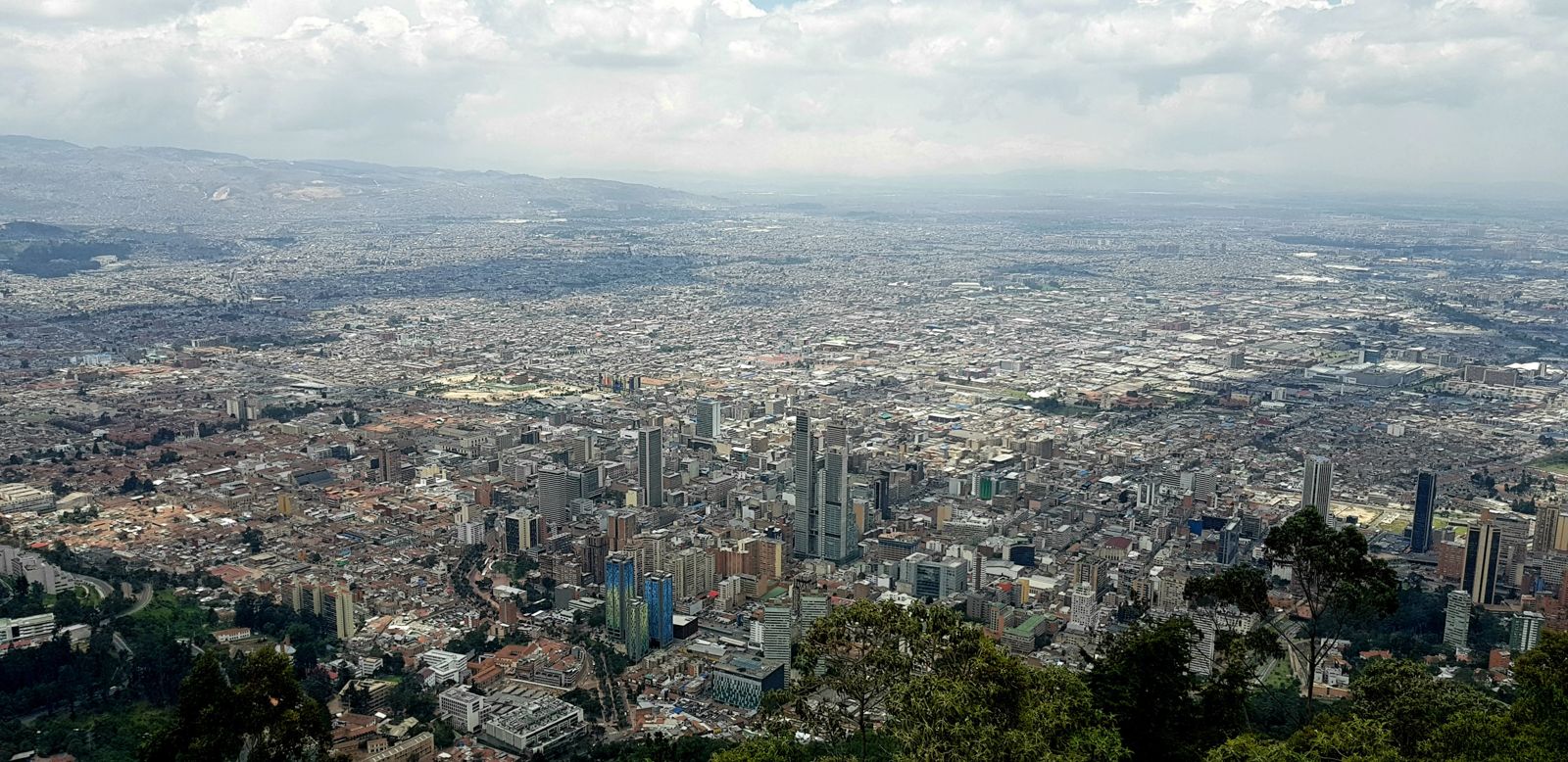
Bogotá already sits at 2,800 metres, and you have to climb another 400 metres to reach the summit of Cerro de Monserrate. The view is of course sublime, but you need to catch your breath for a few minutes before you can appreciate it properly. That is, if you walk up, which we didn't. No, we took the cable car and then a tiny little staircase that still managed to leave us breathless. Altitude is like numbers: it never lies. The sky is a brilliant blue over the top of this ancient mountain, and we discover it's an excellent selfie spot, judging by all the tourists busy smiling at their cameras.
From this perch you can see the sprawling size of the city, stretching as far as the eye can see, and its geography: a vast plateau surrounded by mountains. The centre has the high-rises and wide avenues, while the distant suburbs reveal a jumble of chaotic streets with no real logic where eight million people live. Getting around could be difficult, but the enthusiastic nature of Bogotanos never makes the experience unpleasant. The vast majority are warm and smiling, bearing it patiently when it comes to taking the bus. They live at a different pace, which is far from unpleasant, spending lots of time outdoors, as the long rows of chess players filling the streets show.
The city also has a hard-to-count number of museums, which makes it easy to take shelter when one of the sudden downpours hits the capital. We visit several: a flower museum, one on ancient art and another on the history of Bogotá. We're really in no hurry, as we're spending a week here where the guidebooks recommend three days. But we're not on an express trip, and we want to use this freedom to soak up as much Colombian culture as possible.