 ← PreviousAir turbulence and arrival in Bogotá
15 March
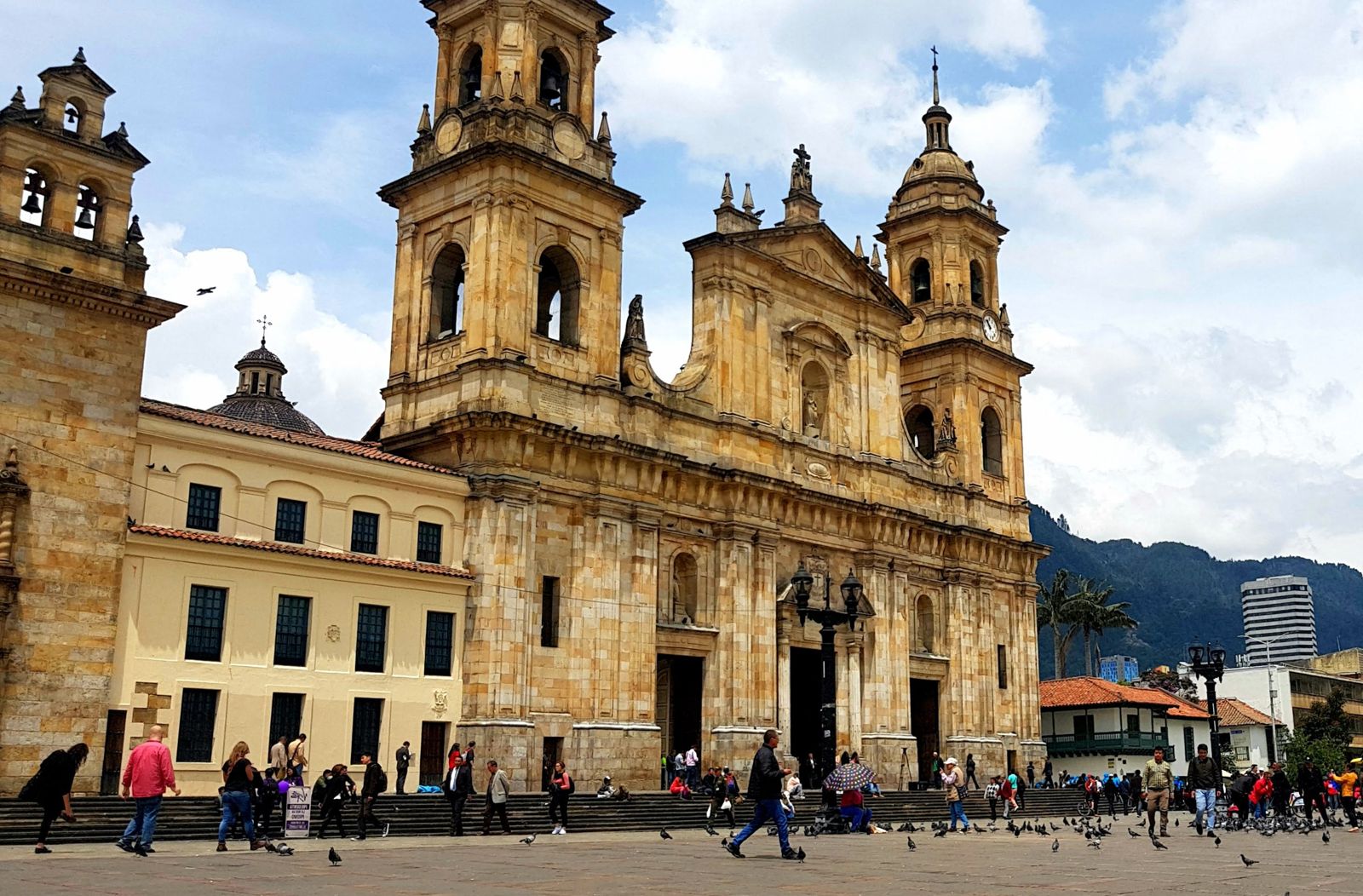
Free tours are a very pleasant way to learn more about a place, a neighbourhood or a city. You just register online and choose a theme. You often end up with someone passionate about history whom you pay by tipping what you like. We do this often, and this morning we're meeting in Plaza de Bolívar for a tour of Bogotá's history. While we wait for our group to be complete, we notice climate protesters who have answered the call of Greta Thunberg here too, fast becoming a global icon. There aren't many protesters, but they're making noise, and our guide leads us away from the square to win back a few decibels.
She's a history student at the city's university; she doesn't speak very loudly, but she knows a great deal about the major events, from Colombian independence in 1810 to the peace agreements with the FARC. It would take far too long to summarise it all here, but this history lesson brought to life enriches our knowledge, and seeing historic sites stained with blood sometimes chills ours. The grim 1985 Palace of Justice siege and its hundred dead becomes all too real as we listen to the account on the very steps the army climbed with its tanks.
The series Narcos, which we're watching at the time, uses this event in an episode, and our guide admits it's fairly faithful to reality. However, Colombians hate the series for many reasons: only one Colombian actor in the cast, Chilean or Brazilian accents and an unwelcome rewriting of history. In short, best avoid talking to them about this Netflix production, and about Pablo Escobar altogether.
A testament to colonisation, the centre of Bogotá is home to a special museum: the Gold Museum. Intimately linked to the Spanish invasion, the yellow metal is as fascinating as ever, and this building is a goldsmith's dream with its thirty-five thousand gold pieces. The visit is interesting, but after an hour wandering the aisles, all the pieces on display start to look alike, and we decide to go down to the basement, where there's an exhibition on slavery.
More precisely, on the importance of the city of Nantes in the trade in Black people. The exhibition stuns us because it covers things we knew nothing about regarding this city on the Loire, subjects that are clearly avoided back home. The country of the Enlightenment certainly didn't enlighten everyone with the same intensity. We come out amazed to have learned parts of our own country's history in Colombia, but knowledge often hides where you least expect it, which is why you have to stay curious.
16 March
Fernando Botero is one of the best-known Colombians, and even if you don't know who he is, you know his paintings. This artist plays with shapes and constantly rounds things off; he paints voluptuous women in particular, but it would be unfair to reduce his work to that. All his paintings betray his inimitable style, inspired by pre-Columbian art, in which proportions are flouted. Horses are enormous, the Mona Lisa has imposing cheeks and even Paris ends up distorted. It's a most interesting visit, especially as it's free: Botero bequeathed works to the city of Bogotá on the sole condition that they be shown free of charge.
Besides Botero and the museums, art also finds expression on the walls in Colombia. Having gone from an act of vandalism to an urban plea, street art has established itself as a free form of expression accessible to everyone. Since the early 2000s, Bogotá has seen an incredible artistic boom, to the point of becoming the South American mecca for lovers of this kind of expression. On a free walking tour, we follow Esther, who leads the group in her pink rain jacket with her loudspeaker. For two hours, around every corner, she tells us the particularities of each mural and the story of its creator. In this roundabout way, we learn a lot about the socio-cultural reality of Bogotá and its suburbs and about the real impact graffiti artists have had.
She tells us the heartbreaking story of two young street artists killed by the police as they fled a spot where they were painting, and of the riots that followed, which led to the anti-graffiti laws being relaxed and police being banned from shooting on sight. The previous mayor, Gustavo Petro, was even very supportive of these artists, and under his term the city commissioned lots of murals to hide the misery of certain walls. The current mayor has kept to this approach, and street art has become a must on any visit to the Colombian capital.