
 ← PreviousA culinary and cultural discovery of Osaka
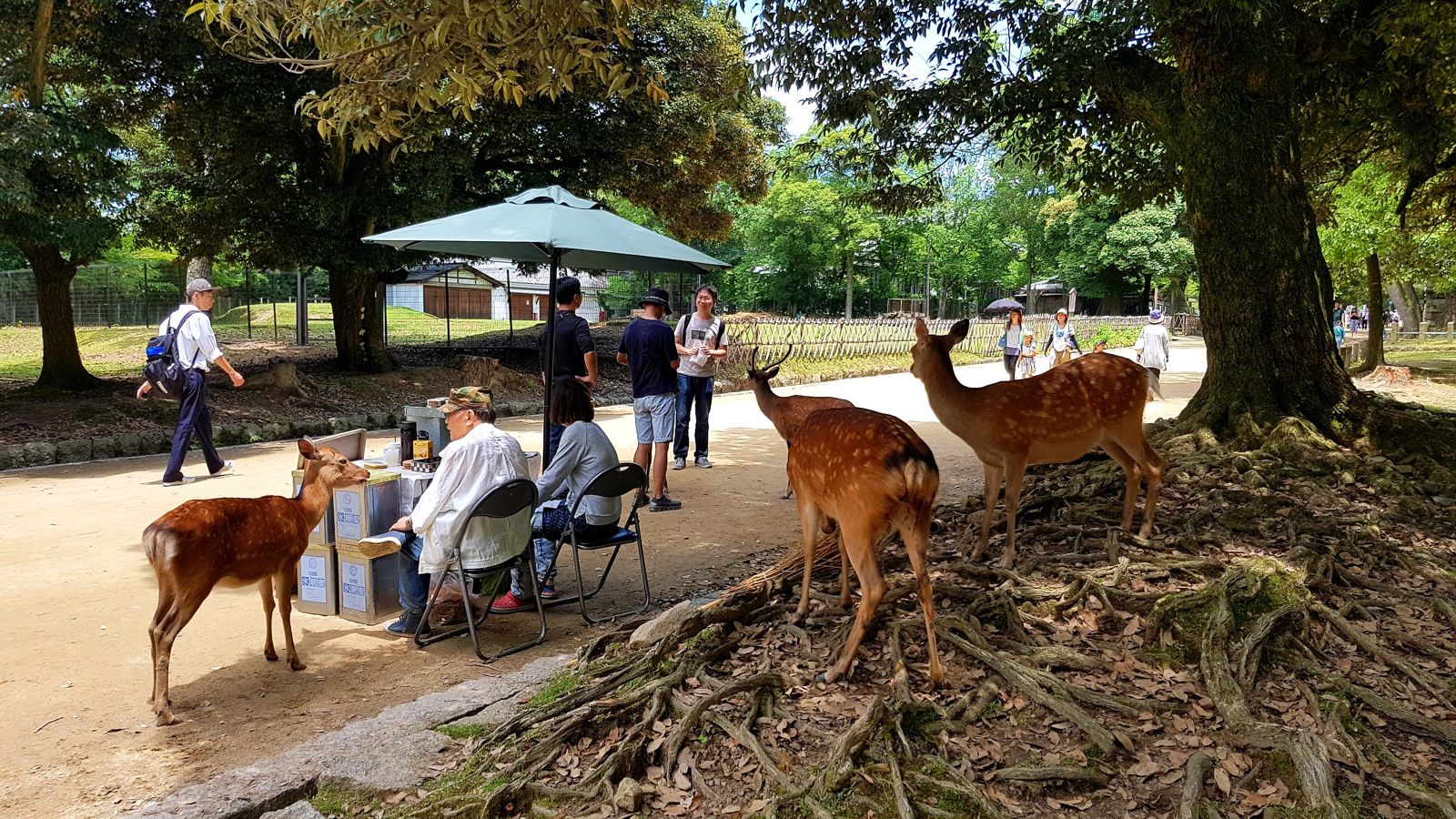
Japan was full of eccentric places. Like every city in Japan, Nara had its share of temples, Shinto shrines and pieces of history. Capital of Japan in the 8th century, it only became an official city at the end of the 19th century. But what really set it apart from the country's other cities, and made it world-famous, was the presence of deer everywhere.
As with every place like this, we didn't know whether its reputation was justified. But coming out of the station, we saw a deer cross at a pedestrian crossing and Japanese drivers patiently waiting for it to finish. The legend told by the city's Shinto shrine, Kasuga, says the god Takemikazuchi arrived in the city on a white deer to protect the then-new capital. This species of deer was once found across East Asia, from southern Vietnam to northern Russia, but today it survives only in Japan. It's a sacred animal and regarded as such in Nara.
They wandered all over the city as if in the wild and weren't afraid of humans at all. Some had even learned to say thank you when tourists gave them a little rice cracker, a senbei, which was sold everywhere. Here too we reached the limits of mass tourism. People came from all over the world to see this place, touch the deer and take their funny little video of the animal bowing to say thanks. But what was still sustainable fifteen years ago no longer was with the crowds passing through the city every day.
We watched two young girls harassing a deer for a selfie, and seeing our disapproving look, an elderly English-speaking Japanese man struck up a conversation. He explained that the deer were becoming more and more aggressive and that it was no longer rare to see them attack people. We refused to take part in what was turning into animal exploitation or to feed them, but it was also paradoxical, because it was the deer that had drawn us here. We just hadn't realised the place had taken on industrial proportions.
We'd set the alarm for 8:30, and I couldn't understand why it was vibrating. I never put my phone on vibrate, and neither did Cassandre. In a split second, everything clicked into place in my brain. Vibration + Japan = earthquake! I jumped out of bed and saw that Cassandre was awake too, panicking. She kept saying "I'm scared, I'm scared." I made her get dressed. The shaking had been long and violent, and I feared an aftershock might catch us in the next few minutes. We were on the top floor of the hotel and had only one thing in mind: getting out. Dressed any old how, we raced down the stairs four at a time to find... imperial calm. Local people were walking calmly outside and the hotel staff at reception didn't look the least bit alarmed. They could tell from our faces how scared we'd been and asked if we were all right. Their serenity instantly reassured us, and we went back up to our room to get our things. We wanted to catch a train that morning, but we guessed there would be complications.
After handing back our room key, we were allowed to wait in the lobby. The staff kept us informed of the consequences of the disaster, especially on transport, but after an hour we were tired of waiting and figured we might as well wait at the station. All the departure boards were flashing red and the usual English translation had vanished entirely. It was impossible to understand a single sign, and our questions to staff were met with answers in Japanese. We vaguely gathered that our choice lay between two platforms, because at regular intervals a railway worker would come and shout an announcement and the crowd would head one way or the other.
A Westerner came up to us. He didn't even need to open his mouth for us to realise he was a fellow countryman. He was also trying to get to Kyoto, and his whole little family came over. In front of us was a couple of travellers with two children, each carrying their own backpack. In a world that is sometimes so sanitised for children, our encounters with globetrotting families taught us that anything is possible if you put your mind to it. After several announcements and by pooling our efforts, we understood that the next train to the country's second city was arriving soon, and all six of us rushed to the right platform along with a crowd of Japanese.
We managed to get into a carriage, but the crowd separated us and we didn't see each other again. That's travel: sometimes carried by encounters that last forever, but more often by micro-interactions destined to fade from our memories. We followed the GPS to a little hotel we'd found online, the Kawaramachi Nijo. Enjoying an excellent reputation and perfect value for money, we dropped our bags there early in the afternoon and went straight back out to explore the streets. Preceded by a magical aura, Kyoto, the city of temples, had intrigued us since the start of this trip, and we couldn't wait to finally discover it.
Having been Japan's capital for years, it now served as its religious and cultural heart, a city where buildings didn't try to pierce the clouds and where modernity seemed to have left its mark only where it was useful. It didn't blaze with activity and lights like Tokyo or Osaka; the pace seemed noticeably slower, and it was the only big city in the country without a motorway running through it.
Kyoto struck us as the least practical of the cities we passed through. The poorly designed transport system wasn't suited to the influx of tourists, and although efforts were being made, it clearly wasn't enough. The sights were very far apart and no means of transport was practical enough to see them all without difficulty. We sometimes found ourselves on a bus for more than an hour to get from A to B, and we used that time to soak up Japanese culture. We felt curious eyes on us and children watching us with interest. Since the city was mostly flat, bicycles were popular and made up the bulk of the traffic.
But with its two thousand temples and its many cultural treasures, Kyoto had more than one trick up its sleeve to delight an enthusiastic eye. Of course, if you only wanted to see the most famous sites, visiting the city could seem tedious. But if you loved getting lost in its streets and discovering temples whose names appear in no Western guidebook, you were in heaven.