Tokyo's bus station was hidden in the urban jungle and it was a long walk from the metro station. Inside, it was perfectly organised with very clear signs, even for foreigners. Screens showed departure times, and staff shouted through the surrounding hubbub to announce that a route was about to leave. We waited a few dozen minutes before being allowed to board our vehicle. The bus was all green and the inside was spacious. Our seats had been numbered when we bought the tickets, so we headed for B1 and B2. Our seats were wide, reclined almost completely, and a hood like the ones on cradles shielded you from any outside light.
For a twelve-hour coach journey, conditions were close to ideal. The bus was no more than 10% full and hardly a sound could be heard inside. Exhausted by the journey and jet lag, we slept most of the way between Tokyo and Hiroshima. We woke before our final destination at a stop at a service station. It looked like the ones in France but still seemed picturesque to us. The bus dropped us in the centre of Hiroshima at seven in the morning, and it was already very muggy outside. We settled into a fast-food place for a drink and to kill some of the time before we could check into the Hotel Santiago. We bought transport passes and jumped on a tram. In Hiroshima, trams still dominated and gave the city a very dated feel, as if it hadn't moved since the industrial era and the dropping of that infamous bomb.
After dropping our things and taking possession of our room, we headed to the memorial without really realising we'd set foot in a history book. Since childhood, the name "Hiroshima" had echoed in our ears as the height of human horror. But today it took on its full meaning, as we were confronted with reality in this museum full of moments from the past. The first room was already striking. On the curved left-hand wall was a gigantic panoramic photograph of Hiroshima just after the explosion. Ruin and devastation filled the image. Ruined buildings, dead trees and drifting smoke dominated. On the right, a three-dimensional model showed the bomb's impact and the direct consequences of the blast.
We were surprised to find dozens, even hundreds, of schoolchildren also visiting, but in the end it made sense. Japanese children learn about their past just as we learned about ours by visiting the war memorials in Normandy. We discovered inevitably grim details such as the Hiroshima shadows. The shadows of the dead were visible on the ground because their bodies had shielded the pavement from the heat blast. It made for disturbing photos where you could see very clearly that of all the people present at that moment, only their shadows remained... In another room, they showed life before the bomb in this working-class city, one of the most populous in Japan, which rivalled Yokohama as an economic engine.
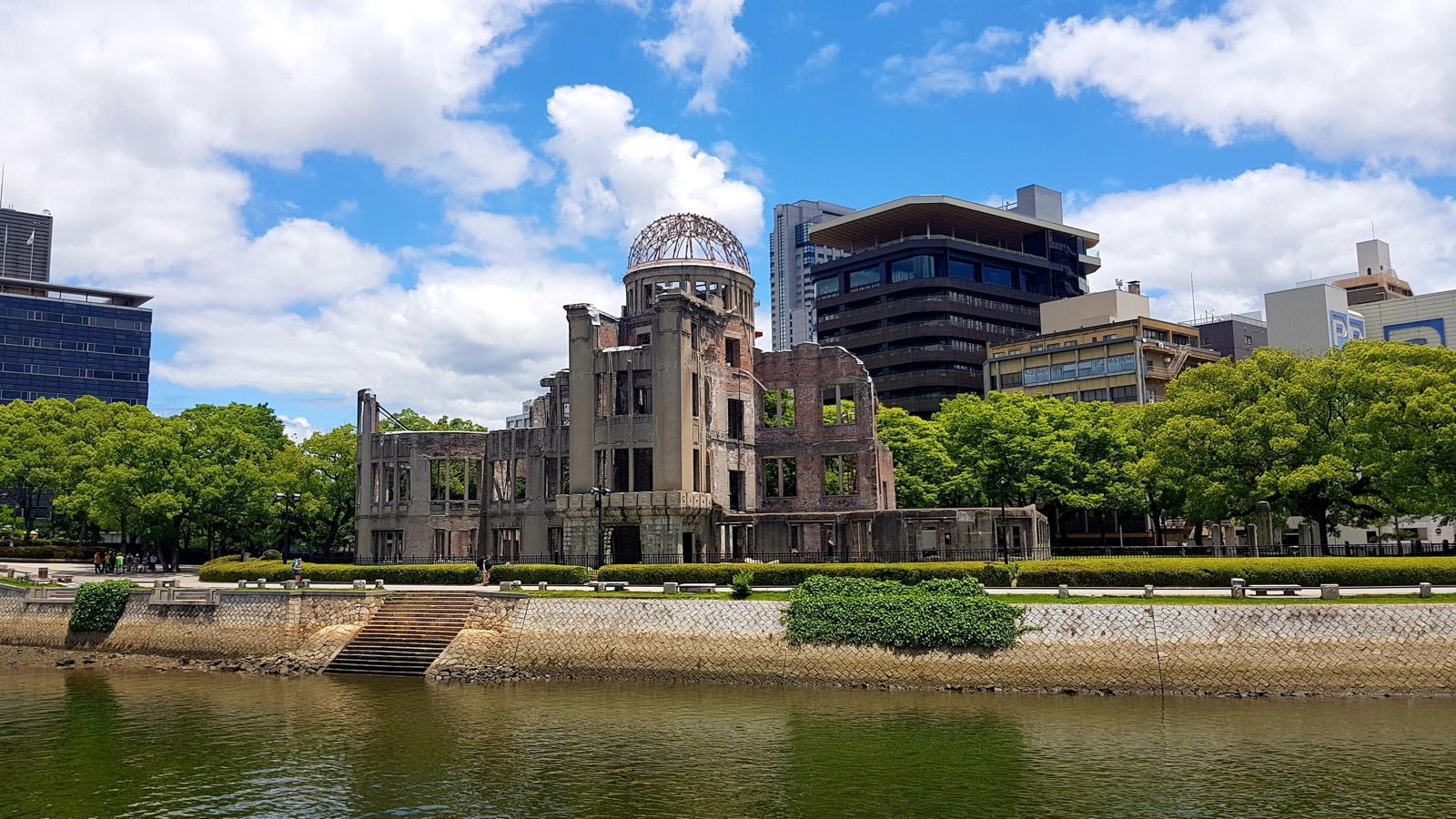
Further on, a whole wall was given over to a gigantic timeline of all the events that led to the war and the atomic bomb. Sometimes trivial facts mixed with more important ones, but they took on their full meaning when you read it all. A replica of Little Boy sat modestly under glass in the middle of the room, a cluster of kids looking at it wide-eyed. It impressed us too, because we couldn't help wondering how such a small device could have caused so much devastation, let alone changed the face of the world. The next must-see was on the other bank of the Ōta River: the Genbaku Dome. The building originally served as Hiroshima's Industrial Promotion Hall, showcasing technical achievements in various fields of industry. It was only thirty years old when the bomb exploded over the city, and by a senseless miracle it was the only building left standing in the immediate vicinity of the blast. It took the impact from directly above, which affected its structure less than the surrounding buildings. Its thirty employees were killed instantly. It became the symbol of the city and its reconstruction, and it still stood more than 70 years after that tragic event.
We were still in a state of shock at walking on the asphalt of one of the most tragically famous cities in the planet's history. After lunch we headed to Hiroshima Castle, a welcome building that reminded us the city existed long before the bomb. Built in 1590, it too was destroyed by the explosion, and it now houses the museum of the city's history before Little Boy. It was a typical Japanese castle with its many tiered roofs, protected by a huge moat that made for a very pleasant walk. The water was full of enormous fish, which earned the building the nickname "Carp Castle". The park was also home to the only tree to have survived, another must-see. Once again we were surprised by the number of Japanese people who came to pay their respects. The memory of the war was clearly still very present.