
 ← PreviousHiroshima: memorial and emotional history
The next day we got up early to go to the island of Miyajima. We could have taken a driver or even a fast train, but our small budget pushed us to opt for the tram. The journey took two hours, but we enjoyed blending quietly in with the local population. On public transport you saw the whole social spectrum of Japan. Young and old, labourers and managers in shirts mixed with no apparent distinction. We felt curious but kindly eyes on us, and we arrived just in time to catch the ferry to the island. From the boat we could see Itsukushima Shrine and its floating torii. A UNESCO World Heritage Site, it's one of the three most celebrated views in Japan. Its nickname, "the gateway to Japan", is well earned. Standing in the sea, it seems to levitate at high tide and gives the place a mystical feel. In ancient times the island was sacred and setting foot on it was simply forbidden. You had to sail between the torii's legs and walk only on the parts built on stilts.
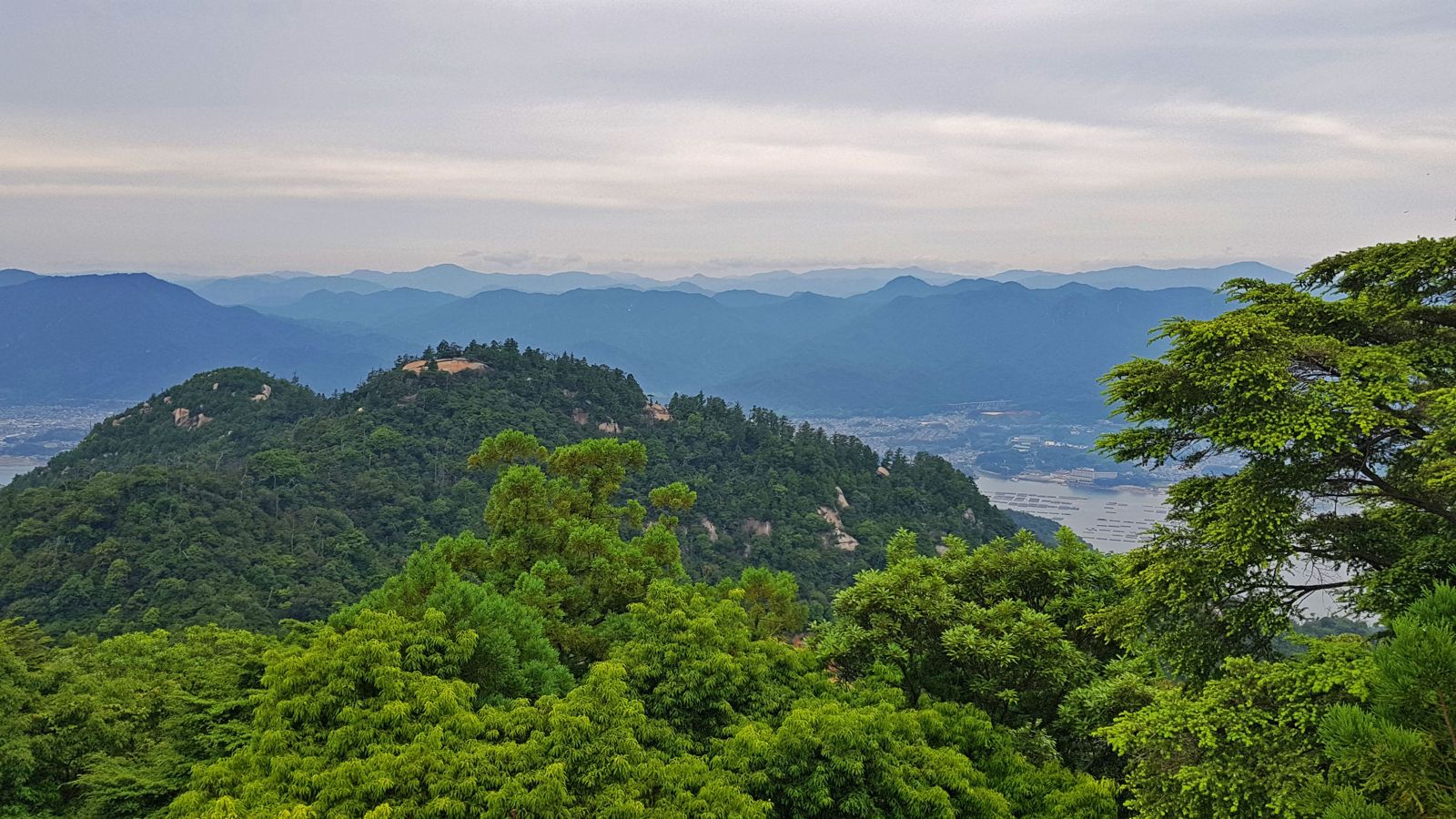
That ban was lifted long ago, so we strolled along the shore. We were immediately surprised by the deer. They were everywhere, harassed by tourists for a few miserable selfies. A little further on, we even had to pick up rubbish one of the animals was determined to eat. I moved forward gently so as not to frighten it, took the plastic out of its mouth and then picked up what was littering the ground. Tourism unfortunately had many downsides. We now looked at the torii from the shore, and it was no less impressive. The traps of must-see sights are unavoidable on any trip, and Miyajima was no exception. The restaurants were too expensive, too crowded and not very tasty. We grabbed a bite at a soulless eatery where you had to sit cross-legged as tradition required. The flow of tourists never stopped, and to escape them we walked to the other side of the little island to take a cable car and admire the panorama. You still had to haul yourself up and down the paths to reach the best viewpoint. From our perch we could see the coast but also the myriad islets sitting on the sea, almost floating. We slowly headed back the way we'd come for practical reasons.
We'd booked a night bus to Osaka and had to kill time until 10 pm. On the way back we got off a few stops before ours and climbed a hill with an immaculate road to go into a very special library. It was the only one in the world that offered manga and only manga. The double glass door opened onto a fake-marble staircase with a wooden banister. There was also a lift for the country's ageing population. The building's shelves were indeed full of manga: old and new, in good or bad condition, on every subject imaginable. A whole section was devoted to first editions, the very first books of a genre that has since made its way around the world. The paper was yellowed, the characters crude and the plots visibly less developed, but they were pieces of history, just like an original Hugo or Flaubert, and we treated them as such. We were surprised to find English and French editions of not-very-well-known manga. We read a few, then calmly went back to collect our luggage. The hotel owners kindly let us shower, and it was clean that we went to wait in a café. Five minutes before the time given, we were waiting at the informal bus stop at a crossroads, and the big Willer coach arrived precisely on time. A young man got off to help us stow our luggage and we climbed aboard to find our seats. As in the previous night bus, there was lots of space both between the two rows and between each seat. The bus was half full, only Japanese passengers in transit, and very quiet. We settled in comfortably and fell asleep immediately.