
 ← PreviousFrom Haputale to Kandy by train
Fate sometimes takes strange turns, as we were about to find out on the island of Coron. Getting off the boat that brought us from Palawan was chaotic, as it often is here. All the passengers waited on the quay for their luggage to be unloaded by the crew, not before menacing soldiers' sniffer dogs had inspected the place. A swarm of taxi drivers formed a guard of honour at the port exit; they weren't there to praise you for surviving six hours of swell on a rough sea, but to offer their services the local way, shouting as loudly as possible and trying to catch your attention.
Some had well-honed techniques, and you certainly couldn't blame them for wanting to earn a living. But we were starting to know the ropes, and we told the first ones we'd walk, to get away from the crowd. Often, after three or four minutes on foot, we'd come across young men sitting comfortably in their seats. They told us almost every time that they didn't want to join the scrum and preferred to wait patiently for customers to come to them. That suited us fine, especially as they charged normal fares and rarely tried to make us pay twenty times the price of a ride.
After a quick detour to a cash machine and a generous tip, we arrived at the Bella Vita Guesthouse, where a very kind lady named Jani welcomed us with open arms. Her hotel was really a big single-storey house open to the four winds thanks to doors piercing every outer wall, with four bedrooms, three of them for tourists. The place was set back from the road and we savoured the pleasant calm, sitting on the terrace. After an hour's rest, we saw on the map that the choice of restaurants within walking distance wasn't exactly plentiful, and we resigned ourselves to eating at the luxury hotel a hundred metres away. We hated that kind of place because the clientele was often haughty and everything was far too expensive. This one was no exception, and we nibbled a tiny club sandwich for five times the price of a restaurant meal.
The hotel had a pool reserved for guests that you couldn't use even if you paid, which sent us back home for a quiet afternoon. We planned the next day's excursion with our host, who recommended a company she'd heard great things about. Sitting around the living-room table, the conversation eventually drifted to life in the vast archipelago that is the Philippines, and pricking up our ears we noticed there were other French people in the guesthouse coming back from outings.
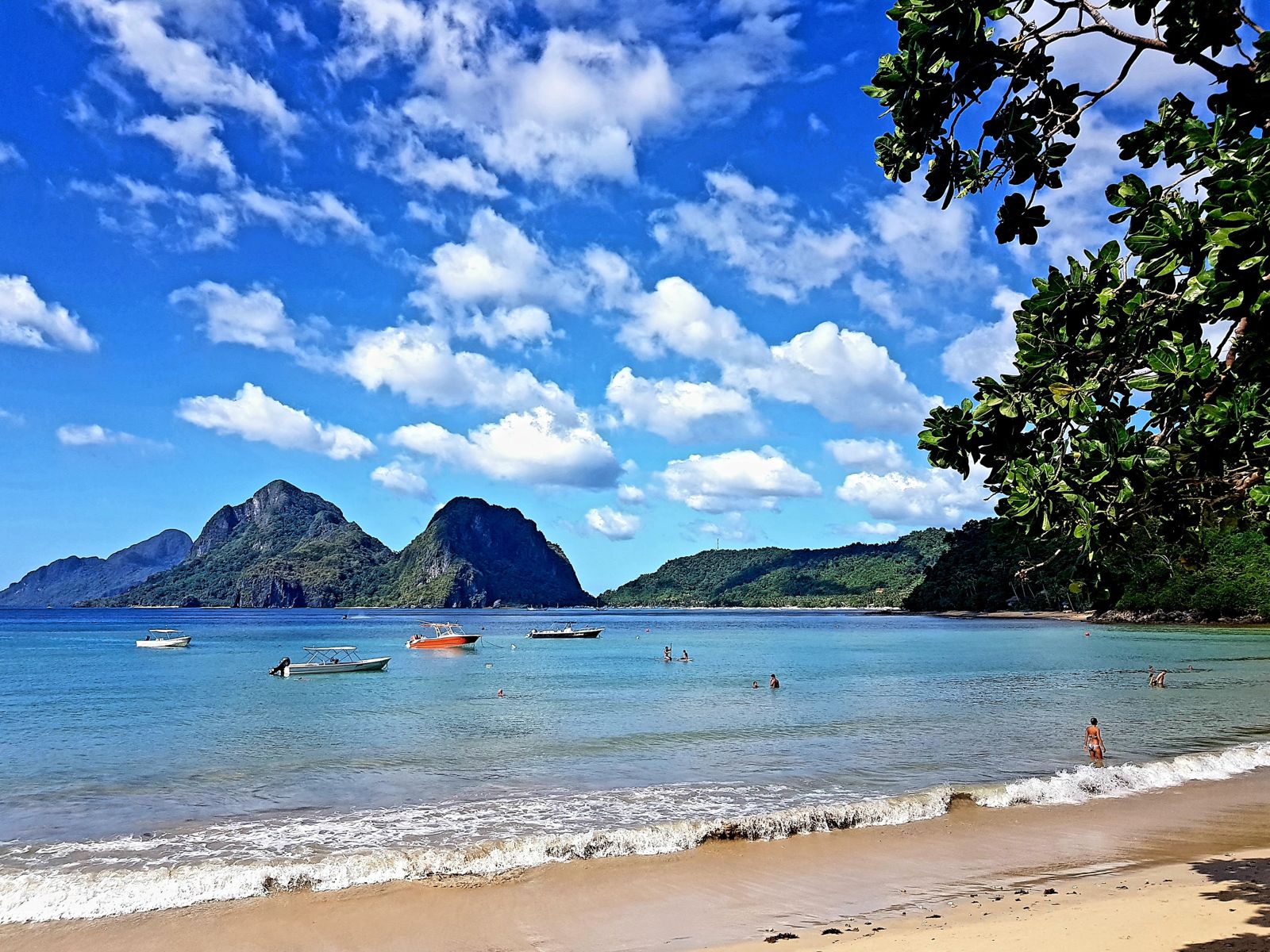
The next morning the driver was on time, and a Korean family joined us to go to the meeting point. The port sprawled over a sort of wasteland, a big square expanse of mixed earth and sand that the car's wheels kicked up, leaving a long trail behind us. There was a jumble of outrigger canoes, sailboats and motorboats, smells and colours that fascinated from afar before becoming worrying up close. A long row of little shops made of age-worn corrugated iron stood near the shore. There were no signs to guide us, but our driver knew exactly where he was going and dropped us at the entrance of a small stall. Rain began to fall, settling the dust and cooling the air all at once. After we'd paid, a young man escorted us to the boats and explained in English that ours was the last one.
For lack of space in the port, the boats were moored one behind another. The first wrapped its rope round the bollard, and when there was no more room, latecomers tied up to other boats, forming a second row, then a third, then a fourth. So we crossed three boats in precarious conditions, sometimes ducking, sometimes balancing, to reach ours. A few people were already sitting on the worm-eaten wooden benches. There was an Australian couple, whose nationality we'd guessed from their consumerism: they bought everything a hawker offered them without even haggling. Two friendly-looking Dutch guys were sitting opposite us, and conversation soon got going. A young Swiss man joined us, and soon we were telling each other our life stories on a boat at sea.
The crew were much less friendly than in El Nido and the boat much less comfortable. Out at sea we even got a breakdown, which the sailors fixed in rustic fashion by banging on the engine over and over. We were dropped on islets and simply given a time to be back. Maurice, our new Dutch friend, grumbled every time about getting back on the boat and didn't hesitate to let the crew know he was unhappy with the service. At noon we landed on yet another strip of sand for lunch. A long table was already set up under a big wooden structure that shaded us from the sun. The meal was meant to be rich and varied, with prawn salads, chicken and vegetables galore.
We spent the whole time with the Dutch guys, talking about cultural differences with our country, which in the end weren't that great. In profile, Maurice looked a little like Bradley Cooper, and that became a running joke for the rest of the day. The hours flew by and we were already on the way back when Stéphane started to feel unwell. The sea was much calmer than on the way out, but for some time he'd been very prone to seasickness. Halfway, he went into the little cabin that served as a toilet and threw up his lunch. "Well, the sea really doesn't agree with me any more," he thought.
But once in the car back to the hotel, the same strange nausea began to grip him, and he threw up again as soon as we got to the room. Something was clearly wrong, because he was also emptying out regularly with diarrhoea. You'd be tempted to think nothing could be worse — what could possibly be added to this sorry situation? Well, Cassandre started feeling sick too. Soon she was vomiting and going through the same symptoms as Stéphane, just two hours behind. And when he finally lay down, exhausted and drained, she hit the peak. We spent a horrendous night, surely the worst of our lives, and woke up ashen. Listless and lifeless, we explained our situation to the owner, who made us white rice. We insisted on disinfecting the room ourselves — we'd cleaned everything thoroughly but feared germs might remain — but she flatly refused and ordered us to rest.
We ended up on the front porch, where two benches stood on either side of the door, and spent the afternoon trying to regain some semblance of normal colour. Around 3 pm, the French couple we'd glimpsed the day before came back from a scooter ride and sat down on the other bench. They had a bag of pastries and the young man offered us some in English. We declined, explaining our state, and a long conversation began. They were called Daniel and Diane and came from the Paris area like us. We hit it off straight away, as we shared the same curious, open-minded outlook. We stayed together until the evening and even until lunchtime the next day, as all four of us were heading to Francisco B. Reyes airport. They were going back to France via Manila while we were heading to Angeles and Mount Pinatubo.
Dani had jumped into the water during a boat trip, forgetting his phone in his pocket, so Stéphane offered him his old one, which he'd kept precisely in case someone needed it. After some hesitation, he gladly accepted, and in the waiting room of the stifling little airport we talked about the tricks of fate. Without that nasty food poisoning that had left us bedridden, we'd never have stayed at the guesthouse and never have met these two wonderful people. In the end we'd lost a day but gained a lovely friendship that's stronger than ever today.